This episode is also on Bilibili too.
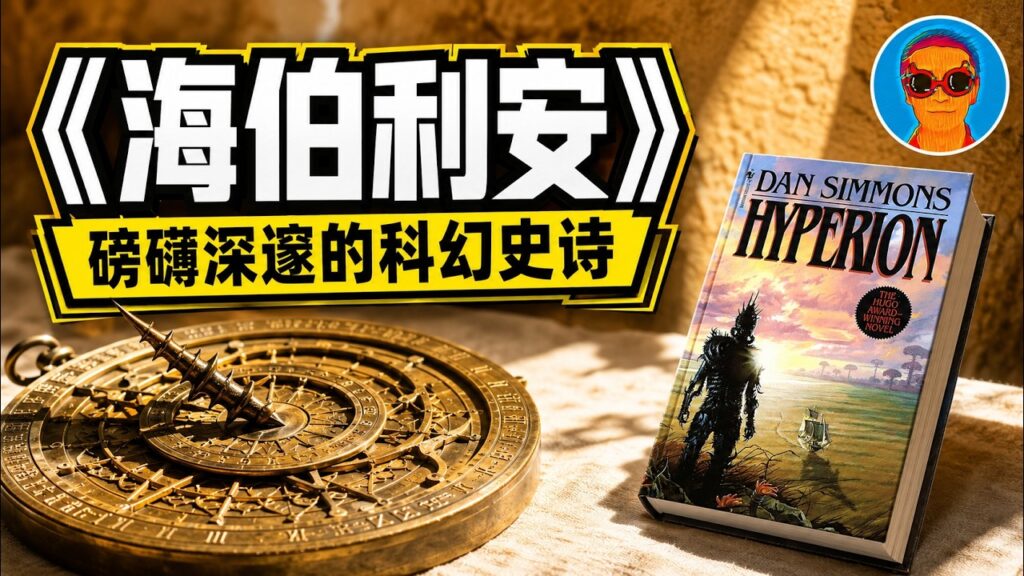
Hyperion won both the Hugo and Locus Awards, and it is also a must-pick on pretty much every “greatest science-fiction novels of all time” list. It is also a work that left me genuinely shaken after I finished reading it. Hyperion is like an epic poem: sweeping and gorgeous. It is also like a philosophical meditation, touching on every ultimate question humanity faces—from fate to time, from the meaning of suffering to the value of faith, and then to the relationship between human beings and God. The Hyperion series is astonishing in both literary power and depth of conception. It hit me hard on both the literary and intellectual levels at once.
The first book in the Hyperion series happens to win on literary merit, while the second, The Fall of Hyperion, wins on ideas, so I decided to introduce them in two separate articles. Here, I’ll discuss the series as a whole, lay out its background, and then use the first book to talk about its literary qualities.
I’ll try to keep things hazy, without getting into major plot spoilers or giving away the ending. I’ll write another article later, based on the second book, The Fall of Hyperion, to discuss the novel’s ideas.
Let’s start with an overall rating of the Hyperion series, and then get into the details.
The Hyperion Series
First, the author.
The Hyperion series was written by American author Dan Simmons, the galaxy’s number-one Keats superfan and the head of the John Keats fan club. He drew inspiration from Keats’s long poem Hyperion and wrote this Hyperion series. To express his love for the poet, Simmons even resurrected Keats in the Hyperion novels and made him the hidden protagonist of the books—a true role model for the spirit of fandom.
Why did Dan Simmons make Keats the protagonist of this science-fiction epic? It wasn’t just an excuse to swoon over him. His deeper purpose only becomes clear in the second book, The Fall of Hyperion. I’ll save that for the next article.
Overall Ratings for Hyperion and The Fall of Hyperion
Five stars plus: knee-buckling level.
As you read, your scalp starts tingling, your heart speeds up, and goosebumps pop up all over the place. Finally, your knees give way and you finish the book reading on them. That’s knee-buckling level. The Hyperion series is a masterpiece at exactly that level.
Translation Rating for the Hyperion Series
Four and a half stars.
I read the version planned by Dook and published by Jilin Publishing Group. It has a few translation flaws, but overall it is completely smooth and readable. Really, for a massive work in which the author casually quotes scripture and classical texts, while writing in a style close to literary fiction, getting the whole series translated at all is already an impressive and precious achievement.
The Reading Barrier for the Hyperion Series
High.
This series is not easy to get into. The main reason is that it doesn’t explain its background. The world of Hyperion is enormous, but that world is revealed to readers bit by bit through characters’ conversations and experiences; many crucial premises are not even explained until the second book. Open the series and you’re immediately hit with a pile of terms invented by the author and all sorts of details from this world. It is very easy to end up completely bewildered.
So I suggest learning a little about Hyperion’s background and setting before you read it. There are related videos and articles online. Of course, you can also just wait and listen to me.
So now I’ll lay out the framework of the Hyperion series and explain where exactly the first novel shines as literature.
The Story Framework of Hyperion
The first book in Hyperion is about a group of seven protagonists traveling to a place called the Time Tombs on the planet Hyperion to make a pilgrimage. On the way to their destination, six of them take turns telling the story of their connection to Hyperion and why they joined this pilgrimage. The first book is made up of the sights and experiences of that pilgrimage and the six stories told by the pilgrims.
At first glance, doesn’t that setup seem kind of small?
Quite the opposite! The outcome of their pilgrimage turns out to be tied to the fate of humanity across the entire galaxy in the book.
So who are these people? Why are they going on a pilgrimage? And how can its outcome determine the fate of all humanity? To answer that, we have to start with the background of Hyperion.
The background of Hyperion is roughly as follows:
In the future, several hundred years from now, humanity has colonized a large part of the Milky Way—and split into two mutually hostile camps.
The camp most humans belong to is the Hegemony, a unified federal government. It has colonized and controls most of the planets in the known universe.
The Hegemony’s most important feature is that it trusts artificial intelligence. By then, AI has long since escaped human control and evolved independently for hundreds of years. Its technological power far exceeds that of the humans ruled by the Hegemony. AI has formed an independent civilization called the Technocore.
Humans at that time can’t merely understand the Technocore’s science and technology; they don’t even know what the Technocore is thinking. Yet the Hegemony is astonishingly relaxed about it. They happily let Technocore AIs serve as their decision-making advisers, and hand over many key operations, from the economy to the military, to artificial intelligence. Doesn’t this sound a bit like Emperor Xuanzong of Tang handing military power to Hu commanders? Something is definitely going to go wrong!
The other human camp is called the Ousters. They are the faction that doesn’t trust artificial intelligence, choosing a path toward independent development free from AI. The Ousters don’t colonize planets either. Instead, they turn fleets of spaceships into habitable environments and become a society of space nomads.
The Hegemony and the Ousters have viewed each other as enemies and cut off contact for hundreds of years, but they have never formally erupted into conflict.
But the delicate balance among artificial intelligence, the Hegemony, and the Ousters is shattered by events on the planet Hyperion.
Hyperion lies on the outermost edge of Hegemony territory, a wild frontier. Although it was colonized centuries ago, it remains relatively independent. Here, humans discovered a mysterious region called the Time Tombs. The Time Tombs are a collection of structures whose meaning is unclear, wrapped in a Hawking Mat. The Hawking Mat moves backward through time. In other words, the structures inside the Time Tombs were built by someone at some point in the future. Those future people wrapped them in a Hawking Mat, making the region move backward through time until it encountered humanity in the present.
Does that sound especially familiar? Nolan, I’m talking to you. Did your Tenet copy this from here?
The Time Tombs don’t merely look creepy—they are genuinely terrifying, because a steel monster covered in blades lurks nearby: the Shrike. Every few days, this thing comes out near the Time Tombs to chop someone up and make a mess of the remains.
If it were only a murderous monster, that would be one thing. The problem is that it seems to control some kind of power over space and time. The Shrike looks entirely capable of casually destroying human civilization single-handedly, which is pretty terrifying. Fortunately, the Hawking Mat near the Time Tombs also seems to imprison the Shrike. It cannot travel too far from the Time Tombs, and its range is limited to a small area on the planet Hyperion.
The Hegemony, artificial intelligence, and the Ousters have all noticed the Time Tombs and the Shrike, but each has its own ulterior motives.
The humans in the Hegemony are completely in the dark about the origins of the Time Tombs and the Shrike. One group is an exception: the Shrike Church. As the name suggests, it is a religious organization that worships the Shrike, and by the start of the first book of Hyperion, it has spread throughout the Hegemony. The church’s upper ranks seem to possess key clues about the Shrike’s origins. They call the Shrike the “Lord of Pain” and believe that the Shrike and the Time Tombs hold the key to humanity’s future. From time to time, the Shrike Church selects seven pilgrims to travel to Hyperion. Supposedly, six of the seven pilgrims die at the Shrike’s hands each time—but the Shrike grants the final pilgrim’s wish.
And the artificial intelligence that vastly surpasses humanity is somehow also deeply wary of the Time Tombs and the Shrike. The Hegemony has noticed that AI seems to be preparing an unimaginable grand plan, and the only uncontrollable factors in that plan are the Time Tombs and the Shrike. What’s more, AI also seems to be trying every possible way to stop humans from learning more about Hyperion’s secrets.
Finally, there are the Ousters. They appear to see the Time Tombs as a weapon for destroying the Hegemony. They seem to be plotting to destroy the Hawking Mat, let the Shrike out of its cage, and wipe out the Hegemony—or at least, that is what the Hegemony believes the Ousters want to do.
And at the beginning of Hyperion, the Hawking Mat really does show signs of collapse. At the same time, Hegemony intelligence reports that the Ousters are gathering their forces to seize Hyperion. An interstellar war is about to break out.
Just then, the Shrike Church gathers seven pilgrims and launches the final pilgrimage. The secrets of the Time Tombs and the Shrike will be revealed one by one during this journey; humanity’s fate and the success or failure of the artificial intelligence’s plan will also become tangled up with the individual fates of the pilgrims.
You see, surrounding this pilgrimage is a world-building concept of astonishing scale.
But—wait—the appeal of Hyperion actually does not lie in this gigantic world-building concept. As I said, the author Dan Simmons deliberately weakens the explanations of the background, breaking them into fragments and scattering them throughout the novel. He never intended to put that grand backdrop on display.
The appeal of Hyperion is not the “big” in its background, but the “small” stories beneath that big background.
The appeal of Hyperion lies in the six “small” stories the pilgrims bring with them—six stories that will make your heart pound.
Let me tell you about the first of them, “The Man Who Cried to God.” We might as well use this story as our entry point for appreciating Hyperion’s literary character.
“The Man Who Cried to God”
“The Man Who Cried to God” is the story told by the first pilgrim, Father Hoyt. But the protagonist of the story is not Father Hoyt himself; it is one of his predecessors, Father Dure.
Years earlier, Father Dure came to Hyperion to test some of his theological theories and search for a tribe called the Bikura. According to legend, that mysterious tribe possessed the secret of eternal life.
Father Dure found the Bikura tribe near the Time Tombs and discovered that its people really were immortal. Even after suffering fatal injuries and being torn to pieces, their bodies would reassemble on their own after a period of time, bringing back eight or nine tenths of their memories from life and allowing them to start living again.
Were these people blessed by God, and thereby granted eternal life? Of course not. Father Duré discovered a parasitic organism on them. The part exposed outside the skin looked like a “cross”, attached to the human chest, while the inside of the organism was connected to every tissue and the entire nervous system. The people of the Bikura tribe were actually a bunch of symbiotic monsters.
It turned out that the “cross” was what resurrected them again and again. But with each resurrection, they gradually lost their humanity and memories, slowly becoming a horde of immortal walking corpses.
Just as Father Duré was reeling in horror, the Shrike suddenly appeared at one of the Bikura’s rituals and forcibly implanted a “cross” into the priest’s body. The priest could neither remove the cross nor escape it. Anyone carrying a cross who left the Bikura tribe would suffer excruciating pain, lose consciousness, and eventually be dragged back by the others. Father Duré realized that one day he, too, would lose his mind like the immortals in the Bikura tribe who kept dying and coming back to life, and would finally become a walking corpse.
So what was he supposed to do? To preserve the integrity of his soul, the priest used an utterly horrifying method to deal with his own body, preventing himself from falling into the fate of a walking corpse.
I won’t spoil what he did, but I can say this: even though I didn’t see a single image, even though all I read was a written description, just thinking about it now still makes my knees go weak…
Before taking that action, Father Duré said:
“I don’t want to die, but I am willing to accept suffering, to accept death, rather than become an immortal, mindless life-form. Even if life has become so cheap now, I still firmly believe that life is sacred……but the soul is even more sacred.”
As for what ultimately happened to Father Duré, and what exactly his relationship was with the story’s narrator, Father Hoyt, who took part in the pilgrimage, I won’t say much more here.
So let’s use this story as our starting point and tease out the literary qualities of Hyperion’s six stories.
The first layer of Hyperion: intense sensory stimulation
First of all, every story in Hyperion delivers intense stimulation at the sensory level.
For instance, The Priest’s Tale is science fiction horror. The Bikura tribe and the crosses there create an indescribably eerie feeling. When I read it, the pictures my mind supplied had a strong Prometheus vibe, with a distinctly Lovecraftian flavor. It was terrifying, bizarre, and intensely stimulating.
Take the second story, The Soldier’s Tale. In his virtual-reality military training, Colonel Kassad encounters a mysterious woman named Moneta. She always appears at the bloodiest moments of the simulated battles and fights alongside Kassad. Together they experience, in virtual reality, some of the most brutal wars in human history. After each narrow survival, they make love like mad beside mountains of corpses……This story has bloody slaughter as well as steamy romance.
Or take the fifth story, The Detective’s Tale, where the chase and combat between detective and killer gave me a full dose of that adrenaline-rushing, heart-pounding thrill.
In short, Hyperion’s sensory stimulation is intense and varied, in no way inferior to popular novels that are very good at grabbing the reader’s attention.
But that’s only the surface of the stories. Dan Simmons wasn’t content merely to present sensory stimulation: in every story, he elevated things another level and added philosophical depth and reflection.
The second layer of Hyperion: profound philosophical reflection
For example, The Priest’s Tale prompts readers to ask: between the immortality of the soul and the immortality of life, how should we choose? And to preserve the soul’s immortality and keep one’s faith pure, how great a sacrifice can a person ultimately make?
Then there’s the third story, The Poet’s Tale. Its protagonist—the poet Silenus—gradually descends into madness while pursuing inspiration for his writing, until he can no longer tell whether the Muse’s existence made him a writer, or whether he created the Muse in his own fantasies. It’s hard not to think of Zhuangzi’s philosophical puzzle: was Zhuangzi dreaming of a butterfly, or was a butterfly dreaming of Zhuangzi? And this isn’t me making wild associations; in the second novel, The Fall of Hyperion, the protagonist of this story actually spells out the allusion to “Zhuangzi Dreaming of a Butterfly.”
The story that goes furthest philosophically is the fourth, The Scholar’s Tale, “The River Lethe’s Taste Is Bitter.” In many readers’ eyes, it is the best chapter in the first Hyperion. Its protagonist is the scholar Sol Weintraub and his daughter Rachel. While conducting scientific research at the Time Tombs, Rachel is accidentally caught in an antientropic field and contracts a strange illness. She begins growing backward through time: with every passing day, her age goes back one day, and she loses memories from her older years. Sol Weintraub watches helplessly as his daughter retreats day by day from a vibrant woman in her twenties to a little girl. By the time the pilgrimage begins, Rachel is a baby only a few days old. Her life is visibly nearing its end, and Sol can do nothing.
Throughout those decades, Sol keeps having a nightmare. In it, a voice tells him to take Rachel back to the Time Tombs and sacrifice her to the Shrike. His daughter’s ordeal and this senseless nightmare drive Sol into a fury. Sol is himself an expert in religious ethics, and he knows that the nightmare is clearly hinting that he should play the role of Abraham in the Bible—one of its most famous stories: God commands Abraham to kill his own son and offer him as a sacrifice, testing whether Abraham’s faith is devout enough. Sol believes that any god who asks human beings to sacrifice their own flesh and blood to prove their devotion has no right to be humanity’s god. So what kind of being would be worthy of becoming humanity’s god?
—This question of “what makes a god a god” runs through Hyperion to the very end. Don’t underestimate it. In the next article, we’ll discuss why this is not merely a concern for religious believers, but an ultimate question the whole human race may eventually have to face.
In short, Dan Simmons weaves a series of philosophical reflections into the six stories. That’s the second distinctive feature of these stories in Hyperion, and what sets them apart from ordinary popular fiction.
The third layer of Hyperion: abundant emotion
But that’s still not enough. Above the philosophical reflection, we reach the novel’s third layer: emotional resonance. Dan Simmons injects these stories not only with philosophical reflection, but also with abundant emotion.
These six stories are actually threaded together by one emotional line: every story is, at heart, about its protagonist’s love and suffering.
Father Duré feels the deepest love for his faith, and so in the end he must protect it through the most painful ritual imaginable. As a reader without religious faith, I can’t directly share the devotion of that belief, but his suffering still left me tossing and turning, unable to let it go for a long time.
In the Scholar’s story, the bond between Sol and his daughter is deeply moving, which makes his gradual loss of her over twenty years all the more heartbreaking.
More brilliantly, Dan Simmons spends so much time writing about love and suffering not merely to pile on melodrama and wring tears from the reader. It serves the novel’s ultimate purpose. In The Fall of Hyperion, the emotional thread of “love and suffering” unexpectedly merges with the philosophical thread of “what makes a god a god,” elevating the story completely at the end. In other words, the novel’s second and third layers are really one. We’ll leave that point for the next article.
To sum up: the stories told by Hyperion’s six pilgrims offer sensory stimulation, philosophical reflection, and emotional resonance. What these six stories give readers is this all-around delight, from the senses all the way to the soul.
The fourth layer of Hyperion: a mad display of literary technique
But is all that enough?
Not even close!
Above all this, there is another layer—the fourth layer of Hyperion’s literary power: Dan Simmons going absolutely wild showing off his literary technique—
Across these six stories, Dan Simmons actually uses six different narrative modes. Some take the form of diaries, some use the first person, and some use a limited third-person viewpoint. Not only do the forms vary; whenever he switches to a new story, the author’s narrative voice and energy—even the rhythm, atmosphere, and texture of the prose—change with it. When reading Silenus’s story, we feel as if we’re listening to a madman of the Wei and Jin periods singing with passionate abandon, or listening to Li Bai spout delirious verses after getting drunk. When reading Sol’s story, we feel as if a gentle, cultured scholar is struggling to contain the waves inside him while calmly recounting his tragic experience.
Besides switching styles on a whim, Dan Simmons also experiments with a huge range of genre mash-ups across these six stories, fusing different story elements and themes into a single narrative.
The priest’s story, for example, strikes me as Alien + The Passion of the Christ: a stitched-together monster combining science-fiction horror with religious redemption, and one stitched together so seamlessly that you can hardly see the seams.
Then there’s the fifth story, The Detective’s Tale. Bookworm friends will recognize from the title alone that it pays homage to The Long Goodbye, the classic novel of the same name by hard-boiled mystery master Raymond Chandler. The story’s foundation really is hard-boiled detective fiction, and its hard-boiled detective is an especially fierce woman—a lot of fun.
But Dan Simmons isn’t going to honestly write a straightforward hard-boiled detective story. The Detective’s Tale introduces the book’s artificial-intelligence storyline. An AI-created cybrid with the memories and personality of the poet John Keats is murdered. After rebooting a backup of his personality and coming back to life, he hires the female detective to investigate who killed him. They discover that the case is somehow connected to the AI’s closely guarded grand plan—and that Keats, a poet dead for several centuries, is in fact a crucial part of it.
When the resurrected Keats first finds the female detective, she asks him:
“How long did that state—the state of being dead—last?”
Keats replies:
“My death? About a minute, I suppose. Then my personality backup was activated.”
The detective simply can’t help herself and bursts out laughing. Keats asks what is so funny, and she says, obviously, his concept of death—does being dead for one minute really count as being dead?
Then a trace of sadness passes across Keats’s eyes, and he replies:
“Maybe this is funny to you, but you have no idea what losing one minute… connection… means to the members of the TechnoCore. That is an eternity of time and information. The dead silence of thousands of years without communication.”
——Take a good whiff of this—it’s pure, authentic cyberpunk!
So this story isn’t merely The Long Goodbye. It’s The Long Goodbye + Ghost in the Shell: a stitched-together monster of hard-boiled detective fiction and cyberpunk. Of course, it’s the kind of stitched-together monster whose seams are absolutely invisible.
You see, Hyperion contains six or seven different writing techniques and at least a dozen story archetypes. This book isn’t just a feast for science-fiction fans; it’s also a spectacular popcorn-eating spectacle for literature lovers watching literary technique show off in every possible way.
——This is Hyperion: a grand, profound masterpiece so immense that even after 7000 words, I could only touch on the tiniest fraction of it.
I can’t say everything there is to say about this book. I just hope these thoughts can be of a little help as you enter the vast, boundless world of Hyperion.
As for why the poet Keats becomes connected to the artificial-intelligence project, and how “love and suffering” are tied to the ultimate question of “what makes a god a god”, we’ll leave those mysteries for the introduction to The Fall of Hyperion.
Written by: Zhichao Wei
Leave a Reply