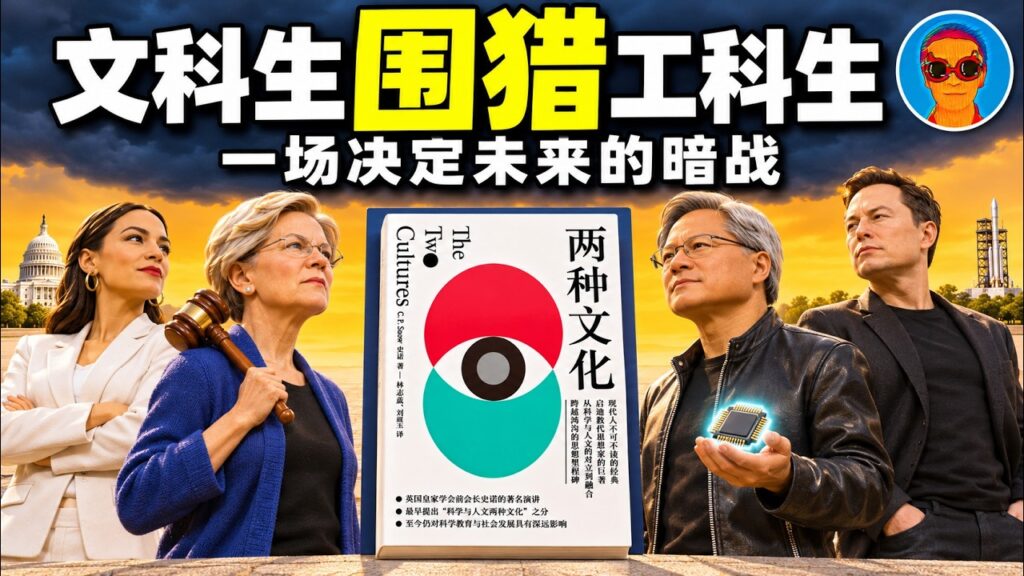
What this episode is about
Start with Nvidia co-founder Jensen Huang, who suddenly resigned amid an investigation into his private life and rumors of espionage, followed by congressional hearings and calls to break the company up. Then the draconian bills against frontier AI and the freezes on approving new data centers. Then Elon Musk getting blocked again and again, on rocket launches and on his performance pay package. Line up the side swinging the clubs of rhetoric, legislation and permits against the side heads-down writing code, building chips and building rockets, and a thread running back more than half a century comes into view: the humanities crowd hunting the engineers.
In this episode I take a close look at The Two Cultures, the 1959 classic of intellectual history by British physicist and novelist C. P. Snow, and borrow the “dynamist” versus “stasist” framework from business writer Virginia Postrel’s The Future and Its Enemies: The Growing Conflict Over Creativity, Enterprise, and Progress to cut through the turmoil in politics and tech right now. More than sixty years ago, Snow, who moved between the physics labs of Cambridge and the literary salons of London, saw that the modern intellectual elite had split into two cultures sealed off from each other. Literary intellectuals who thought of themselves as the refined ones knew next to nothing about basic modern science like the second law of thermodynamics, yet claimed a monopoly on moral and aesthetic judgment, and even became “natural Luddites,” enjoying the fruits of industrial civilization while cursing the machines. What’s more alarming today is that the anti-machine shrieks of the study have merged with a vast apparatus of bureaucracy, legislation and courts, and grown real fangs of state power that actually bite. Reaffirming the value of science and engineering isn’t a rejection of the rule of law or of ethical oversight as checks and balances. It’s a warning: when the scales tip too far and the people who write the rules only want to pin down the people who make things, human civilization will end in a whimper, in a permit that never gets approved, a hearing that never ends, and the soft tap of a gavel.
Highlights
- Who gets to be called an “intellectual,” and the scientific blind spot: from the “second law of thermodynamics” question nobody at a London dinner party could answer, to the poet T. S. Eliot’s world-weary sigh and the nuclear physicist Rutherford’s swagger about riding the wave, see why the humanities and the sciences are separated by a whole Atlantic in how they think and what drives them.
- “Natural Luddites” and a moral sleight of hand: how Snow separated the “individual tragedy of existence,” which no one can escape, from the “social misery of hunger and want,” which can be abolished entirely, and used eighteenth-century population records and three generations of his own family to shatter the pastoral fantasy of pre-industrial life, showing that industrialization was the only hope the poor ever had of escaping their fate.
- When cultural arrogance grows the teeth of state power: using the face-off between “dynamists” and “stasists” from The Future and Its Enemies to take apart how a control elite trained in political science, law and activism encircles the people who build technology through a revolving door: “out of office, they hold the narrative and slip on the moral noose; in office, they hold the permits and hearings and pull the rope tight.”
- Looking back at the Jensen Huang affair and the anti-AI wave: why could the global AI compute foundation he spent more than thirty years fighting to build be wiped clean in some politicians’ rhetoric, reduced to an “argument for a breakup” and a “suspect”? And why, facing the same power shortage, do engineers instinctively build power plants and chase liquid cooling and nuclear, while control-minded bureaucrats happily reach for the “off switch”?
- The “undo button” of the symbolic world versus the irreversibility of the physical one: from Musk’s roughly $56 billion pay package being zeroed out and then reinstated by the Supreme Court, to humanities scholars coining “Muskism” as a cultural sneer, see the deep gap between the world of legal texts and the thermodynamic physical world, and where “healthy checks and balances” ends and “scuttle-the-ship hunting” begins.
Jump to a section
- 00:00 The hidden thread behind tech’s string of crises: the humanities crowd hunting the engineers
- 04:24 Back to The Two Cultures: the split between gloomy literati and optimistic scientists
- 09:02 The second law of thermodynamics question: arrogant “scientific illiterates” and a moral sleight of hand
- 12:21 “Natural Luddites”: the pastoral fantasy and the truth about industrial salvation
- 17:48 Dynamists and stasists: when anti-tech literati join forces with control-minded bureaucrats
- 21:21 Looking back at the Jensen Huang affair and the AI shutdown: how a compute foundation became a political trophy
- 25:11 Looking back at Musk’s run-ins: the “undo button” of the legal world and academia’s cultural sneering
- 28:30 Checks or a hunt: civilization won’t end with a bang, only a whimper
The books
The Two Cultures
- Author: C. P. Snow, Chinese translation by Chen Keji and Qin Xiaohu
- Publisher: Shanghai Scientific and Technical Publishers
- Year: 2003-01
- ISBN: 9787532368198
The Future and Its Enemies (no Chinese edition yet)
- Original title: The Future and Its Enemies: The Growing Conflict Over Creativity, Enterprise, and Progress
- Author: Virginia Postrel
- Publisher: The Free Press
- Year: 1998
- ISBN: 9780684827605
Leave a Reply