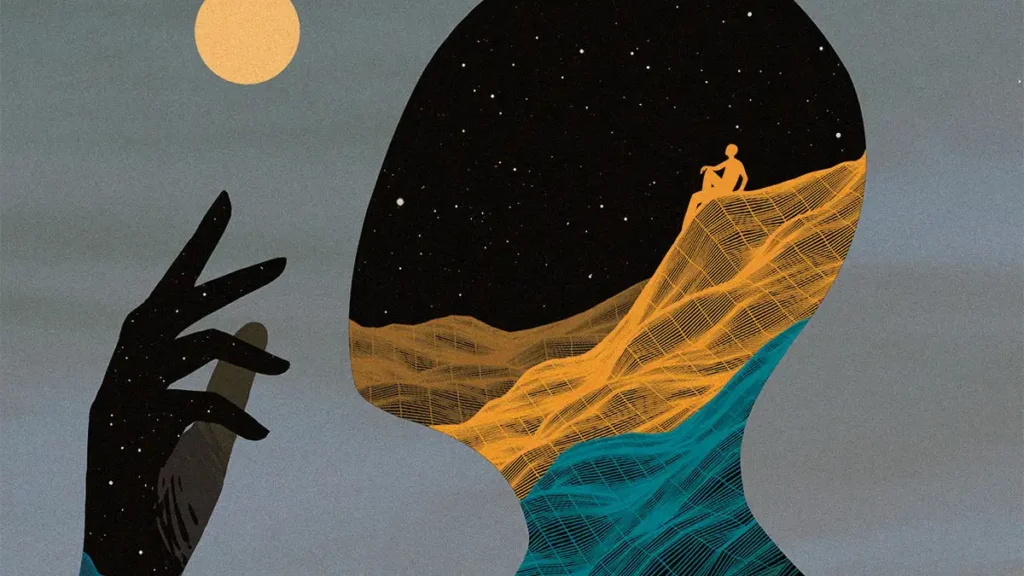
意识到底是从哪里来的?
Today I want to introduce a staggering hypothesis about where consciousness comes from. It is called Integrated Information Theory. It is still very much a fringe theory by current standards, but it has profoundly shaken me.
I have been fascinated by consciousness since I was little. While other kids were still talking about Saint Seiya and Dragon Ball, I was already pondering questions like, ‘Why is there an “I” looking at this world?’ Well, I was a weird kid from the start.
After my interest in this question first took root, I kept returning to relevant material on and off. Of all the various ideas about consciousness I encountered later, Integrated Information Theory was the one that left me most awestruck.
I mentioned it in Zhichao Wei: New Findings in Psychology, while discussing Natural Healing. I said, ‘I can still remember the shock I felt the first time I read Giulio Tononi’s Integrated Information Theory.’ That one sentence caught quite a few classmates’ attention, and they left comments or sent me private messages asking where they could find material on the theory.
Then I thought, why not use this opportunity to make a two-part special and introduce everyone to the theory that once completely destroyed and rebuilt my own view of the world?
Actually, this isn’t my first time introducing Integrated Information Theory on Ximalaya.
Last year, on Ximalaya Book Club, I introduced the science-fiction novel Blindsight. In that episode, I spent a large part of the program using Integrated Information Theory to interpret the book. Some classmates first got to know me through that episode. If you are a Ximalaya member, you can search for it and listen right away.
Here, I’m going to pull out the Integrated Information Theory portion, reorganize it, add more details, and talk you through it.
First, let me answer a few classmates’ questions: where can you find material on Integrated Information Theory? As far as I know, among books published in China, there are two that offer relatively thorough introductions.
The first is PHI: A Voyage from the Brain to the Soul, written by the originator of Integrated Information Theory, Giulio Tononi. The second is Consciousness and the Brain, which I recommended before.
The author of Consciousness and the Brain, Christof Koch, is an authority on consciousness research and also a supporter of this fringe theory, Integrated Information Theory. In Chapter 4 of Consciousness and the Brain, he gives a detailed introduction to the theory. (The material in this special also draws on that book.)

There is quite a lot of information to cover about Integrated Information Theory, and it is a little more brain-burning than our usual programs, so we’ll discuss it over two episodes. Today’s episode is a setup: I’ll use a thought experiment of my own devising to lead into one basic premise of Integrated Information Theory. Next time, we’ll go deeper into the details.
All right, let’s get to the point.
Why are humans conscious?
Why is there a subjective experience in our brains?
Why does each of us feel that there is an “I” looking at and experiencing this world?
These are all huge questions. They have troubled this little weirdo—and countless philosophers and scientists throughout history—just as much.
How, exactly, does consciousness arise?
The most common view is that consciousness is a phenomenon unique to complex systems. A small number of neurons connected together do not produce consciousness. Take a caterpillar, for example: its nervous system is so simple that it seems capable only of a few reflexive movements.
Only when a system becomes as complex as the human brain, with countless neurons linked into a vast network, does consciousness appear.

Of course, not every complex system qualifies for consciousness. Christof Koch uses the immune system as an example in Consciousness and the Brain.
He says, ‘The immune system shows no sign of consciousness. Day after day, it silently identifies and eliminates all kinds of pathogens. Right now, your body’s defenses may be fighting a viral infection, and you may not be aware of it at all. The immune system will remember this invader. If the same virus attacks again, it will produce antibodies and give you lifelong immunity. But this memory is not a conscious memory.’

Still, despite counterexamples like complex systems that lack consciousness, many scientists and philosophers believe that complexity is a necessary condition for consciousness. The philosopher Daniel Dennett was one of the loudest advocates of this view. To him, consciousness emerges from a distributed network made up of countless tiny, unconscious neural circuits.
Simple systems have no consciousness; once a system becomes complex enough, consciousness emerges. Does that claim make sense?
I want to set aside the complicated mathematics and logical derivations of systems science and test this idea with an intuitive thought experiment. (I came up with this thought experiment myself; any resemblance is purely coincidental.)
All right, our thought experiment begins now:
If consciousness really emerges from systems that are sufficiently complex, then in theory there ought to be a boundary between having consciousness and not having it, right?
So where is that boundary?
Let’s start with the human brain and look for it. The human brain can obviously produce consciousness. There shouldn’t be any doubt about that, right?
Now, if we simplify the human brain just a little—say, turn it into that ancient relative of ours, the Neanderthal—did Neanderthals have consciousness? I think they did.
Simplify it a little more, into our distant relative the chimpanzee. Do chimpanzees have consciousness? Surely they do.
All right, simplify it one step further, into a dog. Do dogs have consciousness? Most people in the ancient world would have said no. But we modern people—especially modern people who love dogs—would probably agree that a dog’s brain contains consciousness, or at least a subjective experience. It just may not be as complex, clear, intense, or vivid as ours.
Now keep carrying this simplified-brain thought experiment forward—from mammals to reptiles, to fish, and then to mollusks—and you’ll find that you simply cannot locate a boundary where subjective experience goes from present to absent. It is a continuous change.
That leaves us with only one option: even something as simple as a nematode, or even a microorganism made up of just a few cells, should have some degree of subjective experience—some degree of consciousness. Even if that consciousness is so faint that humans can’t begin to imagine it.
Of course, you may think this thought experiment is not good enough. You may insist that subjective experience is unique to humans, and that even our relatives—the chimpanzee and the great ape—have no consciousness. So using animals to reason about this is meaningless.
Fine. I’ll turn this thought experiment into version 2.0. This time, we’ll use humans alone—ourselves—as the subjects of the experiment:
When did your own consciousness—your own subjective experience—appear?
Suppose you are 20 years old now. Did the 19-year-old you have subjective experience? Of course.
The 18-year-old you did too.
What about when you were 8? Your memories may be fuzzy, but there is no doubt that your subjective experience—your consciousness—already existed during those years. Right?
All right, what about 7? 6? 5? 4? You may not remember any of it, but do you really dare say that your subjective experience suddenly dropped out of the sky and appeared in your brain on one particular day of one particular year? You can’t, can you?
So the only reasonable answer is this: when you were 3, when you had just been born, when you were still in the womb, when you were still a clump of cells, even when you were a fertilized egg, your subjective experience—even an unbelievably faint subjective experience—already existed.

In other words, consciousness is not a feature that belongs only to an ultrasophisticated system like the human brain, emerging only there. It should also exist in extremely simple systems.
And since our reasoning has already brought us this far, let’s take the final step and say it plainly.
If the thought experiment we just ran holds up, then we have to admit that everything in this universe may possess subjective experience, and therefore consciousness, to some degree.
Consciousness is not an attribute found only in complex systems like the human brain.
On the contrary, consciousness may be a fundamental feature of the universe, built in at its most microscopic level—a basic property.
Consciousness may exist in all kinds of tiny systems and tiny structures in the world.
In other words, this world is actually one of panpsychism.
Let me repeat that: this world is actually one of panpsychism.
But this is not the primitive religion believed in by the indigenous extraterrestrials in Avatar, where every rock and every tree has a soul. What we have just reasoned our way to is a philosophical version of panpsychism.
In this philosophical version of panpsychism, consciousness is not exclusive to complex systems; it may well exist in all kinds of tiny structures. So the universe is actually full of consciousness, full of subjective experience. Not only does every living thing possess consciousness to some degree—even simple inorganic matter may contain the tiniest spark of it.
At this point, you will definitely ask: fine, even if I admit that an atom has consciousness, you still haven’t really said anything. If consciousness is a basic property of the universe, what kind of property is it?
Give me the details: does every atom, every quark, have consciousness? Or do these units of matter have to combine into a structure or system that meets certain conditions before consciousness appears? If even a very small system can have consciousness, what features must a consciousness-producing system possess?
Exactly. These questions all need answers, and Giulio Tononi’s Integrated Information Theory answers precisely them. Integrated Information Theory begins by taking this philosophical version of panpsychism as a basic premise: consciousness may arise even in extremely tiny systems.
On that foundation, it goes on to tell us that consciousness can appear only in systems with two key features.
Before introducing those two key features, let’s say a few words about the background of Integrated Information Theory. Its originator, Giulio Tononi, is a neuroscientist at the University of Wisconsin in the United States. This brilliant man proposed the hypothesis in 2004 and revised and developed the details of the theory in 2014.

Perhaps because it is so unorthodox, Integrated Information Theory remains highly controversial among scientists and philosophers. It is nowhere near a consensus. But among the theoretical hypotheses about the origins of consciousness that I have read, it is the only one that made me feel it had put its finger on part of the truth about consciousness. Of course, a possible truth.
So let me explain the core of this theory: what two key features must a system have in order to produce consciousness?
These two key features are also the two dimensions used to measure the strength of consciousness:
The first dimension is how much information the system contains.
All we have to do is observe our own consciousness to realize that every conscious experience contains an enormous amount of information.
Christof Koch wrote this in his book Consciousness and the Brain:
In fact, every sensation is so unique that you can never experience exactly the same sensation again—ever! … When you open your eyes in a pitch-black room, you see nothing. Pure darkness may seem like the simplest visual experience you have ever had. … Yet the percept of darkness implicitly rules out seeing the quiet, brightly lit living room, the surface of the granite on Half Dome in Yosemite National Park, or any single frame of a film shot in the past or the future. Your subjective experience implicitly excludes everything else you might have seen, imagined, heard, or smelled.
In other words, every human conscious experience contains an astronomical amount of information.
In the view of Integrated Information Theory, the essence of consciousness is actually information.
When this universe was created, matter and energy formed the objective world—what you might call the universe’s hardware. The information generated by interactions between matter and energy formed the subjective world: information is the universe’s software. Consciousness did not suddenly drop from the sky when biological evolution produced a system as complex as the human brain. It already existed at the birth of the universe, because information already existed then.
Consciousness exists in the universe just as matter and energy do. It is one of the universe’s fundamental components.
As for why the universe was set up this way? Sorry, I have no idea. It is like the constancy of the speed of light in special relativity. You measure the speed of a beam of light while standing still, and it is 3×10 to the 8th power meters per second. You chase it at half the speed of light, and its speed relative to you does not get cut in half. Amazingly, it is still 3×10 to the 8th power meters per second.
This completely violates intuition, but it is simply a basic setting of the universe, an axiom that cannot be reasoned from. Once you accept that setting, deductions made on its basis all agree with what we observe in reality.
In Integrated Information Theory, the existence of consciousness is another axiom like that.
And this kind of setup gets around, to some extent, one of the most mysterious puzzles about consciousness: consciousness is subjective experience; it is a subjective world. What baffles many scientists and philosophers most is how such a subjective world arises from the objective world of matter.
There seems to be an unbridgeable chasm between the subjective mental world and the objective physical world. On one side is the brain, perhaps the most complex organization in the universe—but when all is said and done, it is still just a squishy lump of meat obeying the laws of physics. On the other side is subjective consciousness, arising from that lump of meat. How does that leap from objective meat to subjective experience happen?
Neuroscientists and psychologists can already use all sorts of high-tech equipment to observe the nervous system. Perhaps one day, as technology advances, they will map every physical detail of the entire nervous system.
For example, scientists may one day work out every neural basis of the visual experience of “red.” They will tell you that to produce the experience of seeing red, these regions—abcde—in the cerebral cortex have to activate in this way and that way. Add up all those neural activities, and they give you the feeling of seeing red.
But the problem is that all these descriptions come from a third-person perspective. No matter how detailed your description is, you are still describing the nervous system at the physical level.
How do these physical activities become an inner, first-person, subjective feeling of “me”? Even if you figured out every detail of the human brain at the level of objective matter, you still could not answer that question.
In other words, even if neuroscience and psychology advanced to their absolute limit, even if you climbed Mount Everest in the objective material world, you would still find the subjective world hanging overhead like a starry sky, infinitely out of reach.
But in Integrated Information Theory, wherever there is matter and energy, information is almost bound to arise. Consciousness and matter are face to face and back to back, like the two sides of a coin or the two poles of a magnet. At the universe’s most basic level, if you have one, you necessarily have the other.
Once matter and consciousness are always back to back, how deep the chasm between them is becomes beside the point.
That is the first core idea of Integrated Information Theory: consciousness is information. Later we will see that the amount of information a system contains is the first dimension determining the strength of its consciousness. The more vivid and clear the consciousness, the more information it contains.
But information alone is not enough. A system containing consciousness must also have a second dimension.
That second dimension is the system’s degree of integration of information.
Let us continue observing our own conscious states. We find that every conscious experience not only contains an enormous amount of information, but is also highly integrated.
What highly integrated means is:
No conscious experience can be divided into two smaller parts. No matter how hard you try, for example, you cannot see a world that is both black and white. Nor, unless you close one eye, can you manage to see only the left or only the right half of your field of vision.
The more vivid and clear a conscious state is, the less divisible it is.
High integration: that is the second feature of consciousness.
One: amount of information. Two: degree of integration. Leave out either one, and you cannot form clear, vivid consciousness.
For example, when people are anesthetized for surgery, measuring activity in the various brain regions shows that each region has a different activity pattern and is processing information on its own. In other words, under anesthesia the brain as a whole actually contains a huge amount of information. But the brain regions are each fighting their own battle, with almost no communication between them; the degree to which information is integrated is extremely low. So you have a lot of information but little integration, and consciousness is very faint. The person is almost completely unconscious.
The opposite happens when people are asleep. Sleep without dreaming is almost the reverse of anesthesia: the activation patterns in the various brain regions are highly consistent, so the brain has a high degree of integration and functions as a unified whole. But the brain waves across the entire brain are extremely simple, containing very little information. High integration but little information—consciousness is equally faint.
Only when you measure brain activity while a person is awake do you find that the different parts of the brain are not only processing large amounts of information independently, but are also communicating extensively over long distances. The prefrontal cortex in particular has many long-range connections with other brain regions, meaning that this information is highly integrated. You see, consciousness emerges clearly only when both conditions are met: lots of information and a high degree of integration.
In fact, Integrated Information Theory has a formula for calculating how strong a system’s consciousness is. The main parameters in the formula are, naturally, the amount of information and the degree of integration. The result can be represented by the Greek letter Φ. The book written by Giulio Tononi himself uses Φ as its title. The higher the Φ value, the stronger the system’s consciousness.
The Φ value is low when the human brain is under anesthesia or asleep, and high only when it is awake.
That brings us to the most basic core ideas of Integrated Information Theory. Consciousness is a fundamental property of the universe. Any system that contains information and integrates that information will have consciousness.
Now, if Integrated Information Theory is correct, we arrive at some astonishing conclusions. Let me give you two examples.
The first concerns artificial intelligence. As I said in an earlier episode, many people worry that AI is developing so fast that one day it might become conscious and enslave humanity. Integrated Information Theory would tell you that you are worrying far too late. AI has already become conscious!
That phone in your hand and the computer on your desk are both conscious. They are, but only very faintly.
Why? Because although computers store enormous amounts of information, that information is not integrated. Files are almost completely isolated from one another, as are one algorithm and the next. Computers have one of the two conditions—information—but are missing integration.
We can compare the information stored in a computer to a freight car full of apples. There are a lot of apples, but they are simply piled one against another in the car. The total amount is huge, but they do not form a whole; each apple is connected to the next only by that tiny patch of apple skin where they touch.
Today’s computer programs, including so-called AI algorithms, are basically like that freight car full of apples. So even if they are conscious, their consciousness is vanishingly weak.
The information stored in the human brain may amount to only one basket of apples, but those apples have been chopped up, covered in juice, and turned into a bowl of apple salad. One basket of apples is not a negligible amount of information, but the key is that the information is massively interconnected and highly integrated.
So although humans are no longer a match for computers in certain narrow algorithms—AlphaGo, for instance, has crushed every human Go champion—we should still have complete faith that the strength of human consciousness beats that of such an algorithm by who knows how many orders of magnitude.
The second astonishing conclusion is the animism we arrived at in the previous lecture. From the perspective of Integrated Information Theory, the entire universe is actually filled with the capacity for experience. Even the most basic microscopic particles possess a tiny bit of consciousness. Take the neutron, for example: it is made up of a three-quark system that cannot be observed in isolation, and that system forms an extremely small integrated system. A neutron, incredibly, is conscious too—although its consciousness is so faint that it can almost be ignored.
I often come across descriptions of humanity’s loneliness in science-fiction novels and popular books on cosmology. From the perspective of a highly intelligent life-form, humanity may indeed be completely alone in this universe. For all we know, humans may never be able to make contact with any other intelligent creatures in the cosmos. We might even be the only highly intelligent life-form in the universe.
But if the true face of this universe really is what Integrated Information Theory describes, then subjective experiences that perceive the world, much like human consciousness does, are actually scattered throughout every corner of the universe.
There is an “I” everywhere in this universe. The “I” is not alone.
In the worldview of Integrated Information Theory, we are surrounded by consciousness—
consciousness, in the air we breathe;
under the ground beneath our feet,
in every star above our heads;
lighting up the entire universe.
Leave a Reply