[Zhihu Question]
Where exactly is Rutger Hauer’s improvised speech in Blade Runner so brilliant?
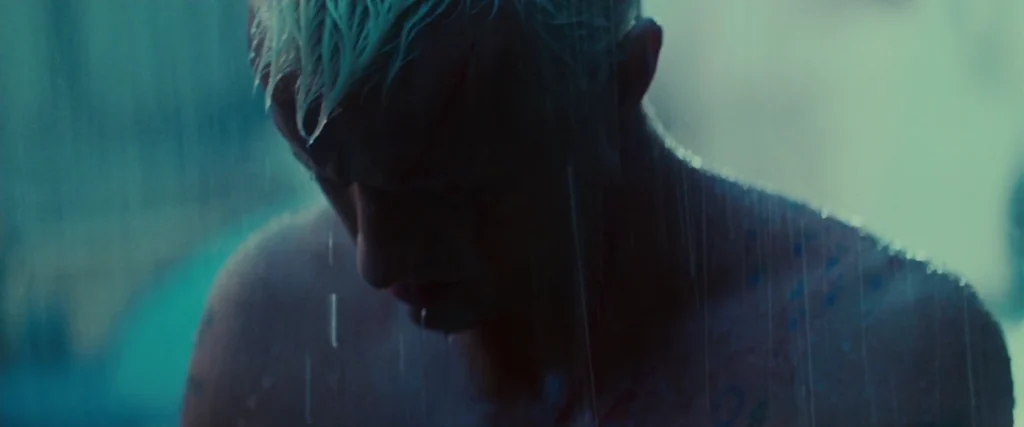
I have seen beauty that you humans would never believe,
I watched starships burn along the shoulder of Orion,
I watched C-beams glitter in the dark near the Tannhäuser Gate,
and all those moments will be lost in time, like tears in rain.
The reason this speech is so brilliant is that, to the characters in the film—and to the audience—it declares, with absolute clarity and leaves no room for doubt: replicants have souls.
No other detail in Blade Runner makes the conclusion that replicants have souls so powerful, or renders it so impossible to refute, as this speech does.
That’s because what the speech reveals is not the replicant Roy’s attachment to life, but his attachment to beauty.
Replicants clearly have an “attachment to life.” The rebellious replicants do everything they can to evade pursuit and preserve their lives. But if a replicant merely shows an attachment to life at the moment of death, you could easily say that it’s nothing more than animal instinct. When an earthworm is pinched, it struggles desperately to survive too. Nothing remarkable about that. An “attachment to life” was never a trait exclusive to humans, so what does it matter if replicants are afraid to die? They’re still just earthworms. They aren’t “human.”
But “beauty” is different. The appreciation of beauty has always been a privilege reserved for humans.
When you get right down to it, what is the essential difference between humans and animals—between humans and those “beasts”?
Many of the boundaries that once seemed clear between humans and animals have been repeatedly breached as science has flourished.
Humans once thought they were born exceptional, God’s chosen people. Then Darwin’s theory of evolution shattered that illusion.
Later, humans thought they alone possessed “morality,” but zoologists showed that some animals empathize and understand self-sacrifice, while some even have a sense of fairness and understand how to uphold justice. And as for basic emotions like joy, anger, sorrow, and pleasure—animals have all of those too.
Even language may not be unique to humans. And even if it were, language as an ability is a little cold and abstract; humans don’t find it especially easy to use it for self-identification.
In the end, the ability to appreciate beauty almost became humanity’s last fortress for protecting its “self-identification.”
In the film I, Robot, Police Officer Spooner, played by Will Smith, interrogates the robot Sonny:
“Can a robot write a symphony? Can a robot turn a canvas into a masterpiece?”
The implication is that robots could never understand beauty; only we humans know how to appreciate beauty and create it.
Officer Spooner’s questions are not actually confident in the slightest. If anything, he sounds deeply rattled—“beauty” has become the last stepping stone beneath humanity’s feet on the altar of the spirit of all things.
Only I—humanity—understand “beauty,” so what if you replicants have emotions and intelligence? You’re not “human.”
It is precisely here that the replicant Roy’s final speech before death breaks through humanity’s last fortress.
I have seen beauty that you humans would never believe, I watched starships burn along the shoulder of Orion, I watched C-beams glitter in the dark near the Tannhäuser Gate,…
I, a replicant, have seen beauty you humans have never seen. In the final moment before my life fades away, I am attached to it.
I am just like you.
You humans have souls. So do I.

It is on this level that Rutger Hauer’s speech strikes directly at—and elevates—the central idea of Blade Runner. It is also on this level that the speech allows the audience in front of the screen to establish a genuine emotional resonance with the replicants in the film: they are just like us; in fact, they may be even more like what humans were meant to be.
This brings to mind Peter Jackson’s King Kong. The film’s most inspired stroke is Kong watching the sunset with the female lead: Kong understands beauty. The effect of this scene is remarkably similar to the replicant Roy’s final speech before death.

The final line in King Kong is:
It was beauty killed the beast.
Some subtitle groups translate it as “He died because of the beautiful woman,” which is completely wrong.
Kong did not die because of the beautiful woman;
Kong died for beauty.
Leave a Reply