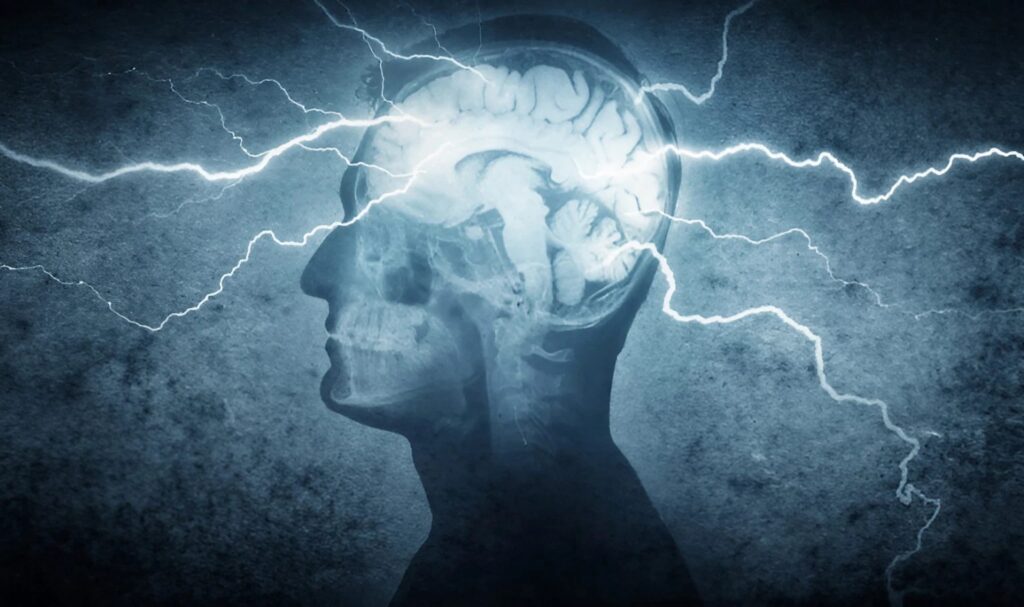
You’re struggling to remember a string of phone numbers or memorize a passage, and just when you feel you’re running out of steam, electrodes in your brain release a specific pattern of electrical stimulation into the lateral temporal cortex. Suddenly, you feel clear-headed and sharp, and within a few tries you’ve stamped those phone numbers and that passage into your brain.
What I’ve described above isn’t just a scene from science fiction like Black Mirror. A study published this February has already explored an early version of this kind of black tech.
In the study, a research team led by Michael Kahana, a professor of psychology at the University of Pennsylvania, used deep brain stimulation (DBS) electrodes implanted in patients’ brains to deliver specific electrical stimulation, improving their word-memory performance by 15%.
Deep brain stimulation (DBS) has already been widely used to treat certain brain disorders. For example, after DBS electrodes are surgically implanted in the brains of patients with Parkinson’s disease, the stimulation they release can effectively suppress epileptic seizures.
Previous studies had already found that DBS could improve some patients’ performance on certain cognitive tasks. But researchers didn’t know exactly what kind of stimulation, applied to which area of the brain and at what moment, would produce what effect.
Kahana’s team cleverly used signals generated by the brain itself to ‘tell’ the electrodes when to switch on and what pattern of electrical stimulation to deliver.
First, the researchers asked participants to memorize some words while recording their brain activity with EEG equipment (the participants in the study were 25 epilepsy patients who had already had DBS electrodes implanted in their brains).
After memorizing the words, the participants had to recall them. This made it possible to distinguish the words they remembered from the ones they didn’t.
The researchers fed the EEG activity associated with ‘remembered’ and ‘forgotten’ words separately into an artificial-intelligence program for analysis. In the end, they found that the main difference lay in the EEG activity of the lateral temporal cortex.
In fact, by looking at each participant’s performance, the software could identify that person’s basic activity patterns in the lateral temporal cortex when they ‘remembered’ and when they ‘forgot.’ Once it had those patterns, the researchers could use them to monitor the participant’s performance.
In a new memory task that followed, whenever the EEG equipment detected the ‘forgotten’ pattern in a participant’s lateral temporal cortex, the software immediately instructed the electrodes in that region to release an electrical signal matching the ‘remembered’ activity pattern.
It was like using electrodes to force the brain to get on beat—to shift its activity rhythm from ‘forgotten’ to ‘remembered.’ It was through this rhythm-setting operation that the participants’ memory performance improved by 15%.
Although this study is still extremely preliminary, it seems to offer a glimpse of the dawn of the evolution from Homo sapiens to godlike humans that Harari describes in Homo Deus: A Brief History of Tomorrow. And the augmented electronic brain in Ghost in the Shell—is it really so far away after all?
References:
1. Ezzyat, Y., Wanda, P. A., Levy, D. F., Kadel, A., Aka, A., Pedisich, I., … & Gross, R. E. (2018). Closed-loop stimulation of temporal cortex rescues functional networks and improves memory. Nature communications, 9(1), 365.
2.Dana G. Smith. Brain “Pacemaker” Could Help You Remember Only What You Might Forget. Scientific American Mind, MAY / JUNE 2018.
Note
- This article in the ‘New Knowledge in Psychology’ series was a short piece of popular science and casual commentary written at the time to accompany content related to Zhichao Wei: New Knowledge in Psychology. It was published on the now-shuttered platform Fantuan; the original link no longer exists.
Leave a Reply