A few years ago, while I was studying in the United States, I often got evangelized. Every time I had finished resisting them in every possible way, the sentence I heard most was: “How can you not believe?” At that moment, in the sorrowful eyes of the believers, I must have looked like a poor soul abandoned by God. What I owe them is this: for a die-hard rationalist, even if you are trying to convert me, you still have to give me a reason. What I want to ask in return is: “Why should I believe, and how do I ‘choose’ to believe?”
That experience partly explains why I like Life of Pi. Although the film does not necessarily give me a satisfactory reason for Pi’s belief, at least it offers this suggestion: faith is not an irrational dependence, but an active choice.
Although many people seem not to see it this way, I still think Life of Pi is above all a story about faith: how we acquire faith, and how the “spirituality” that helps us acquire it confronts the “animality” that exists alongside it in human nature.
Pi was originally a believer, but he eventually lost his faith. Though it is difficult for us to know exactly when Pi lost it (because we do not know the true details of his past), we can imagine what the following experience might do to a person’s faith:
A storm. The ship sinks. Pi, his mother, the cook, and the sailor become the lucky survivors on a lifeboat, while food quickly runs out. The sailor’s leg is broken; after an amputation, the cook uses it as bait to catch fish. Soon the sailor dies, and the cook dismembers his body, drying the flesh into fish bait and food to eat directly. Later, when Pi’s mother quarrels with the cook, the cook kills her. Enraged, Pi kills the kind-hearted cook, dismembers and dries his body, and survives by eating his flesh. After finishing the cook’s flesh, Pi continues eating his mother’s corpse and the monkeys on the lifeboat, until he is rescued.
During the voyage, Pi encounters another storm. He cries out to God: My family is dead. I have given you everything. Why are you still treating me this way? At least at that moment, Pi’s realization resembles that of Pastor Manuel in 1942: If God really exists, why am I still suffering such extreme human misery? — Faith collapses in the human hell.

The next question facing Pi is: How does he regain his faith?
The flood of faith in The Tree of Life tells us that you only need to believe in God—or, to put it one step more simply, you begin by not believing and resisting, then you see people who believe in God ultimately find happiness, joy, and redemption, and naturally you understand and join the ranks of believers. In short, building faith actually requires no reason: either it comes naturally, or you suddenly understand halfway through. Once you believe, that’s that.

This seems to be exactly what happened to Ansel in 1942. God the Father tells him that he should never question God, so through hymns and prayers… he picks his faith back up. To a psychological counselor, however, these methods may look more like a kind of cheap spiritual intoxication than the construction of faith.
Pi’s later experience is different:
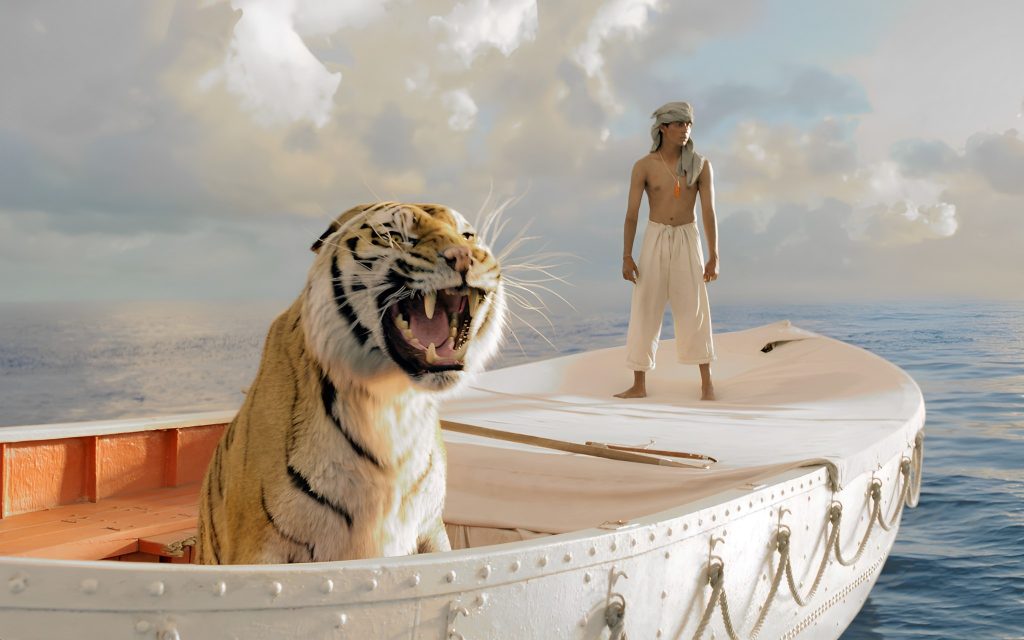
After being rescued, Pi composed this story. He said that, at first, only he and a few animals survived. In the story, the cook became a hyena, his mother became an orangutan, the sailor became a zebra, the cannibals’ history became a carnivorous island floating in the ocean, and the human flesh cut into pieces and dried in the lifeboat became meerkats. Pi himself split into Pi and the Bengal tiger, Richard Parker.

In this story, what exactly do Pi and Richard Parker represent?
Pi later said that his vigilance toward Richard Parker enabled him to survive at sea, so Richard Parker itself was “danger.” The thing that made Pi feel danger was both split off from Pi himself and something Pi had not consciously recognized before; after the hardship had passed, it also seemed to leave him once again.
This dangerous alter ego is the instinctive animality in Pi’s heart.
The complete soul split into spirituality (Pi) and animality (Richard Parker).
I tried to search my brain for words describing the symbolic meaning of Richard Parker, and finally found the most suitable one in an old, moth-eaten concept: the “id” in Freud’s theory of personality. (After the split, Pi himself is the “superego.”)
Richard Parker symbolizes all the survival instincts in Pi’s body.
Among them is the instinct to avoid danger in order to survive—the moment Pi’s fear replaced his courage when his mother was killed.
There is also the huge aggressive instinct that erupts when facing a threat—the instinct that ultimately led Pi to kill the cook.
But the instinct hardest to expose, yet containing the greatest energy, in the civilized world is the instinct to seek food by any means when starving and thereby extend one’s life. Driven by this powerful instinct, even the most untouchable moral taboos can be easily broken, including cannibalism (even eating one’s own relatives).
“Man-eating”—on the lifeboat, Pi saw the enormous, terrifying energy displayed by the survival instinct in his own body. This energy ran completely counter to the spirituality he believed ought to exist in his heart, and it turned him entirely into a beast.
The Richard Parker who threatened Pi on the lifeboat, and whom Pi tried to tame, was the spiritual part of his heart. Or, in Freud’s terms, it was the human “superego”: the part of the human heart that represents morality and goodness.
Only by upholding spirituality can he remain a person. Yet only by following animality can he survive. What should he choose?
So, in my view, the theme of Life of Pi is the conflict between spirituality and animality in the human heart.
Some people say Life of Pi can be interpreted on multiple levels, with each interpretation reflecting one aspect of human nature; therefore, Life of Pi is Ang Lee’s version of The Matrix. I don’t see it that way. The story about the man-eater is true, and the story about the tiger is false—what could be clearer?
Others say Life of Pi is about a boy who has endured hardship using a fairy tale he imagined to comfort his soul and escape pain, so Life of Pi is Ang Lee’s version of Pan’s Labyrinth. I don’t see it that way either. The little girl’s imagined fairy tale in Pan’s Labyrinth can indeed be understood as the unconscious’s passive escape from suffering, whereas what Pi does after being rescued is an active choice.
To me, the work most similar to Life of Pi ought to be something that looks completely unrelated on the surface—Du Qifeng and Wai Ka-fai’s The Great Turn.

In the film, the Great Turn, played by Andy Lau, has also lost his faith. On the surface, he loses it because he sees the consequences after his girlfriend is brutally murdered, and then he “becomes a monk.”
How does seeing consequences make someone become a monk? The real reason is revealed through a line delivered by Li Fengyi, played by Zhang Bozhi. Li Fengyi had been a Japanese ghost soldier in a previous life; a Japanese ghost killed people, so Li Fengyi had to die. Li Fengyi says: “Is that fair?” — No, it is completely unfair. The Great Turn understands this, and therefore becomes a monk: he has seen the unfairness behind cause and effect, while the object of faith should not be unfair.
The Great Turn’s later experience goes like this: one side of human nature, its animality, explodes with Li Fengyi’s murder, and a new evil cause is about to be planted; yet spirituality appears at that very moment. If there is a Buddha in your heart, you can choose not to plant the cause before you, even though you are powerless against the unfairness brought by old causes. Because of faith, you can refuse to plant a new evil cause. The animal side in the heart is replaced by the spiritual side; he lays down the butcher’s knife and becomes a Buddha on the spot.
But is this dependence, or a choice? In my view, the faith here is the choice to use the spirituality in one’s heart to replace animality, not an irrational dependence. What people call Buddhahood is really believing that the spirituality in one’s heart will eventually replace animality.
In The Great Turn, spirituality defeats animality.
And how does Pi face the conflict between spirituality and animality in his heart?
—He turns a story of animality into a fairy tale full of spirituality.
In the film, Pi, now an adult, has this exchange with the writer:
“Which story do you like better?”
“I like the one with the tiger better…”
“Right. That’s why you believe in God.”
Right. Animality or spirituality—it is ultimately a choice. Pi faces the same problem as the Great Turn: the facts of animality before his eyes have already happened, but how he walks the road ahead is up to him. Will he sink into animality, or firmly believe that spirituality will return? There is spirituality in the heart, and therefore one can choose to believe in God. Or, the other way around: because one believes in God, one believes that the spirituality in one’s heart will certainly return. Faith in God and faith in the spirituality that must exist are really the same thing. Nothing exists outside the heart.
But Pi’s attitude toward animality is completely different from the Great Turn’s. When the Buddha-nature in the Great Turn’s heart is awakened, animality disappears with it. From the moment his Buddha-nature awakens, the Great Turn is no longer “human.”
At the moment Pi is rescued, animality likewise leaves him. But the original Life of Pi describes his feelings this way: “I started crying like a child, not because I felt thrilled at having survived my ordeal, although I certainly did feel thrilled. Nor because my brothers and sisters were right there in front of me, although that moved me deeply too. I cried because Richard Parker so casually left me.”
Before Richard Parker disappeared into the jungle, Pi thought it would turn back to look at him so he could say goodbye. But Richard Parker did not even turn its head; it simply walked away, never to return. The power of civilization is so strong that once you are inside it, the animality in your heart is suppressed without a trace and can never again appear before you with such clarity. The original Life of Pi says: “We have lived through it, can you believe it? I am grateful to you beyond words. If it weren’t for you, I wouldn’t be here.”
Facing the animality within him, Pi did not use spirituality to suppress, extinguish, or replace it. Instead, he felt grateful toward it.
Pi says that the goodbye he never said still hurts him today. But in truth, what needed to be said had already been “said.” After the storm that nearly killed Pi and Richard Parker, Pi let Parker rest on his lap, and they breathed and sobbed together. In that moment, the animality and spirituality that had been fighting inside him had already reconciled.

Thus, Life of Pi actually answers the “question from heaven” at the end of Shutter Island: “Live as a monster or die as a good man?” Can one live like a beast or die as a good person? Can the animality and spirituality in the soul coexist?
Shutter Island’s answer is to extinguish one’s soul in order to stop one’s animality—the animality and spirituality die together.
The Great Turn’s answer is to use spirituality to replace animality.
And Pi’s answer is this: be a good person who is alive, with a beast living in his heart.
Thank God for giving me a soul, and thank the beast’s instincts for allowing my soul to endure.
Included
- After revision, this article was included in The Alluring Illusion: Psychological Secrets in Light and Shadow.

Leave a Reply