 ▶
▶
The full talk is in the Feifan series on Fanshu, a Chinese audiobook app; this page is only a summary.
What we’ll cover this time
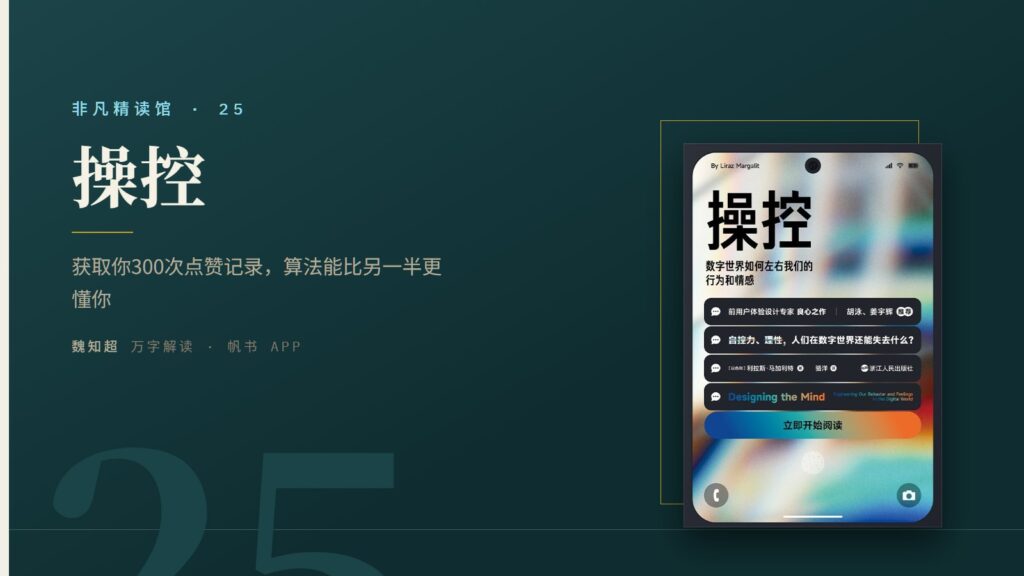
The work of a former app design expert who finally had a conscience: she wants to warn the world that the digital world’s reshaping and manipulation of people is reaching unprecedentedly dangerous levels:
You think you’re just liking, commenting, and searching? In fact, you’re submitting a “psychological self-assessment report” to a much larger system. It may analyze your psychological weak spots so it can “get a grip on you” at a critical moment;
Why are we usually so mild-mannered, yet full of hostility the moment we go online? Why does a quick search for some minor ache or illness always seem to turn up severe or terminal diseases? It all comes from the algorithm’s carefully designed “addiction mechanism”;
Why is the internet now filled with radical, extreme, black-and-white opinions? Where did all the moderate, rational voices with actual reasons and evidence go?
This is a book that exposes the invisible manipulation in the digital world—a “book of staying clear-headed.” In an age surrounded by algorithms, we need more than ever to see through the truth of digital manipulation and build independent thinking and judgment!
You’ll hear about
- The 3 major technologies the digital world uses to manipulate people
- The 3 major psychological principles that make digital manipulation work
- The 4 kinds of social and psychological crises caused by digital manipulation
- 3 ways to resist digital manipulation and keep thinking independently
Quote of the episode
The like button is the greatest invention in the digital world. Never before in human history has there been an era in which we could rate someone’s popularity so clearly, publicly, and promptly.
Once the algorithm has 70 pieces of information about your likes, it will know you better than your friends; at 150, it will know you better than your parents; after 300, it will understand you better than the person beside you in bed.
In this age of information explosion, what grabs people’s attention most isn’t reason or knowledge, but emotion—especially intense negative emotions: anger, anxiety, and fear.
We think we’re making choices freely. In reality, we’re simply being nudged—gently or not so gently—within frameworks set by others, toward the direction the designers want us to take.
About the author
[Israel] Liraz Margalit Digital psychologist, PhD in social psychology from the University of Haifa in Israel, and former user-experience design expert at data analytics company ClickTale.
Leave a Reply