What this episode is about
Whenever people talk about Japan’s “lost two decades” or “lost three decades,” the go-to explanation is always the 1985 Plaza Accord, or the asset bubble that burst in the early 1990s. But Richard Katz, a veteran American economics journalist, longtime editor of the English-language monthly The Oriental Economist Report and a true Japan hand, offers a very different, hard-nosed diagnosis in his signature book Japan: The System That Soured — The Rise and Fall of the Japanese Economic Miracle (no Chinese edition yet), and he backs it up with detailed data and industry case studies. What really dragged Japan into its long stagnation wasn’t pressure from America, and it wasn’t simply a financial blunder. It was the “catch-up system,” the very system that built the postwar boom with its own hands, which went thoroughly sour once its historical job was done.
Katz lays bare the core structural secret of the Japanese economy: a lopsided “dual economy.” Behind the “Super Japan” everybody knows, the Japan of Toyota, Sony and Panasonic, lives a huge parasitic “Domestic Japan” made up of farming, construction, retail, food processing, basic materials and financial services. The first one conquered world markets but employed only about 20% of Japan’s workforce; the second took up a full 80% of workers, yet its productivity was half that of its American counterparts, or worse. To keep that inefficient 80% from going bust and to preserve the social stability of “full employment,” Japan put up non-tariff barriers, legalized “recession cartels,” and ran a “convoy system” that forced whole industries to sail at the speed of their slowest company. The bill was paid by every consumer and every efficient exporter in the country, bled through domestic prices that were often double those in America.
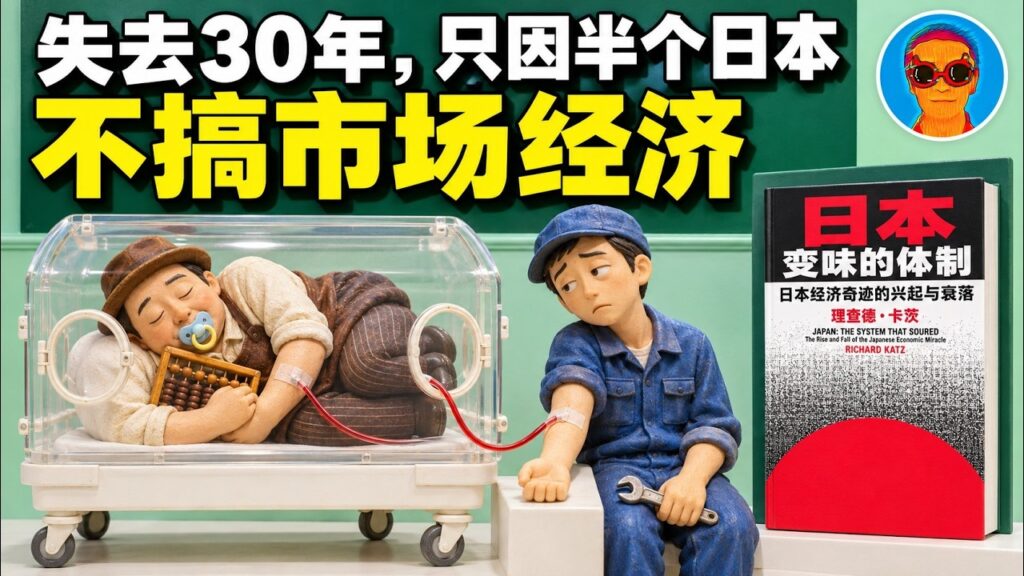
During the catch-up years of the 1950s and ’60s, support from the Ministry of International Trade and Industry (MITI) worked because infant industries like cars and semiconductors had enormous potential for increasing returns to scale, and because subsidies were strictly tied to export competition and survival of the fittest. It was an incubator to help a baby grow. But by the early 1970s, with industrial catch-up complete and the 1973 oil crisis hitting, the system didn’t take the incubator apart. Instead it morphed into an “intensive care unit” devoted to keeping energy-hungry, low-efficiency sunset industries alive. Reform kept dying on the table, locked in place by an iron triangle of interests: the Liberal Democratic Party (LDP), propped up by rural and small-shopkeeper votes thanks to the “vote-value gap”; the Large-Scale Retail Store Law, which hobbled modern chain retail; and amakudari, the “descent from heaven” in which officials from the Ministry of Finance (MOF) and MITI retired into well-paid jobs at the very companies and trade associations they used to regulate. The result: domestic consumption smothered by high prices, an “economic anorexia” of piled-up savings with nowhere to invest, and Japan’s most competitive manufacturing giants pushed offshore one after another, leaving behind a field of zombie companies and a slow-boiling-frog trap at “1.75% growth,” where nobody dares to move anyone’s cheese.
Highlights
- The absurd split between two Japans: both carry the same “Made in Japan” label, but the export-manufacturing “Super Japan,” with only about 20% of total employment, was wiping the floor with competitors worldwide, while the “Domestic Japan” of farming, construction and retail, with 80% of jobs, had less than half the productivity of its American counterparts. Upshot: a Japanese family buying a Japanese-made color TV paid a full twice what an American consumer paid for the same set.
- Three “magic weapons” for protecting the losers, and two pipelines for draining everyone else: inefficient industries kept monopoly prices high with hidden non-tariff barriers (buy imported cement and the domestic makers will cut you off together), recession cartels and the convoy system. On one side this sucked households’ purchasing power dry and produced “economic anorexia,” overcapacity alongside shrinking consumption; on the other it drove up electricity, logistics and land costs, pushing the best manufacturers abroad and hollowing out industry at home.
- From “incubator” to “intensive care unit”: industrial policy in the 1950s and ’60s could raise winners because catch-up infant industries enjoyed increasing returns to scale and had to survive the brutal test of export markets. After the 1973 oil crisis, when yesterday’s winners no longer needed crutches, the same administrative toolkit was turned to sheltering declining industries from the weather and stopping the market from clearing.
- The “iron triangle” of politicians, bureaucrats and protected industries: a “vote-value gap” in which one rural vote could be worth as many as 2.8 urban votes, the Large-Scale Retail Store Law built to choke off new big chain supermarkets, and the unwritten rule that MITI and MOF officials retire in their fifties and “descend” into well-paid jobs in the industries they regulated. Together they welded regulators and laggard sectors into one shared fate, so much so that Morihisa Naito, an official who tried to clean up how industries behaved, got turned on by his own colleagues.
- The missed Maekawa Report and the 1.75% slow boil: from the 1986 Maekawa Report, a reform blueprint under Prime Minister Yasuhiro Nakasone, being quietly gutted while the Bank of Japan (BOJ) flooded the system with money and blew up an asset bubble, to zombie companies dragging down the banks in the 1990s, all the way to the “1.75% growth trap” spelled out by Fuji Xerox chairman Yotaro Kobayashi. When 80% of the population’s iron rice bowls depend on a protected greenhouse, then even with everyone knowing the system is sick, smart people will still instinctively say no to reform.
Jump to a section
- 00:00 The lost thirty years: the root cause isn’t the Plaza Accord
- 02:20 The TV cartel: why the Japanese paid twice the price
- 03:44 Two Japans: “Super Japan” and “Domestic Japan”
- 05:07 Three magic weapons of the inefficient sectors: keeping out imports, recession cartels, the convoy system
- 09:33 Who pays: two drain pipes, economic anorexia and industrial hollowing-out
- 13:26 Where the system came from: the catch-up “incubator”
- 16:22 The upheaval of the 1970s: the incubator turns into an intensive care unit
- 18:50 The iron triangle: the vote-value gap, zoku politicians and the bureaucrats’ “descent from heaven”
- 23:10 The Plaza Accord: a missed opportunity, and a bubble
- 26:15 After the bubble burst: zombie companies and public works
- 28:31 80% of people in inefficient sectors: why Japan hasn’t grown for decades
- 30:10 The 1.75% warm water: what a system that can’t change will choose
The book
- Title: Japan: The System That Soured — The Rise and Fall of the Japanese Economic Miracle
- Author: Richard Katz
- Publisher: M.E. Sharpe
- Year: 1998-05
- ISBN: 9780765603104
Leave a Reply