Liu Qian is on the Spring Festival Gala again, and Liu Qian is getting criticized again.
The so-called Magic Pot that Liu Qian performed on the Spring Festival Gala is said to be a magic trick with a relatively low difficulty level. According to rumors circulating online, Liu Qian performed this low-difficulty trick because the two more difficult tricks he had originally prepared—both with a higher risk of failure—were rejected by the Gala director. With no other option, he had to perform this trick, which was almost impossible to fail.
Anyone who has followed Liu Qian for a long time can feel this: the close-up magic he performs on variety shows in Taiwan and Japan is far more spectacular than what he does on the Spring Festival Gala. The Liu Qian we see on the Gala is never Liu Qian at his best.
Still, we can understand the Gala director’s concern. The Spring Festival Gala is live. If other kinds of programs go wrong, there are usually ways to salvage them on the spot; but if a live magic act is exposed, the consequences are a full-blown disaster. On a recorded variety show, you can try a difficult trick—if it fails, you can always shoot it again. You don’t dare play that way on a live Spring Festival Gala.
But the Gala director may have underestimated a magician’s ability to save the situation.
In fact, top magicians of course understand that the more difficult a trick is, the greater the risk of failure and the lower the probability of success. The success probability of some tricks is as low as one in a thousand!
So would a wise magician simply give up performing a trick like that?
No.
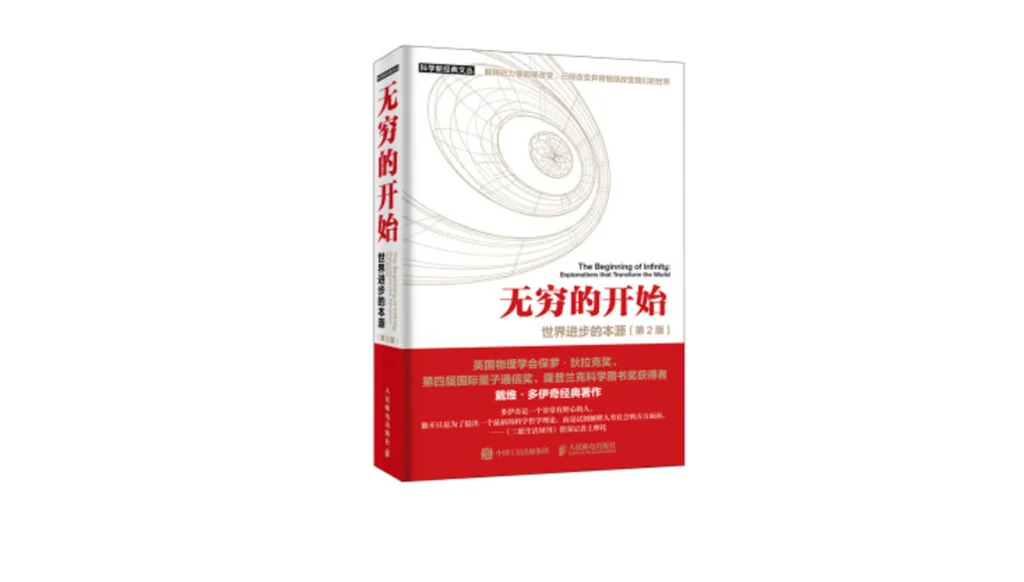
David Deutsch wrote in The Beginning of Infinity that top magicians actually do this:
When you tell the audience that you are going to perform a magic trick, never tell them what kind of trick it is. Start with the trick whose probability of success is only one in a thousand. Of course, it will almost certainly fail. At that point, immediately and without batting an eyelid, do the next trick, perhaps one with a one-percent probability of success. If that one fails too—as it usually will—gracefully and silently begin a third trick, whose probability of success may be one in ten. It is best to have a fourth trick ready as well; suppose its probability of success is fifty percent. If all four tricks fail—which generally is not very likely—perform a trick that will not leave the audience particularly impressed but is guaranteed to succeed. If you always have to rely on the final safety net to escape while performing, you are really very unlucky. But if you manage to pull off a difficult trick just once, the audience will be stunned. ‘Impossible! How could you know that this was my card?’ Aha! You didn’t know. Your clever guess, made blindly, paid off. By hiding all your ‘mistakes’ without letting them show, you have created a ‘miracle.’
Actually, Liu Qian’s ability to control the room is among the very best of Chinese-speaking magicians—and even of magicians worldwide. If the Spring Festival Gala director had given Liu Qian the freedom to use the technique above, nesting low-success-probability tricks inside high-success-probability tricks, I think Liu Qian could have quietly hidden the failure of a low-success-probability trick even on a live broadcast as high-profile as the Gala. Even if the fourth trick were the one he ultimately completed successfully, the effect might not have been any worse than the Magic Pot.
If one of the difficult tricks at the beginning happened to succeed, it would create yet another ‘moment of witnessing a miracle’ for the entire country to talk about with delight for a long time.
I feel sorry for the Spring Festival Gala, and I feel Liu Qian was treated unfairly. I recommend that everyone watch Liu Qian’s close-up magic.
Notes
- This series of short popular-science and miscellaneous essays, ‘New Findings in Psychology,’ was written at the time to accompany material related to Zhichao Wei: New Findings in Psychology. It was published on the now-shut-down platform Fantuan, and the original link no longer exists.
Leave a Reply