
Course Homepage
- Yixinli (Official) Psychology in Film: A Super-Practical Crash Course in Hardcore New Insights
- Youku (Officially Licensed) Zhichao Wei: Psychology in Film
- Ximalaya (Officially Licensed) Psychology in Film: Zhichao Wei’s Hardcore New Insights Course
Related Coverage
Course Overview
How do I watch the course after signing up?
A: After signing up, follow the Yixinli Premium Courses public account, then go to the bottom of the menu bar → My Learning → My Learning. Or download the Yixinli app and log in with your phone number (or a third-party account) to start learning.

↑↑↑
Long-press to scan the QR code and start listening to the course
If there is one field everyone should learn today, it has to be psychology.
If there is one art everyone should understand today, it has to be film.
We rebel against life in movies, then use psychology to make peace with life and achieve self-redemption.
But wait—
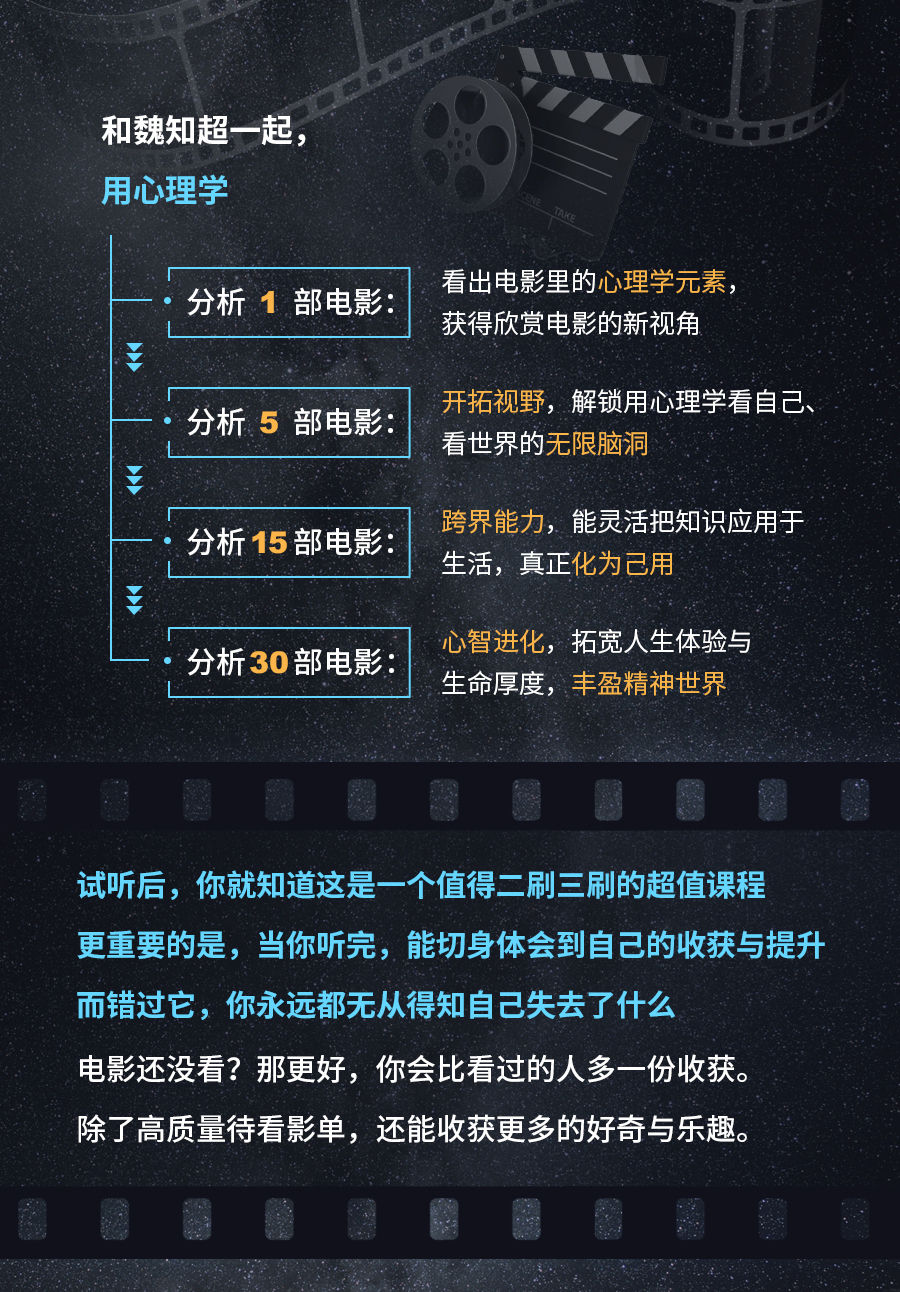
Movies can actually be watched this way?! And psychology can actually be learned this way?!
Beyond the sensory experience, use psychology to dig into the underlying logic behind characters, stories, settings, light and shadow, technology, and culture—
• Do you know what the beam of light above the characters’ heads means when the protagonists of La La Land are fully absorbed?
• Do you know why the female lead’s artistic talent exploding in Black Swan has to come with bipolar disorder?
• Do you know what psychological magic lies in the choreography of light, shadow, and color in Crouching Tiger, Hidden Dragon?
• Do you know what the tiger’s symbolic meaning is for Pi in Life of Pi?
Zhichao Wei knows all of this! But how can he?
He’s a cross-disciplinary maverick: he switched from chemistry to psychology, taught at universities for more than ten years, founded the Zhichao Wei Psychology Radio, with 5000000+ plays across the internet, and is good at spreading the latest in psychology without ever straying half a step from the field’s frontier;
He’s a seasoned film critic: from small-town kid to super-dad, he has watched more than 4000 films over several decades, bringing in cross-disciplinary thinking, using psychology to watch films and write reviews, with sharp angles and deep analysis; his series of articles have racked up more than 100 million reads, earning him countless fans in China and abroad;
He’s also a sharing enthusiast. Films and psychology have enriched his inner world and created his happy love life and harmonious family. But happiness shared is happiness doubled. He takes joy in sharing scientific psychology, growing together with everyone, and always hopes others will overtake him so he’ll have more fellow travelers on the road.






▍Q&A
Q1: Can I request a refund after purchasing the course?
A: This is a virtual product. Once purchased, it cannot be refunded.
Q2: How long can I listen to the course?
A: After signing up, you can study it repeatedly, forever and without limits.
Q3: How do I watch the course after signing up?
A: After signing up, follow the Yixinli Premium Courses public account, then go to the bottom of the menu bar → My Learning → My Learning. Or download the Yixinli Psychology app and log in with your phone number (or a third-party account) to start learning.
For more questions, ask the Whale Assistant
(Weekdays 10—19)
Who It’s For
People who aren’t satisfied with themselves and want to improve
Psychology enthusiasts and people who want to learn psychology
Psychological counselors, science communicators, and other mental-health workers
Film and TV fans who enjoy deep interpretations of screen works
People curious about human nature who seek a rich inner life
About the Instructor
Zhichao Wei
Psychology science communicator and writer
PhD in Psychology, East China Normal University
Visiting scholar, University of California, Davis (UC Davis)
Film-review expert who has watched more than 4000 films
Course Contents
Chapter 1: Harnessing the Power of Emotion
- 1. Inside Out | How should we understand the nature and functions of emotion? (trial)
- 2. John Wick | How can we make use of the positive value of anger?
- 3. Alien | How can we gain the ability to protect ourselves from fear?
- 3.1 Bonus: The right way to watch a horror film
- 3.2 Bonus: The quest for immortality in myths and legends
- 4. Iron Man | How can we turn grief into strength and grow through adversity?
- 4.1 Bonus: Iron Man, the psychopath
- 4.2 Bonus: The “Michael Jackson dance-step” method for escaping post-traumatic anxiety
- 5. La La Land | Career vs. love: on the road to happiness, what matters more?
- 5.1 Bonus: The sources of the three major paths to a sense of meaning
- 5.2 Bonus: Food for thought: What is the meaning of life, really?
- 6. The Martian | What kind of emotional attitude can improve our ability to handle things?
- 6.1 Bonus: To my dream man, Ridley Scott
- 6.2 Bonus: The power of pessimism
Chapter 2: Exploring the Personality Map
- 7. House of Cards | Cold-blooded vs. warm-hearted: which personality is more likely to succeed?
- 7.1 Bonus: How to make good use of what we know about the “personality” module
- 7.2 Bonus: What careers suit psychopaths?
- 8. The Big Bang Theory | In relationships, why are the smart ones always the ones who get hurt?
- 8.1 Bonus: Hermit geniuses and wild geniuses
- 8.2 Bonus: The Head & Shoulders effect
- 9. The Longest Day in Chang’an | What kind of talent does an elite team need?
- 9.1 Bonus: Take the test: what kind of cognitive mode do you have?
- 9.2 Bonus: Why is the “left-brain/right-brain” divide wrong?
- 10. Fight Club | How can you peacefully coexist with your A/B personalities?
- 10.1 Bonus: “Consumerism” and “decluttering”
- 10.2 Bonus: Are you an onion type or an avocado type?
- 11. Black Swan | Do all people with bipolar disorder have artistic talent?
- 11.1 Bonus: Geniuses go “crazy” in all sorts of ways
- 11.2 Bonus: Manic-depressive addicts
- 12. Black Mirror | Is the you that you think you are the real you?
- 12.1 Bonus: Folk remedies for extending your lifespan
- 12.2 Bonus: “Living in the present” is a kind of
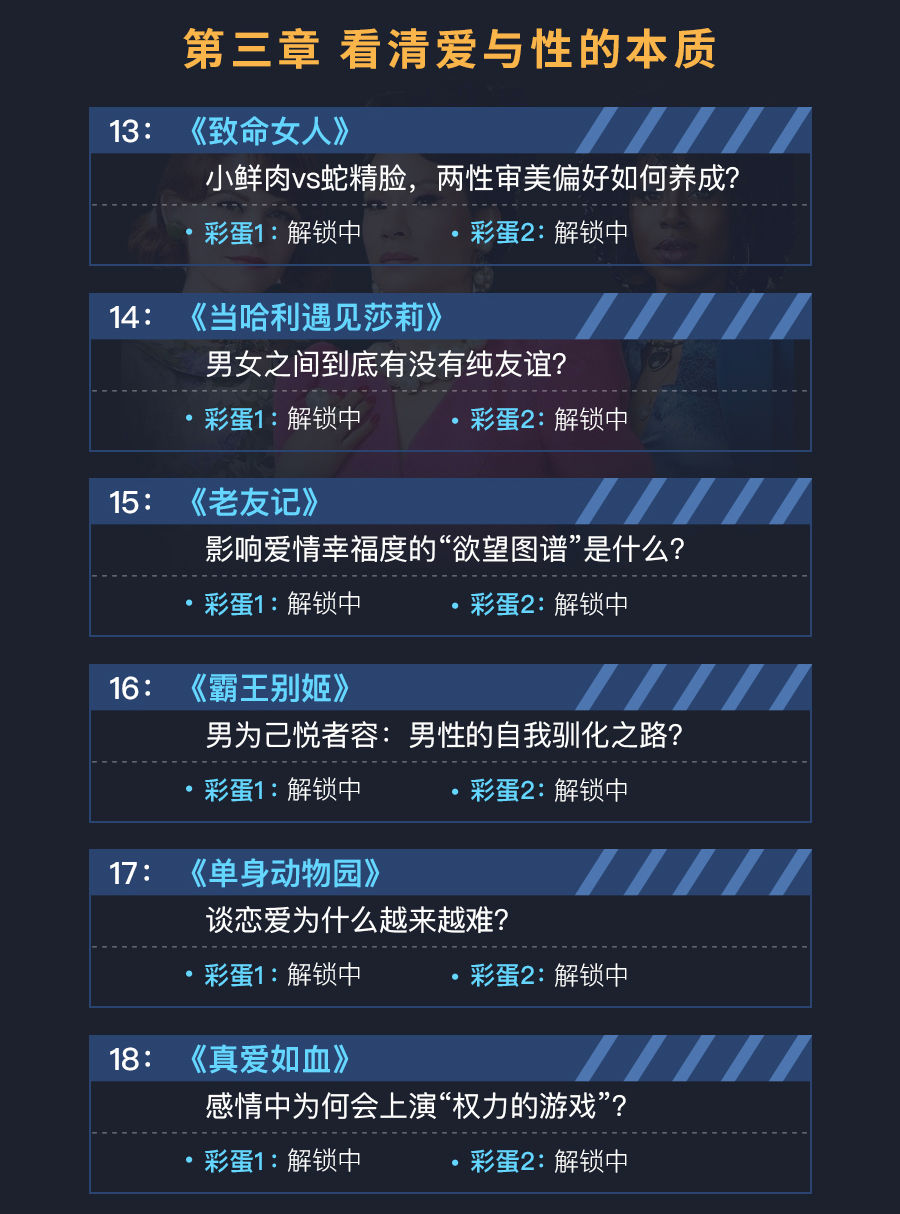
Chapter 3: Seeing the Nature of Love and Sex Clearly
- 13. Why Women Kill | Pretty-boy faces vs. snake-spirit faces: how do gendered beauty preferences develop?
- 13.1 Bonus: Is Lucy Liu beautiful or not?
- 13.2 Bonus: The audience is also a creator of “beauty”
- 14. When Harry Met Sally… | Can men and women really be just friends?
- 14.1 Bonus: What is “masculinity”? What is “femininity”?
- 14.2 Bonus 2: Does finger length affect cross-sex friendship?
- 15. Friends | What is the “desire map” that affects the happiness of a romantic relationship?
- 15.1 Bonus: Draw your desire map
- 15.2 Bonus: Maslow’s hierarchy of needs is unreliable
- 16. Farewell My Concubine | Men dress for those who appreciate them: the road to men’s self-domestication?
- 16.1 Bonus 1: Do you prefer Arnold Schwarzenegger’s muscles or Lin Dan’s?
- 16.2 Bonus: The “domestication extension hypothesis” on the origins of male homosexuality
- 17. The Lobster | Why is falling in love getting harder and harder?
- 17.1 Bonus: The laid-back era
- 17.2 Bonus: The rise of laid-back youth may have nothing to do with the internet
- 18. True Blood | Why does love turn into a “game of power”?
- 18.1 Bonus: Test your “evil quotient”
- 18.2 Bonus: People with dark personalities are better at enduring hardship
Chapter 4: Becoming Aware of Bodily Sensation
- 19. Crouching Tiger, Hidden Dragon | How are perception and thought manipulated by color?
- 19.1 Bonus: Girls like pink and boys like blue?
- 19.2 Bonus: The common theme in Ang Lee’s films
- 20. Aladdin | How does music affect emotion and social interaction?
- 20.1 Bonus: Who doesn’t like music?
- 20.2 Bonus: Why does music contain emotion?
- 21. Perfume: The Story of a Murderer | How do we interpret implicit memories in the sense of smell?
- 21.1 Bonus: Why can smell evoke emotionally saturated memories?
- 21.2 Bonus: Why aren’t there any films with smells?
- 22. Despicable Me | How does the body influence and change the mind?
- 22.1 Bonus: When we perform, what changes take place in the brain?
- 22.2 Bonus: How do actors inhabit a role?
- 23. Arrival | How can language enhance our capacity to feel emotions?
- 23.1 Bonus: An emotional granularity test
- 23.2 Bonus: Why does an ascent in intelligence have to be achieved through language?
- 24. The Devil Wears Prada | How can we improve our aesthetic ability across the board?
- 24.1 Bonus: Refuges and transparent landscapes
- 24.2 Bonus: Natural selection makes organisms converge; aesthetic selection makes organisms diverse
Chapter 5: Embarking on the Next Stage of Life
- 25. 12 Angry Men | Mastering the art and way of persuasion
- 25.1 Bonus: How does identity suppress reason?
- 25.2 Bonus: The “unorthodox play” in the art of persuasion
- 26. Frozen | Learn creativity from film
- 26.1 Bonus: Innovation is hard—harder than reaching the sky
- 26.2 Bonus: Disney and Broadway
- 27. Sherlock | How can we master the thinking skills every great detective needs?
- 27.1 Bonus: Five kinds of detectives, five kinds of detective fiction
- 27.2 Bonus: Guess who the murderer is
- 28. Castle in the Sky | Learn sustained attention from Hayao Miyazaki
- 28.1 Bonus: The Lego bricks of personality
- 28.2 Bonus: Take the test: what is your “emotional style”?
- 29. Game of Thrones | Use psychology to unlock the master key to appreciating art
- 29.1 Bonus: The fates of the characters in A Song of Ice and Fire
- 29.2 Bonus: James Potter’s sacrifice (sacrificed himself for nothing)
- 30. Life of Pi | How can we awaken the divine and resist worldly hardship?
- 30.1 Bonus: Three moral laws
- 30.2 Bonus: “Divine happiness” and “worldly happiness”
- Psychological science fiction novel Blindsight: A 10,000-word deep dive | Ximalaya Book Club 01
- [Bonus] Blindsight: Peering into the ultimate nature of consciousness through a science-fiction novel | A bonus segment from episode 0613 of my Ximalaya Book Club
- Crime novel Psychological Crime (Xinli Zui): A 10,000-word deep dive | Ximalaya Book Club 02
- Essential psychology book Evolutionary Psychology: A 10,000-word deep dive | Ximalaya Book Club 03
- Sociology classic Cold Violence (Leng Baoli): A 10,000-word deep dive | Ximalaya Book Club 03
Leave a Reply