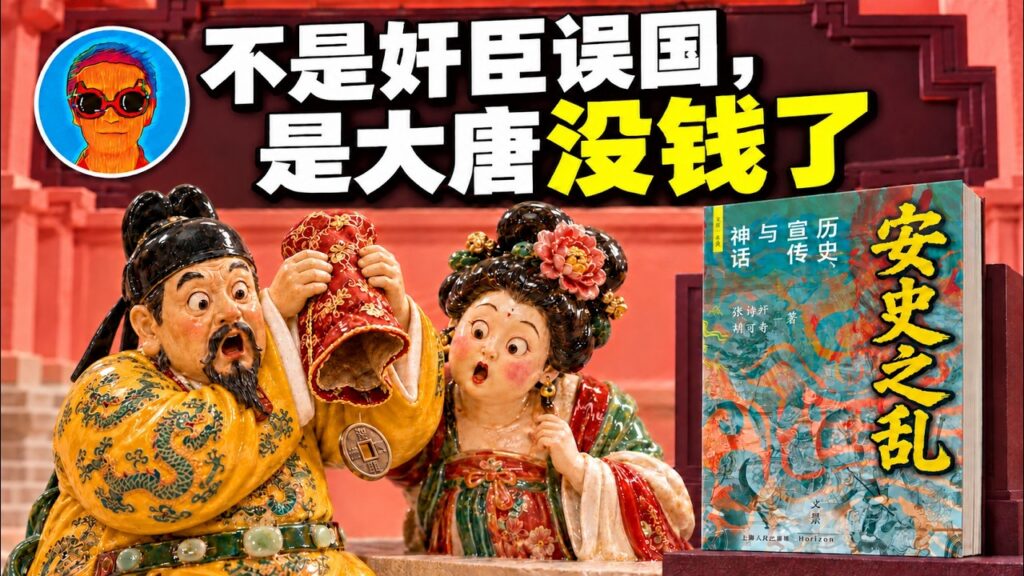
What this episode is about
The muddle-headed emperor, the treacherous chancellor and the eunuchs who’ve been cursed for over a thousand years may have just taken the blame for a ledger that had run dry. This episode covers The An Lushan Rebellion: History, Propaganda and Myth by Zhang Shiping and Hu Keqi. The book doesn’t tell the story of the rebellion as loyalists versus traitors or good versus evil. It asks two questions instead: where was the money? And where was the grain?
The Tang dynasty’s political center was in Guanzhong, but its money and grain were in the Jiangnan region down south. The only link between them was a grain-transport lifeline running from Jiangnan up the Grand Canal to Luoyang, then through the Sanmen Gorge and into Tong Pass. Once An Lushan took Luoyang and cut the canal, every key decision the Tang court made came back to that line. The army at Tong Pass was about to run out of food and the court didn’t trust its general Geshu Han, so Emperor Xuanzong had no choice but to force him out of the pass for one big gamble. Emperor Suzong had only enough money and grain to keep a 100,000-strong army fighting for six or seven months, so he borrowed Uyghur troops to retake the two capitals fast, rather than risk Li Mi’s long-game plan of mobile warfare. The war shrank the number of taxpayers the court could reach from about 8.2 million before the war to roughly 2.37 million, so the army that had retaken the capitals had to sit still for almost a year. Diwu Qi minted the “double-rim Qianyuan coin,” worth fifty ordinary coins, to borrow time from the future—but within two months the price of rice in Chang’an shot up to 70,000 coins a picul, the central treasury went completely bankrupt, and power had to be handed to the regional military governors. In the end, the money Yuan Zai squeezed out of Jiangnan was only enough for two or three more months of fighting, so Emperor Daizong traded nominal suzerainty for peace and recognized the four Hebei garrisons.
So why is the story we all know a different one? The last part of the episode is about the book’s subtitle, “propaganda and myth.” When Suzong crowned himself at Lingwu, he needed to prove that Xuanzong’s reign was all bad emperor and evil ministers. When Daizong took the throne and settled scores with the previous reign, he slapped the same script onto Suzong. And by the Song dynasty, Sima Guang’s Comprehensive Mirror in Aid of Governance had set this propaganda in stone as a moral textbook.
Highlights
- The grain-transport lifeline: why Chang’an’s lifeblood was in the hands of Jiangnan’s grain boats, and why Emperor Xuanzong had to take the entire court to Luoyang just to eat
- The Battle of Tong Pass revisited: with the front line running out of food and Geshu Han hoarding troops, why forcing him out of the pass was the only bet the court had
- The big-coin collapse of 759: Diwu Qi’s plan to borrow time from the future, and the “financial sniping” by regional warlords the authors suspect
- Why even winning meant recognizing the four Hebei garrisons: how a fiscal collapse gave birth to the warlord regimes of the mid-to-late Tang
- Where the loyalists-and-traitors story came from: how the political propaganda of Suzong and Daizong hardened into history through the Comprehensive Mirror
Jump to a section
- 00:00 Opening: the An Lushan Rebellion painted as an opera mask
- 02:12 The grain-transport lifeline: the Tang empire’s fatal weak spot
- 04:16 Why An Lushan’s call found so many followers: Hebei’s long-pent-up resentment
- 08:27 Turning point 1: the Battle of Tong Pass—why the court insisted on forcing Geshu Han out
- 12:08 Turning point 2: borrowing Uyghur troops to retake the capitals, a six-to-seven-month countdown
- 16:07 Turning point 3: after retaking the capitals, the Tang went broke
- 19:14 Turning point 4: the big-coin collapse of 759 and the warlords’ “financial sniping”
- 25:11 The rebel Yan state went broke too: Shi Siming killed by his own men
- 26:17 The final stretch: why recognizing the four Hebei garrisons was the only option
- 28:49 Where the loyalists-and-traitors story came from: two emperors’ political propaganda
- 31:54 Closing: what held up the empire wasn’t loyalty, it was grain boats
The book
- Title: The An Lushan Rebellion: History, Propaganda and Myth
- Author: Zhang Shiping, Hu Keqi
- Publisher: Shanghai People’s Publishing House
- Publication date: 2025-08
- ISBN: 9787208192294
Leave a Reply