 ▶
▶
The full talk is in the Feifan series on Fanshu, a Chinese audiobook app; this page is only a summary.
What This Episode Is About
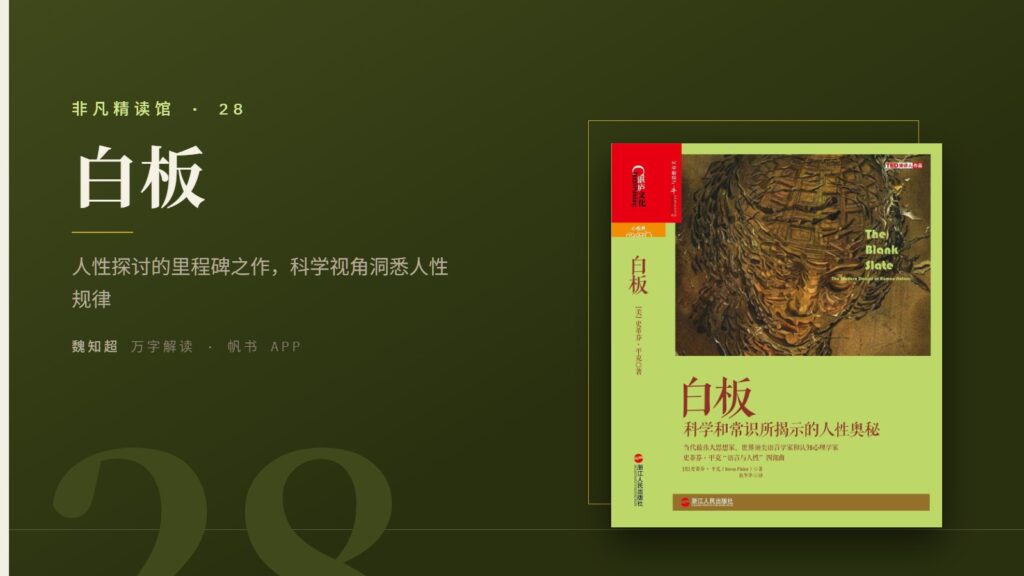
More than 300 years ago, British Enlightenment philosopher John Locke put forward an idea that changed the world: the blank slate theory—that the human mind is born like a blank board, and all our ideas and dispositions come from the scribbling and painting of later experience on that blank slate.
The blank slate theory sounds like a beautiful promise. If everyone is born as a blank slate, then everyone is born equal; if our ideas and dispositions are shaped after birth, then all we have to do is perfect society’s environment and we can create perfect people. You could even say the blank slate theory is a theoretical cornerstone of individualist culture and, by extension, modern society.
But from a scientific perspective, is the human mind really a blank slate? Why do we sigh that human nature is hard to defy, and that old habits die hard?
Drawing on research in cross-cultural studies, evolutionary psychology, behavioral genetics, and cognitive neuroscience, the author of this book sketches an evidence-based scientific view of human nature. He rejects both romanticizing and denigrating human nature: use scientific thinking to understand it, work to change what is malleable, and go with the flow where it is hard to defy.
You Will Hear
- Is human nature fundamentally good or evil? Understanding human nature from a scientific perspective
- Nature or nurture? What, exactly, shapes human nature?
- How to steer human nature and live a happier, clearer life
Quotes from This Episode
The human mind is a product of a long evolutionary history. The principle of “survival of the fittest” shaped not only our bodies, but our minds as well.
The human mind is neither a “blank slate” to be scribbled on at will, nor an unchanging “stone tablet.” We should work to change what is malleable, and go with the flow where it is hard to defy.
Admitting that people are born different does not amount to defending inequality or discrimination, because equality is a moral claim, not a statement of fact.
Children learn behavioral norms and culture mostly from their peers. Parents’ basic responsibility is not to shape their children’s personalities, but to provide a safe, secure, and loving environment.
About the Author
Steven Pinker Named one of Time magazine’s 100 most influential people in the world and twice named one of the world’s leading thinkers by Foreign Policy magazine. In 2021, according to calculations by a U.S. academic-impact website, Pinker ranked as the world’s second most influential psychologist from 2010 to 2020.
Leave a Reply