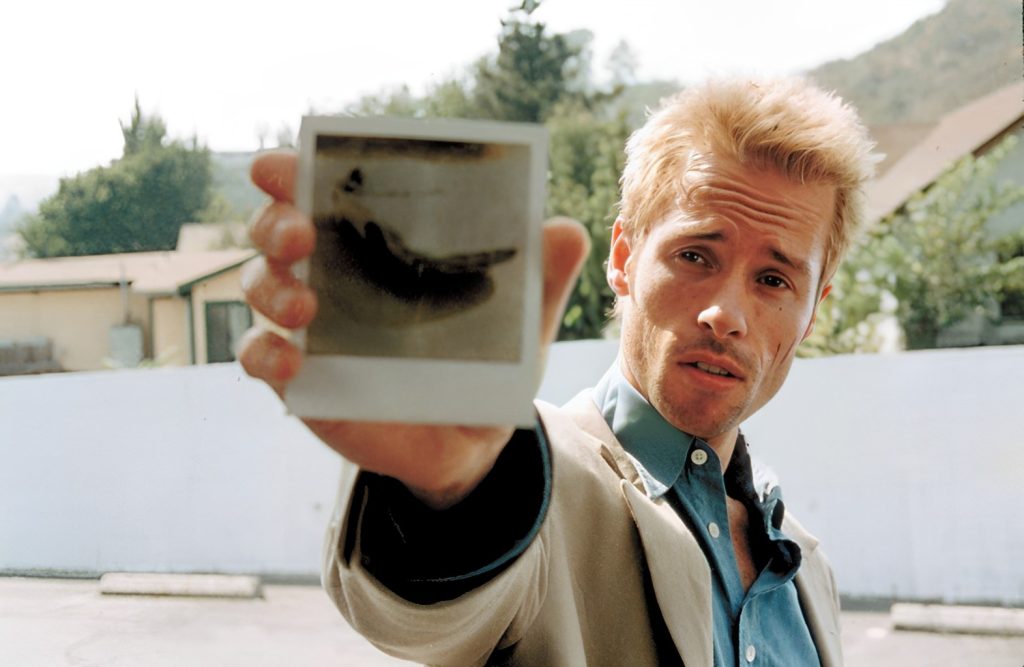
Some of the inspiration for *Memento* probably came from psychological and neuroscience research on memory. Knowing a little about this subject can help us understand several key scenes in *Memento*. So I’ve divided this article into two parts: Part 1 looks at the psychological inspirations behind *Memento*, and Part 2 interprets the plot.
PART 1: Psychological Inspirations—The Two Major Features of Memory
In the history of research on memory, one participant entered the annals of science because of his rare and severe amnesia. His name was Henry Molaison. It was not until after his death that the general public learned his real name. In the many papers and books that mentioned him before then, he was referred to as H.M. to protect his privacy.
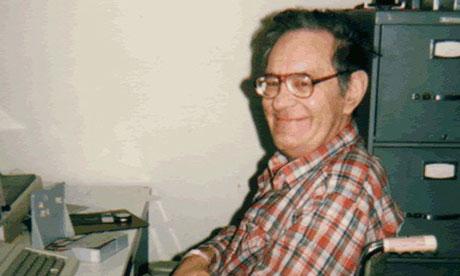
H.M. was born in 1926. He developed epilepsy after an accident in childhood. By the time he was 27, the seizures had become so severe that he could barely do anything. Research suggested that a part of his brain called the hippocampus was involved in his seizures. After medication failed completely, H.M. hoped to find a doctor who would remove his hippocampus and cure the epilepsy. This was an era when our understanding of brain function was still extremely rudimentary, but one doctor, apparently fearless in the face of malpractice—ignorance really is confidence—actually agreed to operate. He performed a craniotomy on H.M. and used a small tube to suction out the hippocampus and surrounding brain tissue.
The operation greatly improved H.M.’s epilepsy. But it came with enormous side effects: H.M. lost roughly the previous 10 years of his memory. Worse still, from then on he could retain new information for no more than 20 seconds—he could no longer form new memories. Scientists later learned that the hippocampus is the brain tissue most closely associated with memory, so much of H.M.’s memory function had been completely wrecked. His brain seemed to have frozen permanently on the day of the operation. For the latter half of his life, H.M. lived mostly in hospitals and care facilities. Every day, he had to introduce himself to doctors and nurses over and over, even though they had actually been looking after him for a very long time.
At first, the scientists and doctors studying H.M. thought he could not form any new memories. But they discovered that this was not true. One doctor conducted a small experiment with him: he slipped a prank device that simulated an electric shock—a joy buzzer—onto the inside of his finger, then shook H.M.’s hand at intervals. During the first few attempts, H.M. seemed not to remember having shaken hands with the doctor, so he was “shocked” every time. But strangely, after several repetitions, H.M. suddenly refused to shake hands—although he did not remember meeting the doctor and could not explain why he refused.
This little experiment showed that H.M. had not lost all his memory. Later, extensive psychological and neuroscience research confirmed that human memory actually comes in many different types. For example, memory can at least be divided into two levels: at the conscious level, people with amnesia cannot form new memories, while at the unconscious level, they can still retain impressions of experiences. H.M. could not form new conscious memories—he did not recognize the doctor—but his unconscious memory remained intact, allowing him to develop a new behavioral habit: being afraid to shake hands. Later neuroscience research found that this kind of unconscious memory, related to behavioral habits, is largely associated with another brain structure, the basal ganglia. So although H.M.’s intact basal ganglia could not help him form new memories consciously, his body could still learn all kinds of new behavioral habits.
This is the first major feature of memory: Different types of memory are often separate; when one breaks down, it does not necessarily take the others with it.
To understand *Memento* better, there is another feature we need to know about: The contents of memory are not necessarily true. Sometimes you remember things you never actually experienced.
In the 1990s, a highly sensational case took place in the United States. In 1990, Eileen Franklin accused her father, George Franklin, of raping and murdering her friend more than twenty years earlier. Eileen claimed that she had witnessed the murder with her own eyes. She said the reason she had waited more than two decades to report it was that the memory had been so horrific that her psychological defenses had repressed it into the deepest recesses of consciousness. It was only during psychotherapy as an adult that this innermost memory was awakened. The jury completely believed Eileen’s testimony, and George Franklin was convicted of first-degree murder.
But is “repressed childhood memory” really reliable? At least Freud and his followers thought so. In Freud’s theory of psychoanalysis, there is an important concept called “repression.” Freud believed that, to protect our present feelings and reduce anxiety, we may repress painful memories. On the surface, we seem to forget them, but certain cues may bring them back. Many therapists therefore believed that hypnosis and other suggestive therapies could recover traumatic childhood memories. For a time, memories recovered under hypnosis were even treated as credible evidence in American legal proceedings. Besides the bizarre case mentioned above, there were quite a few other strange cases in which adults suddenly recalled during therapy that their parents had abused them in childhood, and then brought charges against those parents.
But later research found that the authenticity and accuracy of these “reawakened” memories were highly questionable. Hypnosis in psychotherapy not only fails to improve the accuracy of memory retrieval; it can also produce false memories. In fact, during hypnosis, therapists may deliberately or inadvertently lead patients, making them more likely to construct memories from their own imaginations. Psychologist Schacter argued that hypnosis makes people more prone than usual to treat inner experiences as memories, and to feel extremely confident about these false memories, to the point of confusing reality with imagination. More and more researchers believe that so-called “repressed childhood memories,” even if they exist, are extremely rare.
Based on this new research evidence, the Franklin case was finally overturned in 1996. After that, people became increasingly cautious about using memories recovered in psychotherapy as legal evidence. After all, who can guarantee that these “recovered” memories are not the person’s own imagination? They may well be nothing more than constructed false memories.
PART 2: The Journey in Pursuit of a Phantom—A Confession from *Memento*
With those two “theoretical foundations” in place, I can try interpreting the plot of *Memento*. Here’s a thought experiment I came up with: if Leonard, the protagonist of *Memento*, recovered his memory years later, how would he describe what happened in the film? What follows is a confession I wrote in Leonard’s voice. Naturally, it does not consist entirely of information presented directly in the film; mixed in are my own analyses of the plot.
Many years later, I recovered my memory. This is my confession—
My name is Leonard. My wife liked to call me Lenny, though I didn’t like other people calling me that. To this day, I can recall the happy times I spent with my wife. They are only scattered fragments of memory, but when I piece those fragments together, I feel as if she has returned to my side. Those fragments are enough to make me feel how much I miss her—and enough to tell me how much I hate the murderer who took all of this away.
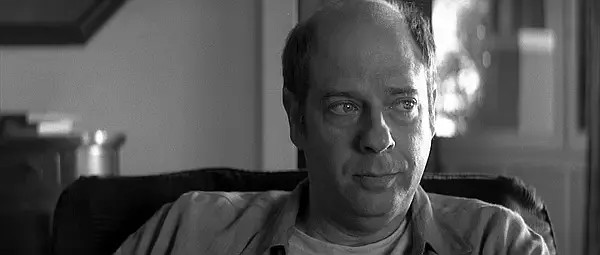
Before that calamity, I was an insurance company employee. My job was to investigate insurance fraud for the company. I was good at it because I was good at spotting lies. The biggest challenge of my career was the case of Sammy Jankis. Sammy suffered minor injuries in a car accident, but afterward he could no longer form new memories; every experience after the accident lasted only a few minutes in his mind. I knew the condition was called “anterograde amnesia.” Some people who suffer brain injuries can develop it, but it is extremely rare. Sammy underwent brain imaging, but the results showed no obvious brain damage. My instincts told me he was just a con artist faking an illness to collect insurance. I started spending time with Sammy, but simply watching his words and expressions, I could find almost no evidence that he was faking. How could I make such a masterful old fox slip up?
I remembered reading a case report by the Swiss physician Claparède (note: this case report was extremely similar to the little experiment conducted on H.M.; there are several other similar reports in history). Claparède described a female amnesia patient who, from the onset of her illness, could not remember where she had spent the previous five years, or even remember the name of the doctor treating her every day. One time, Claparède hid a needle between his fingers, reached toward the patient’s hand, and pricked her. Her hand recoiled reflexively, but she soon forgot what had happened. A short while later, when Claparède moved his hand toward her again, he found that she instinctively pulled her hand back. Asked why, she said she didn’t know. Pressed to explain, she said, “Sometimes there’s a needle hidden in people’s hands.” This case gave me a major insight: human memory has two levels. At the conscious level, people with amnesia cannot form new memories; at the unconscious level, they can still retain impressions of experience. Although they cannot directly retrieve these impressions, the impressions can influence their behavioral responses. In other words, forgetting is sometimes a mind-body split—and Sammy Jankis may not have understood that.
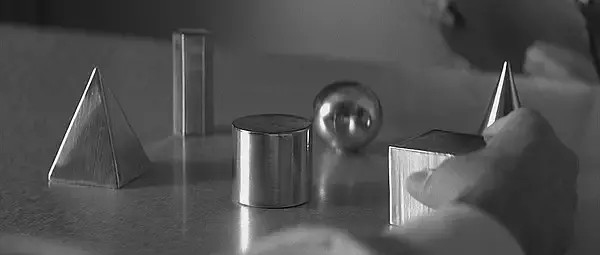
I decided to have Sammy undergo a test at the hospital. We placed several metal objects in front of him and asked him to pick up one according to our instructions. One of the objects was electrified. Sammy picked it up, got shocked, and became furious, but he seemed to forget the incident almost immediately. Some time later, we had him repeat the same test. If Sammy really had amnesia, he would refuse to pick up the electrified object, like Claparède’s patient: although his conscious mind did not remember, the impression of being shocked would stop his body from picking it up. But in fact, Sammy once again picked it up with apparently no hesitation, got shocked again, and became furious again. Sure enough, Sammy did not know that different levels of memory could split apart. He thought forgetting meant forgetting completely, so he overplayed his performance. That was how I caught the fox by the tail. Sammy’s fraud was exposed, and I won that battle hands down. Little did I know then that Sammy would one day merge with me.
The incident happened not long after the Sammy case. That night, two petty criminals broke into my home. They thought only my wife was there, and they brutally raped her. I woke up and shot one of them dead, but the other struck me in the head. Maybe it was fate: from that moment on, I became the person Sammy Jankis had tried so hard to play—the brain injury turned me into a genuine amnesiac, unable to form any new memories ever again. Although my wife recovered from the incident faster than I did, I still swore to avenge both of us. The police did not believe there had been a second attacker. They would not trust the testimony of an amnesiac, even when I told them my memories from before the incident were completely intact. Only one policeman believed me. He said his name was Teddy. He helped me get the police case files, giving me a chance to investigate the killer myself.

I had no memory. I did not know where I was, and I could not even feel time passing. How was someone like me supposed to get revenge? The attacker had taken away my ability to survive, so I needed a ‘system’ that would keep me going. I began tattooing the key clues I uncovered onto my body. I took Polaroids constantly, so I could remind myself where I was and whether the people around me were friends or enemies. Soon my body was covered in tattoos. But I deliberately left a blank space over my left chest, waiting for the day I killed the attacker so I could tattoo my victory declaration there.
Revenge went much more smoothly than I had expected. Teddy and I soon discovered that the killer’s name began with John G., and we followed that clue to the bastard. I killed him. The pleasure of having my great revenge filled my whole body. I pointed to my left chest and had Teddy take a photo commemorating my successful revenge. I tattooed ‘I’ve done it’ over my left chest, reminding myself that the mission was complete and it was time to return to my wife.
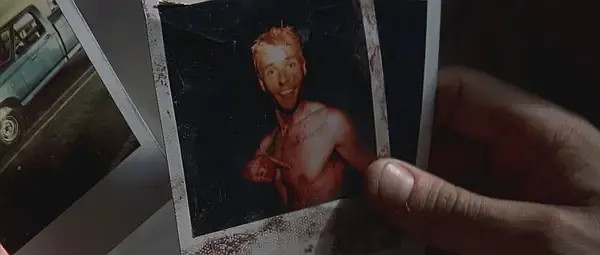

My wife did not believe that my memory would never recover. She tried every method she could think of to make me better—hiding all the food, for example, and forcing me to remember where she had put it, or else go hungry. Unfortunately, it was all useless. She kept hoping it was entirely psychological, that there had to be some way to make me suddenly recover. She did not want the monster standing in front of her, with no past and no future. She wanted the me from the past to come back to her.
At the time, I had absolutely no idea that my wife was sinking deeper and deeper into despair. I was oblivious to time, so I had no way to catch the subtle changes in the emotions of the people around me—even when that person was the one I loved most. My wife decided to stake her own life on one final gamble, hoping that my love for her would awaken my memory. She had diabetes, and I injected her with insulin every day. That day, she asked me to inject her three times in succession. It was a lethal dose. She thought that if I still loved her, if I still cared about her life, I would surely realize something and stop. But I had no memory of any of the previous injections. And so she watched helplessly as I killed her with my own hands.

After my wife died, I seemed to feel neither grief nor pain, because it did not take long for me to forget that she had died. From then on, I lived permanently in a care facility. The past was a blank, and the future no longer meant anything. I became a prisoner of the ‘present,’ a walking corpse.
But I could not accept it. I knew that, just as Claparède’s patient was afraid of being pricked by a needle, all of this from the past must have left something behind in my brain. Now and then, scattered memories of the days I had spent with my wife would float before my eyes like fragments. But what I felt inside was no longer warmth; it was an indescribable guilt and sorrow. I knew that somewhere deep in my unconscious, I actually remembered that I had killed my wife myself. But I refused to believe it. I would not accept this brutal reality. It was not me—John G. killed her! I was not some freak with no past and no future. I did not want to become a lost soul wandering the world. I wanted my life back.
I remembered some other material I had seen while investigating the Sammy Jankis case. It told me that memory not only has different layers, but can also be fabricated. People have plenty of false memories. Psychologists once conducted an experiment like this (note: this is another classic study of false memory): every week, they asked children, ‘Do you remember getting lost in a shopping mall?’ Although the children had never been lost in a mall, being asked the question repeatedly led them to construct a memory of getting lost around it. A few weeks later, when the psychologists asked again, the children actually ‘remembered’ getting lost and even described all sorts of details vividly.
If you keep constructing something in your mind, it may turn a lie into the truth and eventually become a real memory. For me, Sammy was the perfect raw material for constructing a false memory. In my unconscious, I grafted my own experience onto Sammy, telling myself this constructed fantasy over and over until I believed the falsehood was true. I succeeded. Later, I genuinely believed that Sammy had accidentally killed his wife because of amnesia, and that my wife had died at the hands of John G.
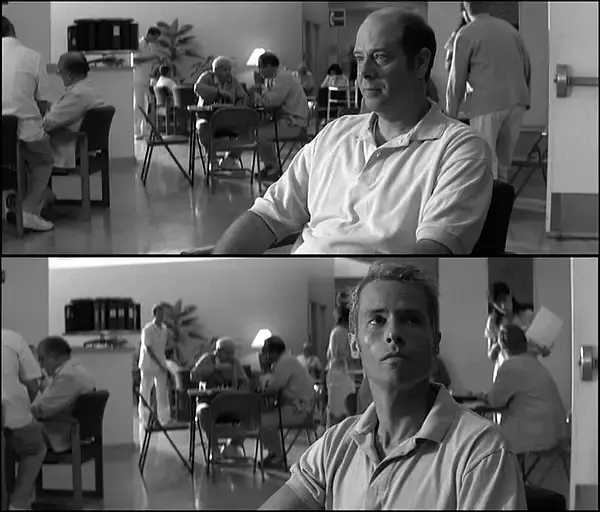
This not only freed me from the guilt, buried in my unconscious, of killing my wife; more importantly, it gave my life meaning again. Revenge—that was my reason to keep living. I freed myself from the prison of the ‘present.’ I erased the ‘I’ve done it’ tattoo from my chest, tore out the 12 pages of the police file Teddy had given me, blacked out what remained, and created an unsolvable mystery for myself. Chasing its answer became the entire meaning of my life.

I teamed up with Teddy again. He had helped me, but he was hardly a good cop; pocketing dirty money was how he made a living. Teddy saw everything clearly: ‘You’re looking for revenge, right? Fine. I’ll create an enemy for you to kill.’ He packaged his target as John G., until the answer to my imaginary mystery seemed to emerge. He got rich, while I thought I had taken revenge. In a sense, we were practically the perfect partners.
After that, Teddy revealed everything to me: Sammy had no wife, and it was actually my wife who had diabetes. For a moment, the world I had painstakingly constructed seemed to collapse all over again. What I had been chasing turned out to be nothing but an illusion that did not exist. But no—I could not accept it. I wanted to believe the world was not something I had imagined. I wanted to believe that what I did still had meaning, even if I could not remember what I had done.
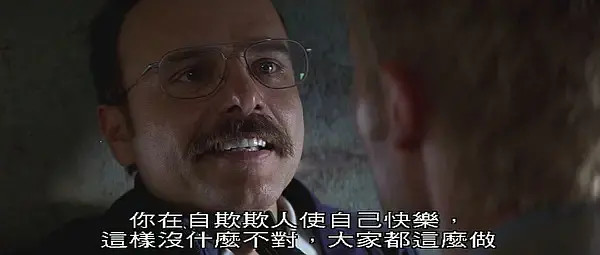
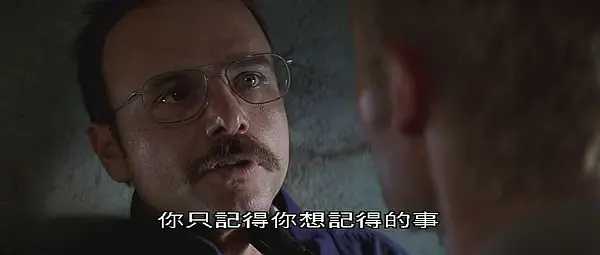
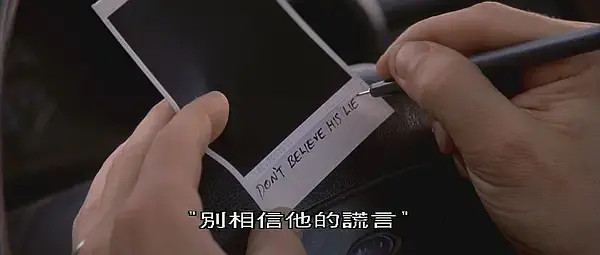
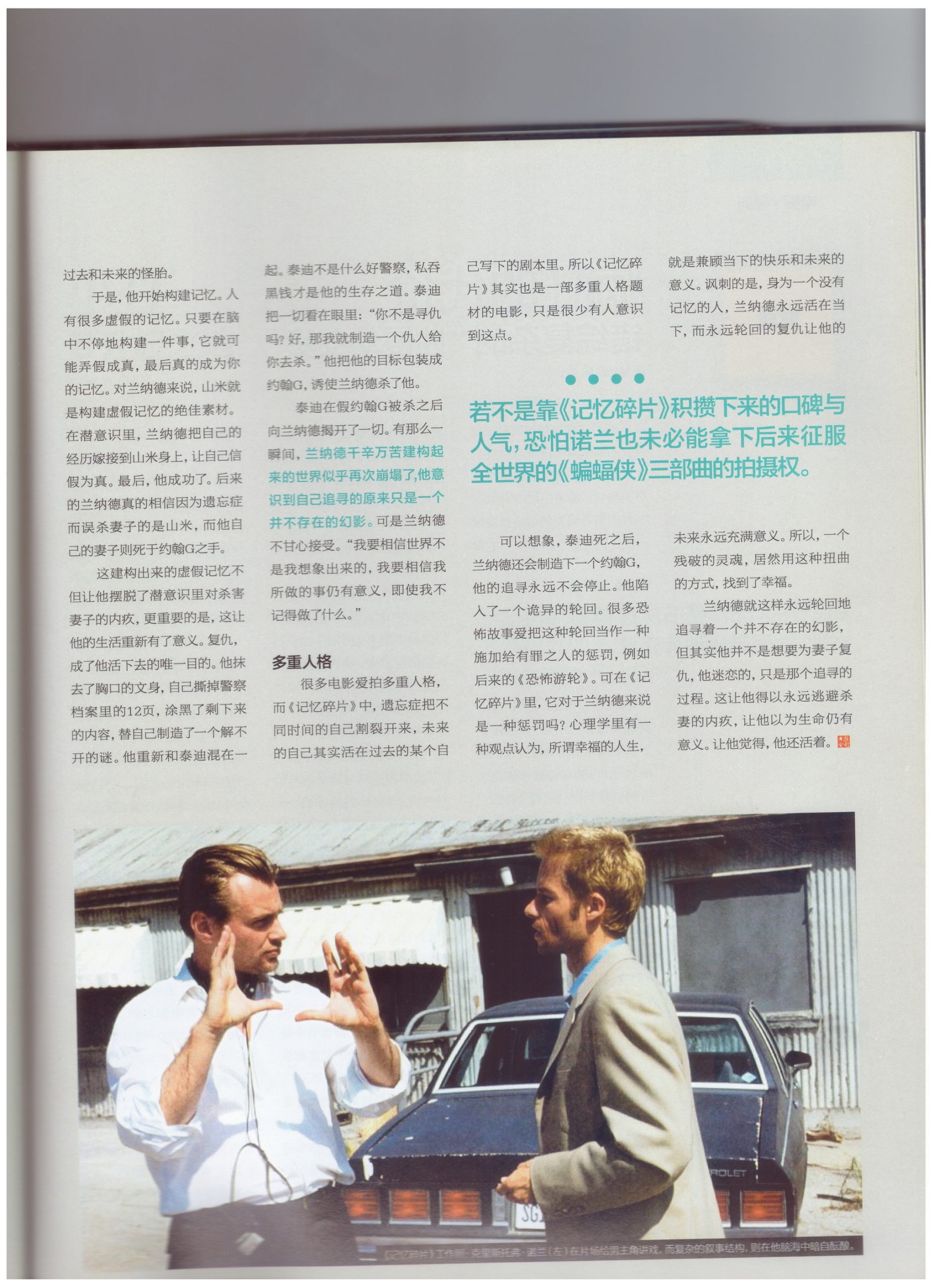
The worst thing Teddy could have done was tell me his real name was John Gammell. So he could be a John G. too. There are far too many John G.s in the world waiting for me to hunt them down, so my illusion would never be destroyed. And Teddy was the next one. I wrote ‘Don’t believe his lies’ on the back of Teddy’s photo, and tattooed his license plate on my body as the identifying mark of John G. You could say that the me of that time had laid a trap for the me who came later. The trap step by step lured my future self into discovering the ‘truth’ that Teddy was John G. Lots of movies like to make multiple personalities their subject; in those films, two souls can live in one body at the same time. Looking back now, amnesia split the me of different times apart from one another. The future me was actually living inside a script written by some past version of me. You could call that another kind of multiple personality.
After Teddy died, there was the next John G., and after that, another… There would always be more John G.s in the world who had not yet been killed, and my search would therefore never stop. I fell into a bizarre cycle. Many horror stories like to treat this kind of cycle as a punishment imposed on the guilty. But was it a punishment for me? I remember a book saying that a happy life means balancing the pleasure of the present with meaning in the future. The irony was that, as a man without memory, I lived forever in the present, while my endlessly recurring revenge kept my future forever full of meaning. Seen that way, was I actually a happy man back then? Yes—a broken soul had found happiness by twisting life into this strange shape.
I want to confess to my wife: in those days, I frantically chased an illusion that did not exist. But the truth is, I was not trying to avenge you. What I was addicted to was the process of searching, because it gave my life meaning again. Everything I did was only for myself.
That illusion that did not exist made me feel that I was still alive.
Version History
A revised version of the second half of this article was published in Popular Cinema:





Leave a Reply