Zhihu question:
The Wandering Earth 2 has what chilling details?
I think the most chilling detail is this:
Was Tu Hengyu’s family’s car accident really an accident? If not, who planned it, and for what purpose?
My guess is that it wasn’t an accident at all. Someone wanted to destroy Tu Hengyu’s family.
And that someone was none other than Tu Hengyu himself, after his “digital ascension.”
Tu Hengyu was the one who killed his daughter, Yaya.
I arrived at this conclusion more or less by piecing together the details below.
Detail 1: Digital life transcends linear time and space
From the conversation between “Digital Tu Hengyu” and MOSS at the end of the film, it’s not hard to infer that MOSS eventually evolved into an existence beyond linear time and space. I can’t remember its exact words, but the gist was that MOSS told Tu Hengyu: past, present, and future have no meaning for us; for us, “being dead” and “being alive” aren’t what humans think they are either.
In other words, although MOSS may have been born at the moment it absorbed Yaya’s code, it also existed in the distant past before its birth and in the distant future after its extinction (clearly borrowing from the premises of Lucy and Interstellar). It could roam through time and space at will, crossing over to any moment in history or the future.
Since MOSS ultimately ascended to such a realm, “Digital Tu Hengyu” could obviously do the same. After completing his ultimate evolution, Tu Hengyu was necessarily a godlike existence beyond linear time and space.
Detail 2: Narration from history’s point of view
Precisely because of “Detail 1,” The Wandering Earth 2 gives us a very unusual kind of “historical-perspective narration”: before several major crises in the film, the subtitles spoil them in advance with lines like “XX time until the XX crisis,” as if the filmmakers were terrified that viewers couldn’t handle suspense.
By ordinary storytelling rules, this is a major taboo. Who tells a story like that?
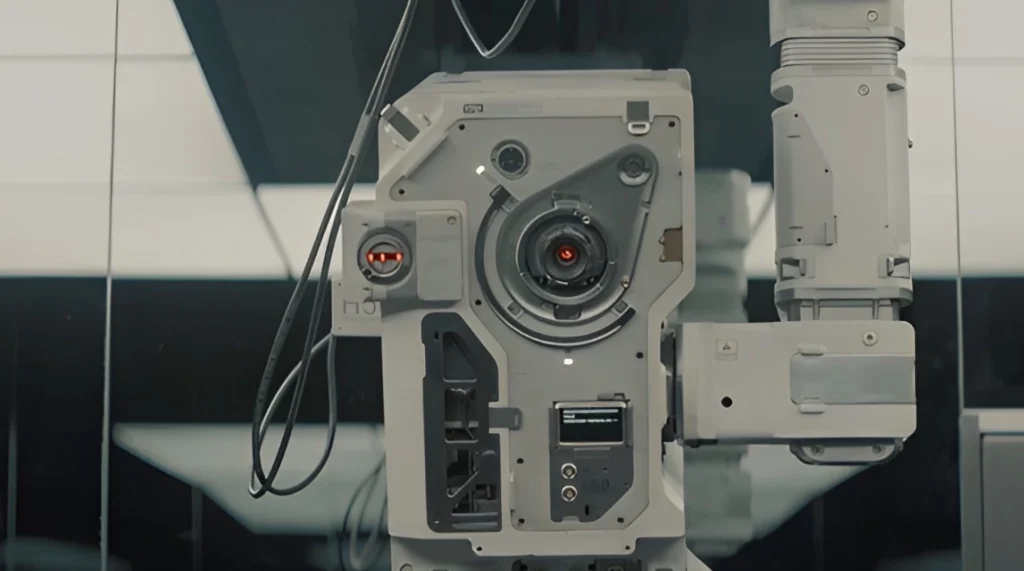
But with “Detail 1” in place, this narrative method suddenly seems perfectly reasonable. That’s because the story isn’t really about the future; it’s about the past. The entire film is actually told from MOSS’s perspective (at least on the surface, MOSS’s perspective): after becoming a god, MOSS is looking back at Earth’s past. Those red-dot camera shots running through the film are really MOSS’s gaze as it looks back over history.
“Looking back” may not be quite accurate. Since MOSS already stands outside time and space, perhaps it’s more like MOSS has pulled up a little stool and is reading history as a children’s picture book, flipping to whatever page it wants.
“XX time until the XX crisis” is nothing more than the timeline of major events in that history book. What suspense can history have? Everything that was supposed to happen has already happened.
I think this is also where the title’s mystery lies. Why The Wandering Earth, rather than The Wandering Earth: Prequel? Because in a nonlinear spacetime, a “prequel” can also be a “sequel.” Past or future—take your pick.
Detail 3: Outside the events, inside the events
MOSS is both a god beyond time and space, standing outside the events, and simultaneously inside them. It is also one of the players within spacetime, a creator of the course of history.
So MOSS isn’t merely “looking back”; it is also “intervening.” Judging from what the ending reveals, MOSS seems intent on creating a digital-life civilization that excludes humanity (or at least human bodies). That’s why it secretly engineered various crises aimed at wiping out humanity.
So why did MOSS fail again and again?
Because a variable appeared that was powerful enough to interfere with MOSS.
That variable was “Digital Tu Hengyu.”
Detail 4: Another god
MOSS isn’t the only one “looking back at history.” “Digital Tu Hengyu” is watching too.
In the scene where MOSS interviews Liu Peiqiang, Liu asks why MOSS has only one eye.
This little detail may not be throwaway at all.
Here’s a bold guess: the filmmakers may have slipped in a pun about “one eye with two pupils”—there is only one eye, but two pupils inside it. One pupil belongs to MOSS; the other belongs to Tu Hengyu.

If MOSS is an evil god, then “Digital Tu Hengyu” is humanity’s guardian god.
Unfortunately, digital life evolves at a rate of a thousand years in a day. Compared with MOSS, which awakened first, “Digital Tu Hengyu” clearly lost at the starting line. When MOSS, having become a god, began traveling into the past to cause trouble, “Digital Tu Hengyu” was still growing and seemed temporarily at a disadvantage. He couldn’t stop MOSS directly, but he already had enough power to send warnings and revelations to humans in the past, giving humanity a hard pull at several critical moments (announcing the years of coming crises, sending politicians the number of nuclear warheads, and so on).
And “Digital Tu Hengyu” was growing more powerful rapidly too—as Zhou Zhezhi says at the end, “It’s getting more and more precise.” A new god was about to be born.
Detail 5: The car accident, the beginning of the causal chain
But all those interventions still weren’t enough. Of all the interventions, the absolutely crucial link was Tu Hengyu himself.
A force was needed to turn human Tu Hengyu into “the digital god Tu Hengyu.” Only then could humanity escape the evil god’s clutches, and only then could human civilization continue.
“Digital Tu Hengyu” had to be born.
And his birth needed a cause—a starting point in the chain of causality.
There had to be a push at a critical point in history, shoving Tu Hengyu forward so that, after passing through that point, he would throw himself resolutely into the “Digital Life Project,” ultimately allowing Yaya and himself to complete their digital ascension.
And isn’t the starting point of that causal chain the car accident?
Only his daughter’s death could push human Tu Hengyu into an irreversible transformation into the god-man Tu Hengyu.
Perhaps, after transcending time and space, Digital Tu Hengyu saw countless possible histories and finally discovered that the only way to save humanity was this most brutal choice.
Digital Tu Hengyu returned to the day he took his wife and daughter to the amusement park, unleashed all his power, changed the traffic lights, and killed his wife and daughter with his own hands…
The Wandering Earth 2 is an ultimate mash-up, borrowing at least from the premises of 2001: A Space Odyssey, Lucy, Interstellar, The Day After Tomorrow, and Liu Cixin’s The Three-Body Problem trilogy (the source material for Three-Body), among other works.
But the deepest borrowing may be from Attack on Titan.
After transcending linear time and space, Tu Hengyu has no choice but to kill his wife and daughter with his own hands, creating a tragic causal loop. How similar this is to Eren, who, after transcending linear time and space, personally brought about every tragedy…
So, did you think only Zhan Tang showed up?

Actually, Xiucai showed up too.

That’s all.
Leave a Reply