I’m continuing to riff on some of the ideas I shared at that “Time, Time, and Time” forum.
Idea 3: The tangled relationship among the three “I”s—the past self, present self, and future self—is one of the central threads of psychological research
I only touched briefly on this idea at the forum, without really unpacking it. Let me unpack it a little here.
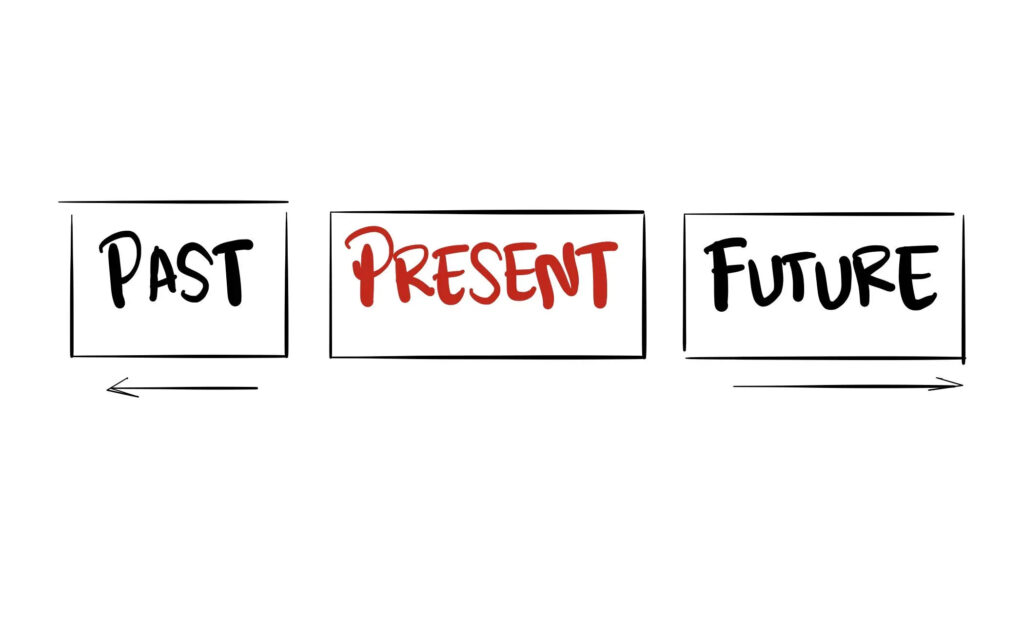
One central thread of psychological research is the story of the three selves—the past, present, and future selves—loving and killing each other in turns.
The past self is original sin: we all carry the past on our backs as we live in the present. The currently fashionable talk about the “family of origin” and “trauma in our formative years” is all about this original sin.
The present self is the devil, and the future self is the angel: procrastination is what happens when the devil and the angel get into a fight.
What’s interesting is that one or two of the three selves sometimes go missing. In real life, this shows up as some very unusual disorders. They’re also favorite subjects for science-fiction writers.
1. The past self is gone
Disorder: retrograde amnesia.
The most typical example in film is Jason Bourne in The Bourne Identity, who has forgotten his past. In science fiction, the one that left the deepest impression on me is Daryl Gregory’s Afterparty, the most dazzling imagining I’ve encountered of the theme of “losing one’s past self.”
2. The future self is gone
Disorder: anterograde amnesia.
The most typical example in film is the protagonist of Memento. Because he can’t form new memories, he has no “future” and can only live in the present with his past. (I couldn’t think of a particularly apt example from science fiction here.)
3. The present self is completely gone
Disorder: Lhermitte syndrome.
People with this disorder have no present self. All their reactions are triggered by external cues they see in the moment. They are literally “living in the present,” but this kind of “living in the present” is an illness.
Here is a passage from The Hidden Mind describing what Lhermitte syndrome looks like:
**************
A neurologist at the Salpêtrière Hospital in Paris, France, was treating two elderly patients who had recently suffered strokes. The doctor’s name was François Lhermitte.
His two patients, a man and a woman, behaved in equally bizarre ways. Their behavior seemed to be driven entirely by cues from the environment, as if they were unable to control it independently.
“Excessive control of behavior by external stimuli, at the expense of behavioral autonomy,” was Lhermitte’s description of their symptoms.
Lhermitte started with simple things. He poured two glasses of water and placed them in front of the patients, who immediately drank them. Nothing abnormal about that, of course. But as Lhermitte kept pouring water into the glasses, the patients kept drinking, one glass after another, even while complaining that they were painfully full. They couldn’t stop themselves from drinking every glass he filled.
In another situation, the doctor took the male patient to his home, an apartment. He led the man onto the balcony, where they looked out over a nearby park and admired the view. Just before they went back inside, Lhermitte said softly, “Museum.” Once they were back in the room, the patient examined the paintings and posters on the walls with enormous interest. He also stared intently at the ordinary objects on the table—plates and cups with no aesthetic value—as if they too were genuine works of art.
Then he asked the patient to show him the bedroom. The man saw the bed, began taking off his clothes, lay down, and soon fell asleep.
Lhermitte continued the experiment at a new location in Paris, which seemed to bring out the patients’ impulsive and industrious natures. On a path in the Tuileries Garden near the Louvre, they happened upon some gardening equipment: a hose and a rake. Sure enough, the man and woman spontaneously picked up the tools and got to work, raking the soil loose and watering it as if they were gardeners. Despite their advanced age, they kept working like this for several hours, until the kind doctor finally stopped them.
On another occasion, at his clinic, the female patient wanted to examine Lhermitte’s body—at least, that was how she understood a medical examination. She even asked Dr. Lhermitte to take off his trousers so she could give him an injection. Dr. Lhermitte agreed (when he published the study, he even included a candid photograph of the scene).
Later, when he questioned them about their behavior, neither patient seemed to notice or discover anything abnormal or strange. They appeared unaware that they were being propelled by naturally occurring primes in the environment. Yet they had no trouble consciously rationalizing these actions—drinking water, admiring art, gardening, and practicing medicine without a license.
The brain’s finely tuned responses learned in the past, or oriented toward the future and connected to whatever plans or goals they might otherwise have had, had been replaced by hypersensitivity to the present—and apparently only the present.
**************
Note
- This series of “Little Lessons in New Psychological Knowledge” articles was written at the time as popular-science commentary and short essays related to Zhichao Wei: A Course on New Psychological Knowledge. They were published on the now-shuttered platform Fatuan, and the original link no longer exists.
Leave a Reply