
This episode is also on Bilibili too.
Let’s start by looking at a tombstone.
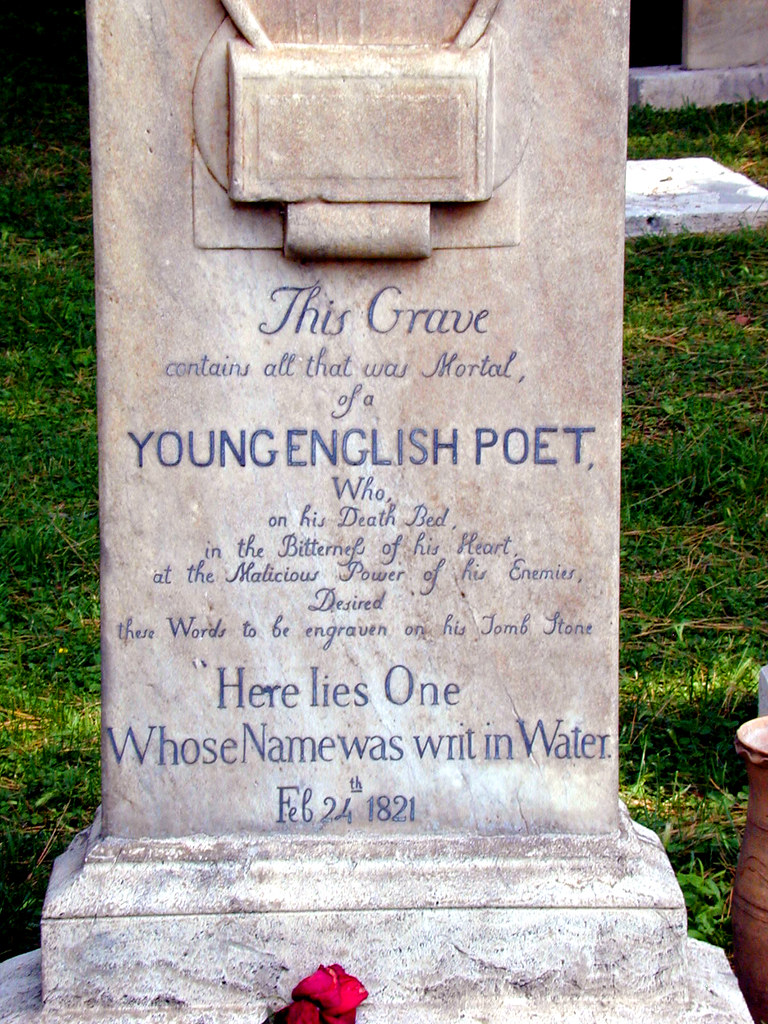
The inscription on this tombstone reads—
In this tomb,
lies a young English poet.
He once lay on his sickbed,
heartbroken by the power and cruelty of his enemies.
He hoped that on his tombstone,
someone would carve these words:
“Here lies one,
whose name was written on water.”
That passage was the epitaph of the English Romantic poet John Keats. At 25, he was in Rome, far from his family and friends, slowly suffocating to death from tuberculosis. It was an excruciating death. And before he died, he was also tormented by the fact that he had never received the honors he felt he deserved. So he asked for his epitaph to read “Here lies one, whose name was written on water.” He felt that his reputation was written only on water; once the ripples faded, so would his name be forgotten.
Before Keats fell seriously ill, he firmly believed his work would continue to circulate after his death. Despite the many bad reviews at the time, he was very confident. He said, “After I die, I’ll take my place among Britain’s great poets.”
But as death approached, he no longer believed his work would keep circulating after he died. Like every mortal, he eventually asked himself that eternal question: “Does life come around again?” He mentioned it in his last letter home: “Will I wake up and discover that all of this was just a dream?” He believed there must be an afterlife, because “life cannot exist merely to suffer.”
In the previous episode, I said that pursuing literal immortality can help some people ease the fear brought by death. But in reality, literal immortality is too nebulous for most people. That’s why more people seek comfort in “symbolic immortality.” What is symbolic immortality? It means still longing to become part of an enduring culture: continuing the past and carrying the future forward. My life may end, but I hope my spirit won’t; I hope my spiritual legacy will be remembered by those who come after me, become part of culture, and keep being passed down.
The reputation Keats longed for was a form of “symbolic immortality.” He didn’t want a momentary flash of fame. He wanted to be remembered by later generations—to have a lasting name.
In that Sumerian epic, after Gilgamesh realized he could not obtain physical immortality, he began focusing on winning renown. He started doing “things the whole world would remember,” hoping to earn a name after death. When Alexander the Great was at war, he would constantly leaf through Homer’s Iliad. This epic records heroes who won imperishable fame through acts of courage in war, and Alexander hoped his own name would last like theirs. He even took a recorder with him on campaign to write down his military achievements as they happened.
If we could become as famous as Keats or Alexander the Great, that would naturally be wonderful. But strangely enough, even someone else’s fame can calm our fear of death.
Imagine this scene:
One day, you’re flying somewhere on a business trip. By the time you board, the first-class passengers are already seated. As you pass them, you happen to notice a woman wearing huge sunglasses, with short hair and a thin face, looking down at her phone. Clearly, she doesn’t want to be recognized. She looks vaguely familiar. Soon after takeoff, the plane begins to shake violently. The captain announces, “Ladies and gentlemen, we may encounter some turbulence. Please return to your seats and fasten your seat belts.”
As the turbulence gets worse, you grow more and more nervous. Then inspiration strikes: Wait—wasn’t the woman you saw in first class Faye Wong? Suddenly, your anxiety seems to ease a little. After a while, the plane stops shaking, and you hear someone behind you say, “Wow, did you know Faye Wong is on this plane too? She’s sitting in first class. Maybe that’s why we haven’t fallen out of the sky.”
This sounds superstitious—and it really is. But the story isn’t entirely made up. One survey found that if people knew a celebrity was also on the plane, they would believe the odds of a crash were lower. Being physically close to a famous person gives people a magical sense that disaster can be kept at bay.
You see, fame and immortality are very easy to connect in the unconscious. Fame drives away death anxiety. Even when it isn’t our own fame, being close enough to it seems to do the trick.
The reverse is also true. In another study, when people’s fear of death was brought to the surface, they became more likely to worship celebrities, because celebrities’ existence proved that being remembered “forever” might actually be possible.
If we realize that achieving the kind of fame these celebrities have is too difficult, we take one step back. At the very least, we hope our values and ideals can be inherited by our descendants. Even if we can’t live on in the history books, we should at least live on in the family tree, right?
In one experiment, German participants showed a stronger desire to have children—and wanted to have them sooner—when thinking about their own deaths. When thinking about death, American participants were more willing to pass their names on to their children, naming them Little Smith Smith II or something along those lines. When they thought about children continuing their lives, Israeli participants recalled relatively fewer death-related words in a word-completion task. See? Once you imagine a house full of descendants, death seems a little less troubling.
And the most important point is that children are not merely heirs to their parents’ bodies. We pass on the beliefs and values we cherish, hoping our children will remember them firmly and then pass them to the next generation. In fact, some parents cut off or abandon their children—or even kill them—because the children turned away from their faith. This is one psychological mechanism behind killing one’s own kin for the greater good. It shows that, deep down, passing our cherished values to our children is often more important to us than passing on our genes.
This also shows that the desire to have our names remembered by later generations is of a piece with the attitude discussed two episodes ago: embracing cultural values and embracing self-esteem.
Fame directly boosts self-esteem, and it also binds a person more deeply to the cultural values they believe in. Through that, they gain a form of symbolic immortality.
So, if people can soothe their hearts through symbolic immortality, then conversely, they can also kill one another over the contradictions of symbolic immortality.
We all long to transcend death, but this longing has ignited slaughter and violence between us. Our sociocultural systems help us temporarily fend off death anxiety, while other people have entirely different systems of belief to help them manage their own death anxiety. If we admit that someone else’s belief system is “the truth,” then our own belief system will inevitably come under suspicion.
The American writer Alan Harrington wrote a passage in The Immortalist that describes this psychology with remarkable precision. Harrington wrote: “If those people’s strange beards and ridiculous hats are acceptable, then in what way am I superior to them? Do they dare hope for immortality too? If so, perhaps they might push me out of heaven. I don’t want that. All I know is this: if he is right, then I am wrong.”
That’s why “nothing is deadlier than incompatible worldviews”: at bottom, arguing over worldviews is really a fight for admission tickets to heaven. If your ticket is valid, mine is void. Simple as that.
So we develop all kinds of responses—from relatively positive to negative to extremely negative—to neutralize the impact of other cultures’ values on us.
The relatively positive response is to assimilate and absorb the other side’s culture. In the 1960s, young Americans became hippies, played rock music, wore jeans, and ate oatmeal. They did almost everything opposite to their parents’ generation, kicking off a “counterculture movement” meant to turn mainstream American culture upside down. But by the 1970s, when President Reagan took office, the hippies’ values of “love and peace” had morphed into a Coca-Cola advertising slogan: “I’d like to teach the world to sing in perfect harmony. I’d like to buy the world a Coke and keep it company.”
See? Ten years later, mainstream culture had absorbed the counterculture as part of itself. Back then, high-end jeans sold for as much as $100, grocery stores carried oatmeal bars in 50 flavors, and songs that had protested mainstream culture in the 1960s had become easy-listening music in elevators by the 1970s.
Still, conflicts between cultural values rarely end in such a relatively peaceful way. Most of the time, we deal with conflict through very negative means.
The mildest level is called “denigration and dehumanization.” Our first psychological line of defense is to disparage or slander groups whose values differ from ours. We decide they are “ignorant savages,” “servants of the devil,” that they have been “brainwashed by evil rulers,” or that they simply aren’t human at all.
The Nazis called Jewish people rats. In Inuit, in some Indigenous languages of the Americas and Africa, and in the Indigenous languages of New Guinea, the word for one’s own tribe is simply “people” or “human beings.” That means members of other tribes are not treated as human in those cultures. In one region of Saudi Arabia, people call all outsiders “tarsh al bahr,” meaning “garbage from the sea.”
You people who are different from us aren’t even human. So whatever you believe can’t really threaten me, right? But this kind of self-deception doesn’t always work. So quite often, we simply choose to wipe out the other side physically.
The Nazis didn’t just call Jewish people rats; they also threw them into crematoria.
In an experiment conducted by the author of Fear of Death, when some American conservatives were reminded of their own deaths, they became more supportive of launching preemptive nuclear and chemical attacks against countries that directly threatened U.S. security. They also believed that capturing or killing Osama bin Laden was worth it, even if it meant killing tens of thousands of innocent people.
In another experiment, after Iranian university students were prompted to think about death, they became more supportive of suicide attacks against the United States and more willing to serve as suicide bombers themselves.
So death anxiety magnifies our hatred of people with different beliefs, making us want to physically harm those who challenge and insult our faith.
The philosopher Bertrand Russell said, “I would never die for my beliefs, because I might be wrong.” The choices made by ordinary people, however, are often exactly the opposite of what Russell said.
In the next episode, we’ll switch perspectives again and talk about death anxiety from the angle of how we view our own bodies.
Written by: Zhichao Wei
Leave a Reply