It’s the end of the year, so as usual, I’m doing my annual roundup of the books I read and the films I watched—my 2018 “leftovers.”
Let’s start with books. Since I began recommending and interpreting psychology books for Psychology’s New Discoveries, I won’t say much more about those here. I’ll just talk about the novels I read this year.
The ones worth mentioning are these:
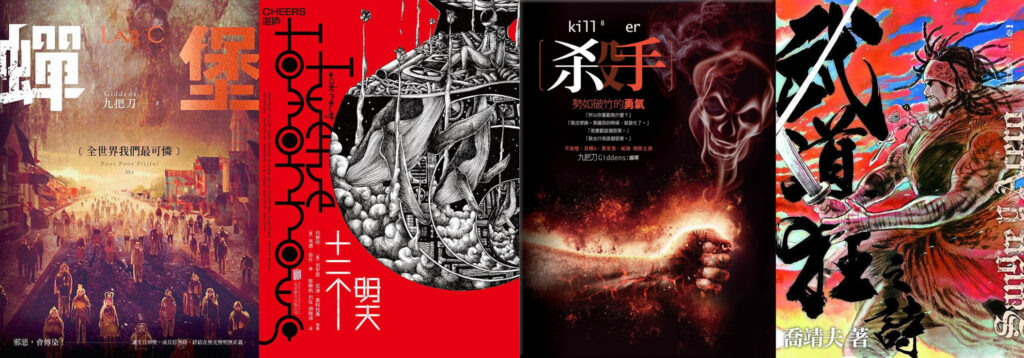
An Ode to a Martial-Arts Maniac — Qiao Jingfu’s Martial Arts Madness: The Song, Volume 21 — Blood and Iron

I don’t know whether it counts as the best wuxia novel since Jin Yong, but it should be the most distinctive in flavor—and it finally came to an end this year.
I’d always worried that Qiao Jingfu’s writing wasn’t strong enough to give this series a proper ending. The volumes before the finale had already started to show signs of decline, and some plotlines were downright childish. I never expected that final burst of energy to hold up—but it did, and the ending was thoroughly satisfying!
Qiao Jingfu’s jianghu is nothing like Jin Yong’s jianghu.
In Jin Yong’s world, the heroes’ passion is for being chivalrous, not for martial arts; their enthusiasm for helping others far exceeds their enthusiasm for training. They learn martial arts either because circumstances force them to or because fate hands them the opportunity. Even those who learn willingly rarely seem all that fanatical about the martial way.
Jin Yong even deliberately rejects that kind of fanaticism: his martial-arts obsessives usually meet bad ends. The three martial-arts maniacs in Dragon—Xiao Yuanshan, Murong Bo, and Jiumozhi—would all have gone berserk and died if the Sweeper Monk and Duan Yu hadn’t rescued them; with the final level of the Great Shift of the Universe, the more doggedly you try to master every detail, the more likely something is to go wrong, while someone “casual” like Zhang Wuji masters it almost by accident. The martial arts carved into the walls in “The Heroic Knights” become less comprehensible the harder you study them, and in the end Shi Potian, a complete outsider, understands them after merely taking a few casual glances.
Jin Yong’s attitude toward the martial way is very Daoist. Only by not seeking can you ultimately attain. Once you start seeking, you’ve already lowered yourself.
On this point, Qiao Jingfu is Jin Yong’s exact opposite.
In Qiao Jingfu’s world, the heroes’ passion is only for martial arts! Martial arts!! Martial arts!!!
Are the people of the jianghu really all about “the greatest chivalry is serving the country and its people”? The great heroes in Martial Arts Madness do charge into battle for Wang Yangming, but they’re basically a special-operations unit. They understand that their role is merely to provide “assistance”—nothing more.
The righteous path of a martial artist is never in the world at large; it is only in the training hall. A martial artist’s life should have just one goal—the strongest under heaven.
There are actually no great heroes in Qiao Jingfu’s jianghu, only “martial-arts maniacs.” All the radiance of Martial Arts Madness converges on that one word: “madness.”
In Jin Yong, pursuing the title of strongest under heaven is something to be mocked. Qiao Jingfu, by contrast, shows you just how gloriously hot-blooded that pursuit can be!
A Carnival of the Deranged — Giddens Ko’s Cicada Castle 2 & Killer: Courage That Breaks Through Like Bamboo


Early this year I happily finished Giddens Ko’s Cicada Castle 2 and Killer: Courage That Breaks Through Like Bamboo (neither is new). In these two books, the two great universes of his fiction—the “urban horror illness” universe and the “killer” universe (perhaps they’re actually the same universe)—can be said to have officially taken shape. The callbacks to details from earlier installments may matter more than the plots themselves. As a longtime Giddens Ko fan, I felt immensely comforted and relieved.
I took a look at the reviews on Douban. The negative ones all said, in perfect unison: Giddens Ko once again failed to rein in his deranged scenes. Is telling a straightforward story really that hard? Is it fun to throw in “some organ” every few pages? If you’re going to kill people, can’t you just kill them properly—why dismember the bodies?
I find these reviews completely baffling. Was Giddens Ko only just now becoming deranged? He hasn’t been normal since his very first novel. “Deranged” is obviously an inseparable part of Giddens Ko, okay?
He’s always been everyone’s sweet little darling—so why are people suddenly blaming him for not behaving like the big sister-in-law anymore? It makes no sense.
This year I’d planned a special episode comparing Giddens Ko and Otsuichi from a psychological perspective. I wanted to discuss them together because they’re both, in a sense, “semi-psychopathic.” Both are bundles of contradictions: bloodthirsty on one side, tender on the other. Otsuichi has his White Otsuichi and Black Otsuichi modes; Giddens Ko writes scenes of bodies dismembered across the floor with one hand and pure romance with the other.
In the end, I couldn’t make the project happen for lack of energy, so it has been added to next year’s New Year plans.
Psychological Fantasies — Daryl Gregory’s Second Person, Present Tense & Ken Liu’s Byzantine Empathy
Sorry, psychology has shown up again.
The two best science-fiction stories I read this year were both “psychological science fiction,” built around psychological concepts and questions.
The most dazzling was Daryl Gregory’s short story Second Person, Present Tense, included in Hieroglyph: Stories and Visions for a Better Future. The psychological question it tackles is the nature of self-awareness.

Second is Ken Liu’s short story Byzantine Empathy, included in Future Tense Fiction. The psychological question it tackles is the value and limitations of empathy.

I originally bought Future Tense Fiction for Cixin Liu’s Gold Mountain, but unexpectedly, the most beautiful thing I got from it was Ken Liu’s Byzantine Empathy.
Masters Gregory and Ken Liu, I swear here and now: next year I’ll try to write my first piece of psychological science fiction (whether it gets published is another question…).
A quick summary of my own writing in 2018, while I’m at it.
In 2018 I produced a total of seven figures’ worth of content. This included—
Dozens of episode scripts for Ximalaya’s “Zhichao Wei: Psychology’s New Discoveries”:
Dozens of short popular-science essays for Guokr’s “Psychology’s New Discoveries Mini-Course”;
A foreword recommending The Mystery of Rationality for CITIC Press;
An interpretation of Betting Against for the “Read the Same Book” column of Wu Xiaobo Channel;
My film-review output continued to shrink. This year I seem to have written just one long piece and one short one:
What are the details in Detective Chinatown 2 that become terrifying when you think them through?
How should we evaluate the film Annihilation?
My Two New Books
Lately I’ve been pouring all my energy into writing two new books: one about new discoveries in psychology, and one about psychology in film. They’re both still on the way, and both are expected to be published next year.
So next year is going to be busy. I need to make it as gloriously hot-blooded as Martial Arts Madness!
Leave a Reply