【写于第4季开播之前】
Written before Season 4 premiered
“What is LOST about? What makes it so good?” Every time I recommend LOST to a friend, I get these questions in return. And every time I find myself at a loss, because LOST is so rich that it’s hard to introduce it briefly from any angle. A dish usually has one main ingredient and one dominant flavor; it tastes good because that flavor is authentic. So what’s the main ingredient in LOST? What makes it so delicious? All I can say is this: LOST is a bowl of stew, packed with wildly varied ingredients, every one of them potent, yet somehow combined without a seam showing. In other words, LOST is a bowl of stew delicious enough to “destroy your soul.”
A World of Possibilities
What kind of story is LOST? It’s mystery, disaster, science fiction, romance, ethics, everyday life, and even religious drama. Using mystery and science fiction (or perhaps religion) as its trunk, and delicate psychological portraits of its characters as its branches and leaves, it miraculously blends the elements of all kinds of genre drama into one coherent, all-encompassing whole.
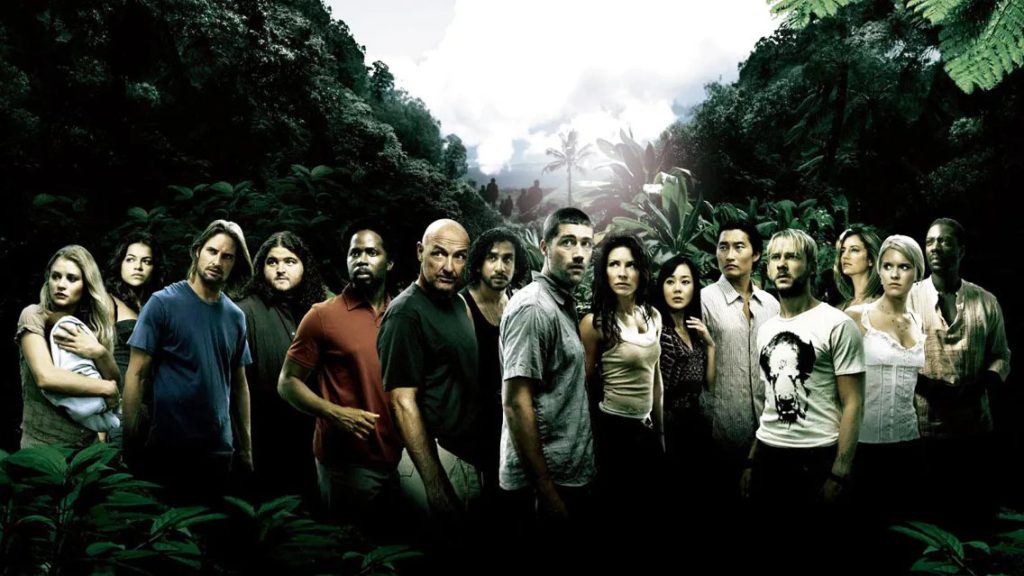
LOST begins in the atmosphere of a disaster movie: Oceanic Flight 815, flying from Australia to the United States, crashes, yet the dozens of passengers aboard miraculously survive and discover that they have landed on an island.
But the story that follows is soon taken over by gripping mystery and science-fiction elements. The survivors of Flight 815 quickly discover that beneath their feet lies a mysterious island full of wonders. The island harbors mysterious powers that cut it off completely from the outside world: no one outside can find it, and the survivors of 815 have no easy way to leave. The island was once the site—and the subject of research—of a mysterious scientific project called the Dharma Initiative. The Dharma Initiative appears to have been abandoned, but some of its facilities are in fact occupied by a mysterious group. The survivors of 815 call them “the Others.” These deeply hostile Others arrived on the island long ago, protecting and studying its mysterious powers. They take a special interest in the island’s children and pregnant women, seemingly hoping to break some kind of “fate” through their research. The survivors gradually discover that their crash was not an accident, that their survival may itself have been an “arrangement,” and that even their destinies were mysteriously connected to the island long before they arrived…
Then the story turns again, and its mystical and religious elements gradually come to the fore. The mysterious power not only cuts the island off from the outside world; it also seems to “watch over” the survivors of 815 like a god, either protecting or judging them. Some survivors find salvation for body and soul in the hands of this “god,” while others suffer its merciless judgment and are killed, directly or indirectly, by the “black smoke” conjured by the island’s mysterious power. And the Others who guard the island’s secrets are, to some extent, genuinely a group of “fanatics.” They protect and zealously worship a mysterious man on the island named Jacob. Jacob is the Others’ “god,” intimately connected with the island’s mysterious power—or perhaps himself the source of it. Stranger still, only a tiny number of exceptionally “special” Others can hear and see Jacob. These extraordinary people become the “apostles” among the believers, and the de facto leaders…
As the story unfolds, we also discover astonishing connections among the destinies of the people on the island. Some are half-siblings who have never met; some once passed each other in the street years ago, only to meet again on the island… The survivors of Flight 815 should have been complete strangers. So why were their lives already tangled together before the crash?
These plot points are only a tiny fraction of the first three seasons of LOST. Friends who haven’t seen LOST can use them to imagine just how intricate the show becomes. They rather inappropriately remind me of Jin Yong’s Dream of the Dragon Eight. That novel takes a martial-arts duel between the two sects of the Wuliang Sword school as its entry point, then opens onto a sprawling wuxia story far beyond that little sword school—as if the author happened to glimpse a vast, turbulent world through a small window. LOST’s creators likewise use the crash of Flight 815 as their entry point, leading viewers into a marvelous world made up of the mysterious island, the survivors of 815, the Others, the Dharma Initiative, Jacob, and the black smoke.
A Measured Rhythm
What exactly is the island’s power? Who is Jacob? Where did the Others come from? Whose plan was the Dharma Initiative originally? How do we explain the connections among the survivors’ destinies?… The creators are in no hurry to reveal every answer. Instead, they devote a substantial portion of the story to carefully depicting the characters’ psyches. The principal survivors of 815 and members of the Others have wildly different personalities, yet each has carried a personal destiny to the island. “Everyone comes to this island for a reason.” The island gives them a chance to re-examine their own fate. The frequent shifts between these characters’ “flashbacks” and the island’s “present” are one of LOST’s most distinctive narrative features. The finely observed character work in the flashbacks also lifts LOST beyond an ordinary mystery series, giving it the poise of a classic art film.
The result of combining so many elements is not to make LOST chaotic, but to give it a controlled rhythm and extraordinary poise: the “tension” of mystery, horror, and thrills alongside the “release” of delicacy, emotion, and aftertaste. LOST consequently radiates a uniquely unsettling charm. Its tense side has made it a cult classic with a devoted specialist following, while its relaxed side has won the hearts of mainstream viewers. LOST is like the full-flavored Dream of the Red Chamber: a doctor sees a prescription, a chef sees a recipe, an architect sees architecture, and a poet sees beautiful lines. Everyone carries their own LOST inside them. Different viewers can find different pleasures in it: mystery fans find material to scrutinize, suspense fans enjoy its aura of mystery, science-fiction fans see a masterpiece, and viewers drawn to romance find a moving love story.
A series as full of cult elements as LOST ought to be niche. Yet its first three seasons averaged roughly 15 million viewers in the United States—a remarkable achievement. So we can call LOST a mainstream series with a deeply cult sensibility. That may well be unprecedented.
Variations
Besides constantly varying its rhythm between tension and release, LOST undergoes a major variation in its plot every season.
Season 1 focuses on the psychology of the 815 survivors. Its science-fiction and mystery details never stop, but overall its pace is relatively relaxed, winning us over with delicate character portraits. In Season 2, the mystery and science-fiction elements arising from the interwoven fates of the Others, the Dharma Initiative, and the survivors take center stage, and the pace accelerates dramatically. By Season 3, the mysterious “island,” previously just the stage backdrop, steps fully into the spotlight and becomes the true protagonist; the mystical and religious overtones grow steadily stronger.
LOST’s creators reinvent the show every season, which is bound to unsettle viewers who like to classify a story in advance and form expectations, because the plot keeps veering far away from their psychological predictions. Thus, although supernatural elements such as the black smoke and polar bears appear as early as the first episode of Season 1, viewers could still be asking at the end of Season 3, “Is LOST a science-fiction show?” Even more amusingly, some viewers think it would be terribly disappointing if LOST ultimately used science fiction to explain everything, while others think it would be terribly disappointing if LOST ultimately did not use science fiction to explain everything.
Why can’t we allow a work to have delicate character portraits, gripping tension, and science-fiction and religious premises at the same time? LOST is so compelling precisely because it fuses these elements perfectly.
If you haven’t seen LOST, before you begin appreciating this singular work, try throwing away the rigid boxes in your head about story genres and experience LOST’s hard-to-classify plot and frequent variations more intuitively.
Foreshadowing That Runs Deep
Anyone who watches mystery series worries that the show may not ultimately provide a reasonable answer. If that happens, all the brilliant setup and process become empty mystification. Fortunately, LOST doesn’t seem to be that kind of show. We can have confidence in LOST’s ending (though I don’t agree that an ending determines a work’s success or failure).
That’s because the first three seasons of LOST already contain so many details of “a grass snake leaving an ash-gray trail, winding a thousand miles”—small clues that stretch far into the distance. A minor detail mentioned in one episode may be answered dozens of episodes later; examples like this are everywhere. LOST clearly wasn’t written entirely like a soap opera, making things up as it went along. And judging from what several principal creators revealed in interviews, they had long since worked out the outline of the entire story. During production they revised and polished the details according to factors such as the actors’ performances, then wrote the actual scripts. Their confident, slightly smug tone was practically saying, “We figured out the ending ages ago. We’re just not telling you.” That drives viewers like us crazy, but all sorts of internal and external factors make it feel as though LOST’s grand architecture was conceived from the beginning. A long-running show like LOST is bound to contain some suspense that is merely bait, but its central mysteries should not be cheap tricks for stringing us along. So unless it is ruined by circumstances beyond the creators’ control, I believe LOST will ultimately give us a satisfying answer and establish itself as a landmark classic.
Looking Ahead to the New Season
Every season finale of LOST leaves a deep impression. The ending of Season 2 was widely praised, while Season 3 ended in a genuinely shocking way. In that episode, the creators unexpectedly replaced the flashback—a narrative device that had become LOST’s trademark—with a flash-forward. The story shifted from past and present to present and future. When Kate, the female lead, emerged from the darkness at the end of Season 3, I suspect many viewers felt the kind of chill that even a horror movie rarely manages to produce.
So at the end of Season 3, LOST underwent another dazzling variation. Will this set the tone for Season 4? Will the stunning flash-forward prove to be a brief flourish, or will it become the new narrative form once Season 4 begins? This also raises the question: Are the survivors of 815 irreversibly rushing toward a predetermined future, or can they change it? Let’s wait and see.
Leave a Reply