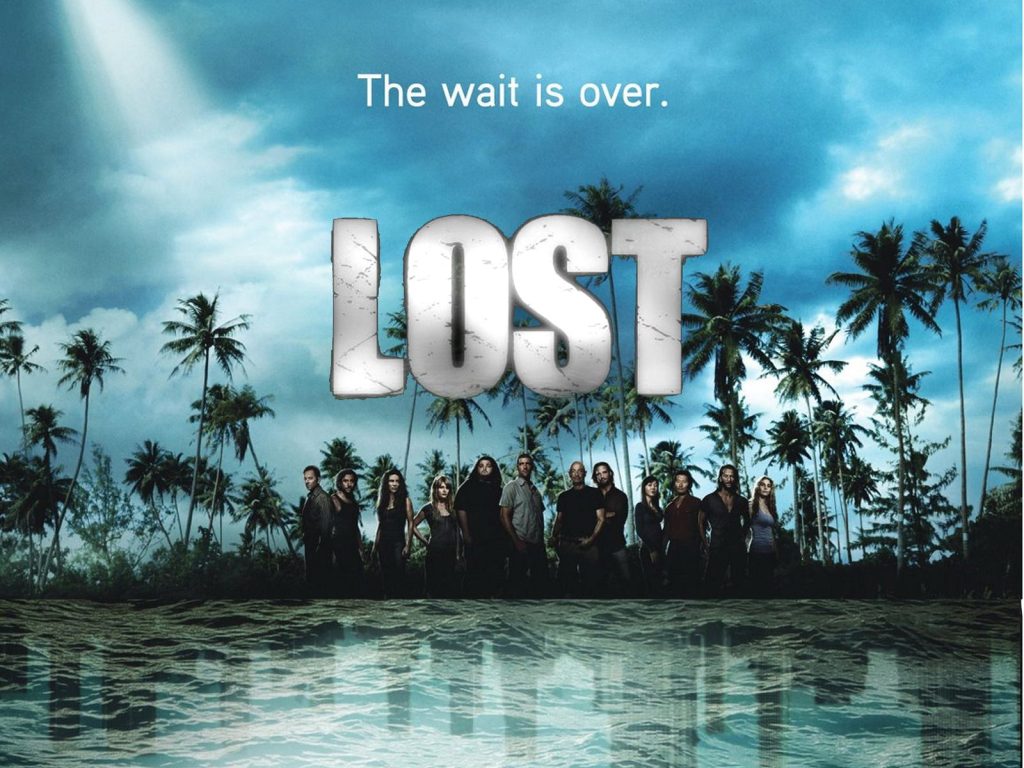
[This article was written years ago, after the end of Season 4 of LOST. It analyzes and speculates about the story based on the first four seasons. MAJOR SPOILERS—if you haven’t finished the first four seasons, proceed at your own risk!]
I promise, this is my most magnificent theory yet.
1. The Ultimate Theory
Ever since the end of Season 2, whenever an installment of LOST came to an end, I couldn’t help writing something about it—analyzing the plot while worshipping at the altar of the writers.
The plot of LOST is like the writers leading us into a pitch-black room, then lighting a candle to illuminate one corner of the wall. We notice what look like rather beautiful patterns in that lit-up corner and are instantly drawn in. Then more and more candles are lit, and our field of vision gradually expands, until we suddenly realize that the corner we saw at first was merely an inconspicuous patch of a huge mural. And the mural in its entirety is a grand epic panorama.
So each of my analyses has gradually gone a little deeper as my field of vision expanded.
Of course, many of the predictions I made in those three analyses turned out not to be especially accurate. But if you’re going to make predictions, I suppose you have to develop a thicker skin. I hear that the average accuracy of those all-powerful stock-market pundits on television doesn’t even beat random guessing. They can drive people into bankruptcy one day, then go right on confidently spouting nonsense the next, without turning a hair. So I have to learn from them too.
And this time, why not make the game a little bigger? Here’s what I’m going to do:
- Speculate about the island’s true origins;
- Speculate about the island’s ultimate allure—what exactly it is, and why people like Ben and Widmore, who know its secrets, become utterly obsessed with obtaining it at any cost;
- Use my answers to those two questions to sort through the plot threads of LOST so far, and see whether this logic of mine can explain the entire story from beginning to end, including every mystery and every character’s motivation.
This unprecedented mystery story, LOST, has inspired countless experts to develop theories and analyses of their own. But I think most of the theories so far can explain only one mystery, or a small portion of the mysteries, in LOST. They may explain a few selected puzzles perfectly, but they don’t quite hold up when applied to every mystery since the show began. However, if we believe that LOST is a series carefully conceived by its writers and capable of tying itself together logically, then its final, ultimate answer must be able to explain the logic behind the entire development of the story.
So here I’d like to see whether, before the official answer is revealed, I can work out an “ultimate theory” that explains all the mysteries and plot logic of LOST so far.
2. The Hidden Clues
The reason it’s possible to speculate about the plot is that LOST is full of examples of clues planted early and paying off miles down the road.
People say Dream of the Red Chamber doesn’t contain a single superfluous stroke. In my view, LOST is the real master of that. From the premiere onward, nearly every detail that initially seemed casual has later turned out to be a carefully planted clue by the writers. Take the life or death of Jack’s father, Christian, and Aaron’s connection to the island, for example. Audiences had nearly forgotten these details, but the writers remembered them perfectly well. After watching Season 4, we realized that even those unresolved details from the beginning had all been part of the writers’ careful design. Even the seemingly irrelevant line Tom, one of Ben’s men, said to Kate in Season 3—“You’re not my type”—got a payoff in Season 4 (Tom is gay).
3. Impressions of Season 4
Before starting this round of speculation, let me first say a few words about my impressions of the just-finished Season 4.
In principle, this season was no worse than any of the previous ones.
Narratively, Season 4 gained plenty of room to maneuver by introducing the flash-forwards that began at the end of Season 3. In some episodes, we even saw flash-forwards, the present, and flashbacks running in parallel. Moving from simple flashbacks to using flash-forwards and flashbacks together was somewhat like Christopher Nolan’s evolution from Memento to The Prestige: from a somewhat rigid mode to something that looked inscrutable but was actually completely freewheeling. Those J.J. Abrams people even dared to tell us the ending of Season 4 ahead of time at the end of Season 3, then spend this season explaining how the story reached that point. A setup that could so easily have damaged the whole structure would have been unimaginable without a certain amount of nerve—and the writers’ formidable brains.
As for pacing, this season was also almost the tightest since the show began. The original plan was for a short, 16-episode season, and the writers’ strike cut two more episodes, so the plot was largely free of the kind of sluggishness we saw in the middle of Season 3.
As for the story itself, this season certainly had no shortage of shockers.
Still, why did I feel, after finishing the season, as if something were missing? It seemed that while watching Season 4, I experienced less of that old ecstatic delight. Maybe it was like the ending of Stephen Chow’s famous sequence of exaggerated facial expressions in The King of Comedy: after someone has been jolted too many times, no matter how strong the next jolt is, they stop reacting—I had been overstimulated by too many cliffhangers. The writers even made the characters poke fun at this feeling: when Sawyer first heard Locke and Ben talk about Jacob, he finally snapped and said he was so damn sick of all this. I suspect many viewers felt something similar to Sawyer. It wasn’t that LOST had stopped being exciting; there were simply too many bombshells, and they had pushed us past our limit.
While my brain cells were being overstimulated, my emotions were being stirred up like never before. Season 4 of LOST moved me more than any season so far. That was probably because the flash-forward structure made everyone seem to be helplessly heading toward a predetermined ending, and that narrative device created a powerful tragic effect all by itself. And after a series like this has been accompanying us for four years, when we’ve inevitably grown attached to its characters, the tragic tension becomes even stronger. Take the slow-motion montage at the end of Episode 11 of Season 4: the camera moves across Ben, Sun, Jack, Kate, Locke, and the others in turn, filling the scene with a sense of fate. I watched that sequence over and over.
And the scene that moved me most this season was neither Desmond and Penelope’s love across time nor Sawyer jumping into the sea to give Kate her chance. It was Ben’s desperate sobbing as he moved the island. I’ll explain why this scene later.

Now that the digressions are over, let’s put on the thick skin and begin this round of stock-market forecasting and analysis.
I promise, this is my most magnificent theory yet!
Leave a Reply