
I previously wrote a review of Zootopia called Why the Terrible Twilight Actually Has a Better Moral Outlook Than Zootopia, which sparked some controversy and criticism (pretty rare among my reviews, as far as I can tell), and even earned me the big hat of a racist. I want to use this essay to respond to those controversies and criticisms. And then, while I am at it, compare The Mermaid and Zootopia, two works about across-race entanglements.
1. Several States of Multiracial Coexistence
What I was actually complaining about in that controversial review was Zootopia’s setup for racial coexistence (the sunny, positive ideas about not judging people by appearances or using their race to judge their worth were never part of my argument)—
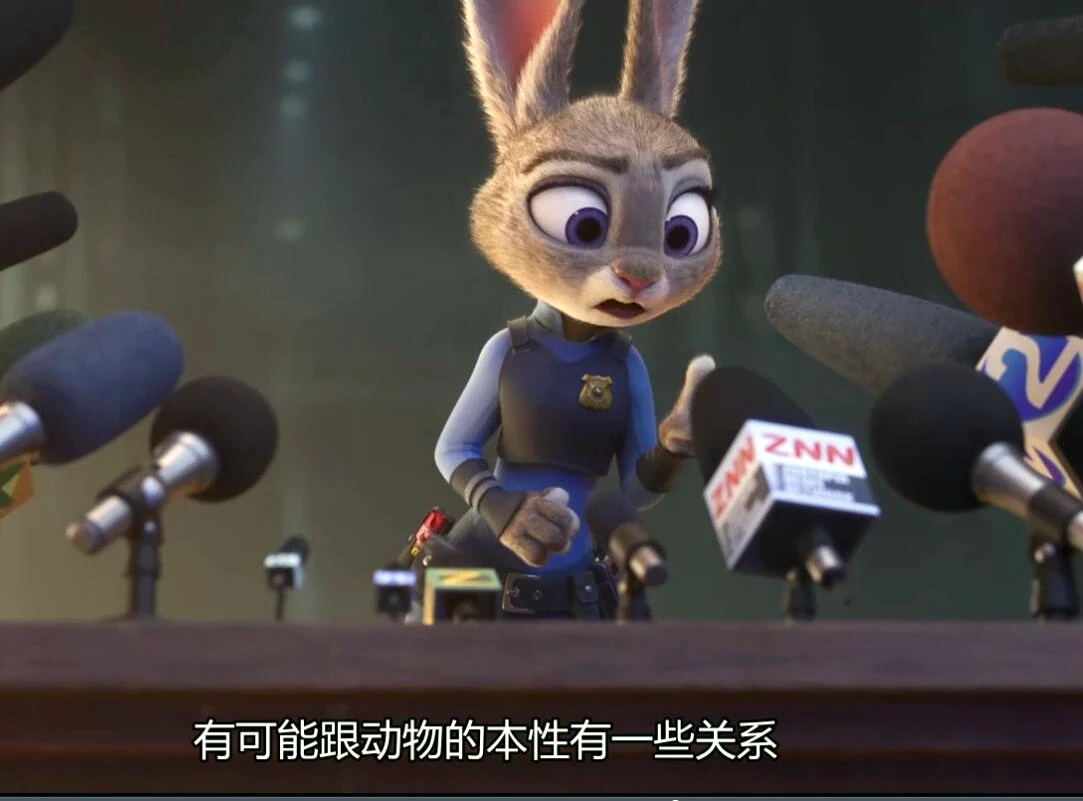
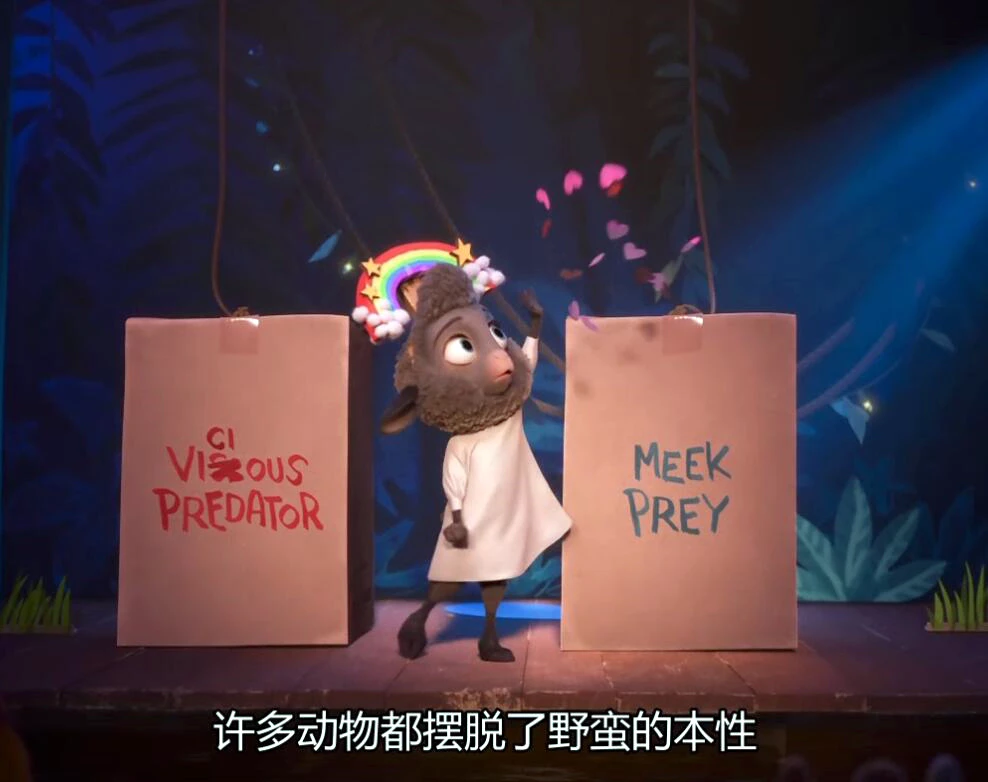
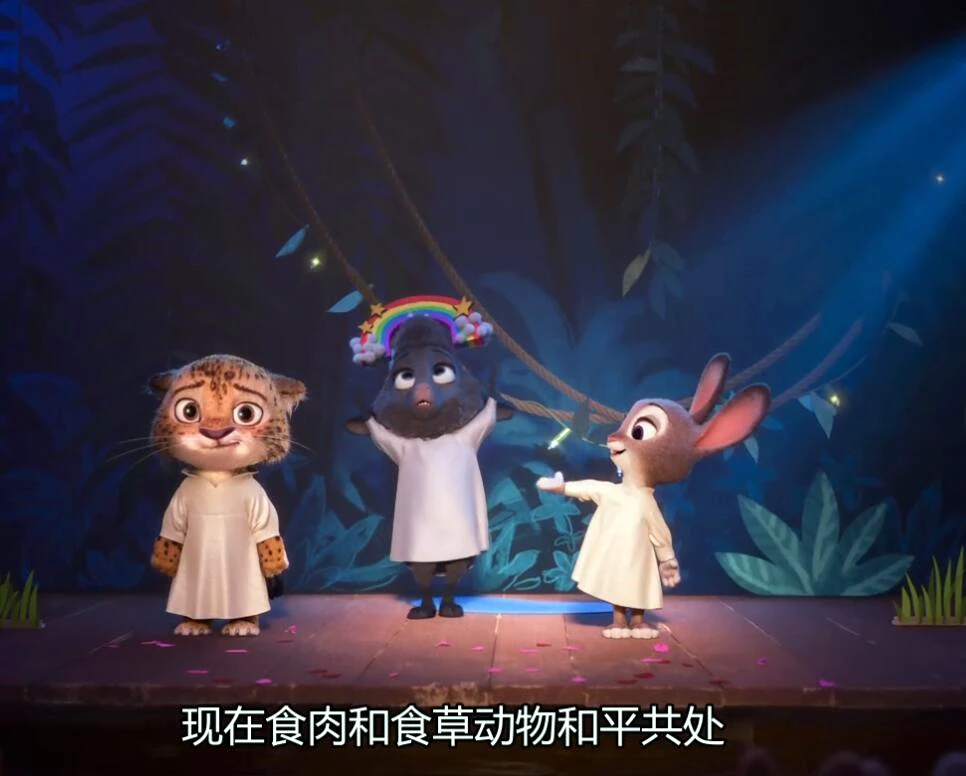
The premise behind the animal utopia of Zootopia is that carnivores have evolved beyond the “instinct” to eat meat. Carnivores and herbivores are really just different in size and appearance. Under the surface of those many racial faces lies a highly unified set of inner values.
“Instinct” is the key phrase in Zootopia: don’t assume I eat rabbits just because my ancestors once did. I don’t eat rabbits. So please don’t treat me according to your impression of my ancestors. I only look different from you; inside, my “instinct”—repeatedly mentioned in the film—is exactly the same as yours.
That setup is pretty crafty, actually.
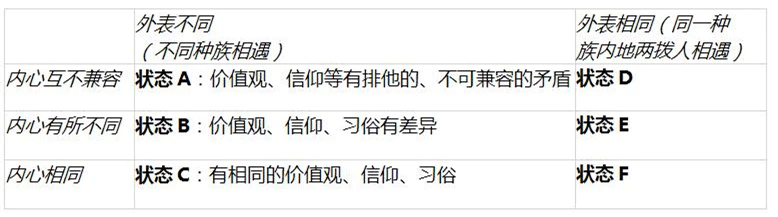
When two different races (or nations, or ethnic groups—I may not be using the precise term; you get the idea) meet in real life, things are much more complicated. If we crudely sort people along the two dimensions of “appearance” and “inner life,” then when two groups meet, there are six possible situations, as shown in the table below:
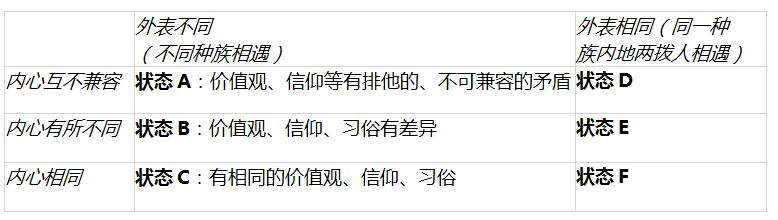
State B and State C are the two typical situations in racial coexistence.
First, State B. When two different groups have just met, their existing values, beliefs, and customs may differ greatly. In real life, the most common and intense problems of racial coexistence actually erupt at this stage. This is what I mentioned in that original review: if carnivores still have, deep down, some desire to eat herbivores, is peaceful coexistence in the animal utopia still possible?
When I wrote that review, my public account had only recently launched. I had barely figured out what I was doing (I still haven’t, really), so I just followed the crowd—chasing hot topics. I wrote too quickly, and my skill wasn’t quite up to the job; plenty of sentences came out badly judged. For example, on the point above, the article said: “Real-world racial conflict is a group of foxes who want to eat rabbits barging into a group of rabbits.” That sentence was pretty awful—not only oversimplified, but also extreme.
One reader criticized me, saying that this sentence was describing terrorists, basically: did I mean that those “intruding” ethnic groups were all terrorists?—Fair criticism! I accept it and apologize. I meant to write State B from the table, but the words somehow turned it into State A. State A is when two groups have exclusionary, incompatible contradictions in their values, beliefs, and so on; their conflict may then be unavoidable. That is outside this essay’s scope.
So what I am actually interested in is the huge middle ground between “I simply can’t stop myself from eating you” (State A) and “My inner self is exactly like yours; I never even thought of eating you” (State C): I have a little impulse to eat you, and you have a little impulse to pull out my teeth, but we make a contract, restrain those impulses together, or defuse them in other ways—seeking common ground while preserving differences. If two groups can still coexist peacefully in this state, that is genuinely precious.
In other words, I think State B is the one that most deserves to be represented and has the most real-world meaning—some things inside me differ from you, but that’s okay; we still work toward peaceful coexistence.
Isn’t this where most racial conflicts in the real world actually happen?
Unfortunately, the state of racial coexistence shown in Zootopia is actually State C. And State C is the model state of mature racial coexistence. Often, after two races have lived together long enough, their coexistence moves from B toward C. Eventually, some of them deeply overlap, becoming two races that differ only in appearance while sharing the same values, beliefs, and customs. This kind of situation is fairly common in parts of Canada and the United States where racial integration has gone relatively well.
My earlier review said: “If two groups of people differ only in appearance but have the same instincts, then living together would hardly create racial-conflict problems.” A reader criticized that as oversimplified too. Fair criticism!
Being wary of people who look different is an evolved psychological tendency that helped our ancestors quickly tell whether someone was “one of us.” Although this tendency is often badly out of date, modern humans still carry some of it, and we still need to work to overcome it.
That is to say, even in the fairly idealized State C, there will still be prejudice and conflict between races. But compared with State B, racial-coexistence problems in State C have softened enormously.
And Zootopia found this “least painful” zone for touching on racial issues with remarkable precision—or, you could say, craftiness. As a work suitable for all ages, its calibration, or “calculation,” is practically flawless. No complaint there. But I still have the faint feeling that it is shifting weight away from the hard parts, because racial subject matter inevitably brings real-world racial conflict to mind. When the real world is often still stuck in States A and B while the film’s world has already entered the utopia of C, I can’t help feeling a little annoyed.
Please forgive my pettiness.
2. Why I Don’t Like the Logic of State C
My hostility toward State C as shown in the film has a more important reason: it overemphasizes the idea that “there is no difference between you and me.” In Zootopia’s utopia, carnivores and herbivores can coexist peacefully precisely because their instincts are basically the same, leaving no real possibility of mutual harm.
But if our instincts differ—if I am different from you—so what? Does that mean we cannot coexist peacefully?
That is what I wrote in the original essay: When two groups whose instincts differ, or even conflict, suddenly find themselves standing face to face, how should such groups coexist?
One reader was enraged by this and asked, “Do you mean Black people and white people have different instincts?” That is how I ended up wearing the hat of a racist. Again, I apologize: using the word “instinct” was inappropriate. What I meant was values, beliefs, and customs.
But one point does need defending. This reader’s implication was that I had placed myself on the side of the “privileged group,” white people, implying that white people were noble by nature while Black people were savage by nature.
—Good grief, this person thinks far too highly of me. The reason I am so sensitive about this issue is precisely that, in daily life, I often find myself on the other side.
Huh? Have I been racially discriminated against?
No. My situation is on the right half of the table above.
I live in Jiangnan, where the Han majority is overwhelming and everyone looks more or less the same. Within my own narrow circle of life, I have relatively little firsthand experience with the different-race coexistence problem on the left side of the table. So what makes me more sensitive than outward differences is the inner dimension.
In fact, I can constantly feel that my worldview, values, and habits differ enormously from those of the fellow members of my race around me, even though we look more or less alike. My situation corresponds to State E in the table, opposite State B—we look the same, but we are very different inside.
And I know that there are many dark, unmentionable sides to my inner life. If those sides were released completely, they would be capable of hurting people.
My “instinct” (this time, I did use the word correctly) is not the same as that of most people around me!
But so what? I have not let the dark sides inside me hurt the people around me.
That is why I asked in that review: If there is a fox who has never eaten a rabbit, and there is ample evidence that he will not eat one in the future either, but who nevertheless has a small impulse to eat rabbits inside him, should such a fox be allowed to live in the utopia of Zootopia?
I think the implicit premise of Zootopia is that a fox like me has no place in its utopia. That really resembles my own situation—I want to coexist peacefully with the world in State E, but the world insists on dragging me into State F.
That is the biggest reason I don’t much like Zootopia. I hope I have made myself clear this time.
3. Near-Perfect Calculation v.s. Flawed to the Core
My final reason for disliking Zootopia is entirely a product of my overactive imagination. I just can’t stop.
This has to be discussed alongside Stephen Chow’s The Mermaid. Zootopia and The Mermaid are completely different kinds of films and need not be compared. But I happened to watch them back to back, and both deal with across-race entanglements, so I couldn’t resist putting them side by side.
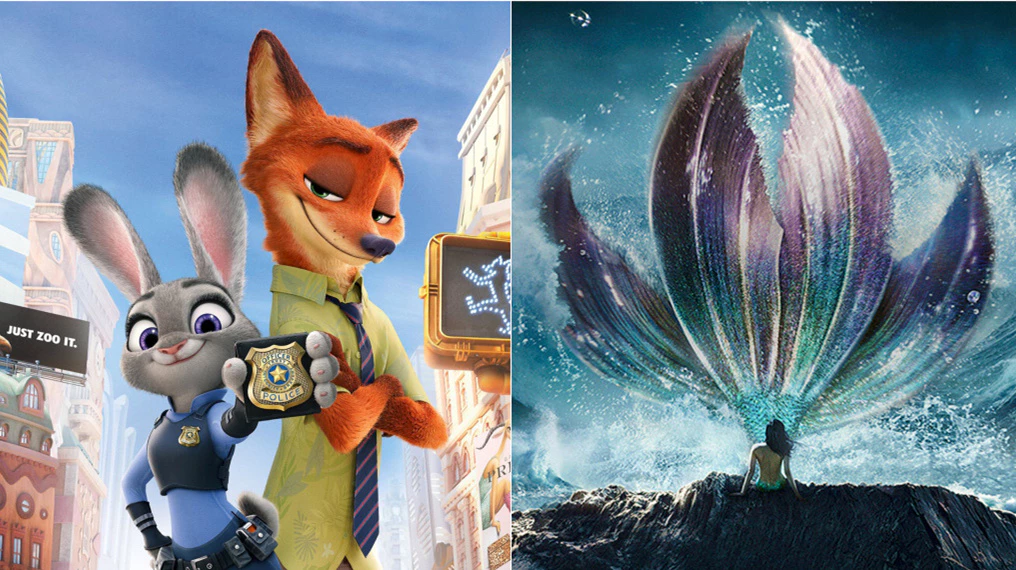
Here are the two films’ current ratings on Douban:


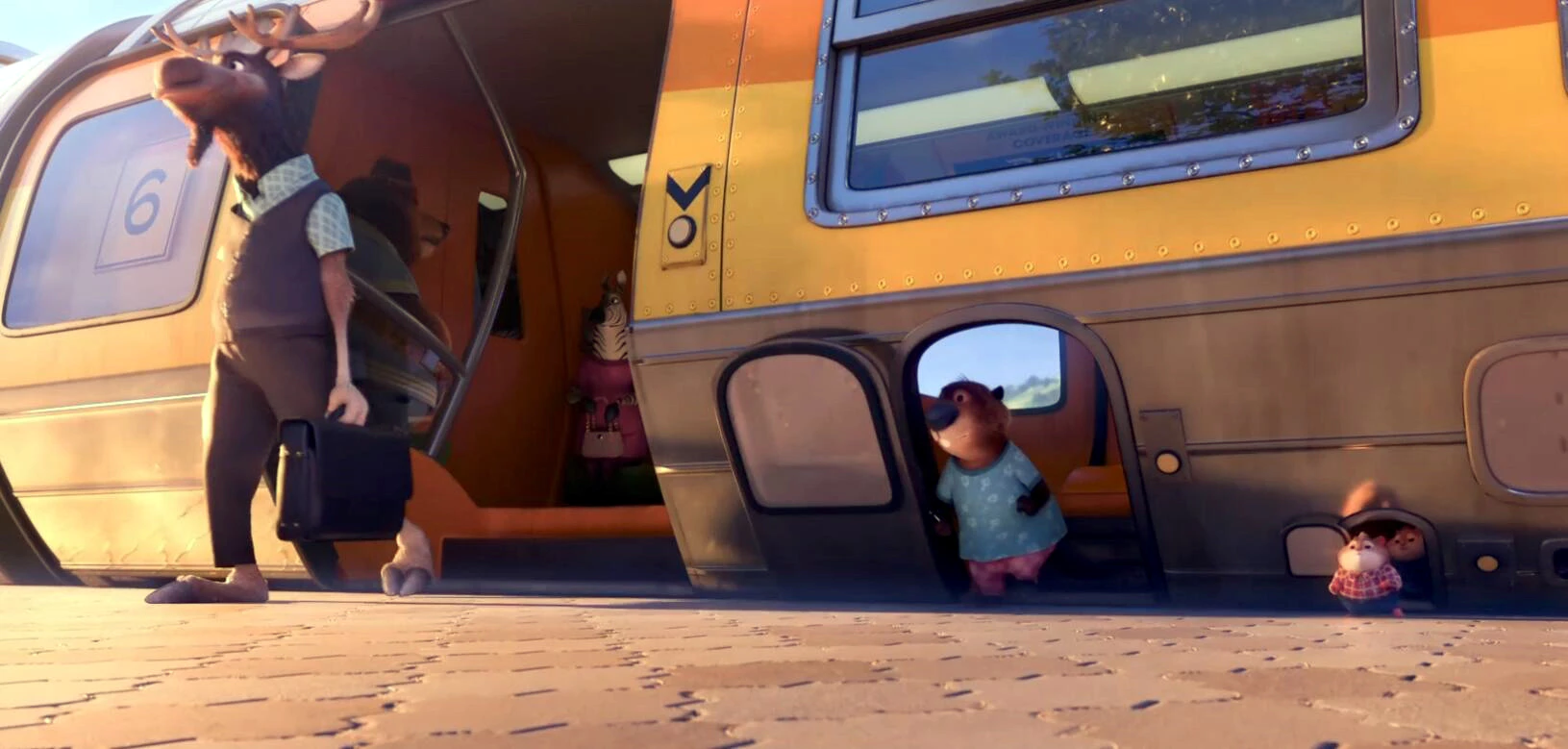
The former is showered with praise; the latter has a “polarized reputation” and is “highly controversial.” That comparison is actually pretty fair. From story and characters to production quality, nearly every part of Zootopia is perfect. What I like most is the detail in its design of physical objects. How do species of wildly different sizes live together in one city? How do public facilities meet the needs of animals of different dimensions? How do animals of different sizes communicate in everyday situations? The filmmakers’ thinking is genuinely fascinating in these details.
By comparison, The Mermaid is flawed from head to toe, and some of those flaws are downright damaging. For example, the “foreign big bad” in the film is made an ocean biologist. And isn’t the thing an ocean biologist would most want to do to “capture alive” as many new species as possible? Yet this ocean biologist kills merpeople without the slightest hesitation, no different from Ruolan, who really does want to wipe them all out. Isn’t he worried that he might accidentally kill all the living specimens? The film has plenty of details like this that fall apart under close thought.

And yet I like the deeply flawed The Mermaid far more than the nearly perfect Zootopia.
That is probably because Zootopia feels too much like something carefully planned by a bunch of Hollywood’s top professionals.
To put it in a not-quite-apt analogy, suppose I were a girl who had recently met a guy who was exceptionally good at flirting. He flirted with me so skillfully that I felt as if I were basking in a spring breeze—I had never felt so good. But then, after some gossiping around, I found out that he had just graduated from a pickup-artist class. It turned out that his perfect performance when hitting on girls was really just him applying the techniques he had learned there. That made me feel a little awkward. The feeling of basking in a spring breeze was real, obviously, but once I thought about how it had been created through carefully executed techniques, it somehow started to feel a bit off.
That is exactly how I felt watching Zootopia. I could feel the world-class production team behind it precisely calculating every joke, every big laugh, every adorable moment, every twist, and every choice of values.
Yes, it always manages to hit every one of my funny bones and every one of my sore spots with exactly the right amount of force. Most of the values it conveys are also so correct that I can only shut up, prick up my ears, and accept the lesson.
But that flawless sense of being “exactly right” is precisely what I do not much like. On the surface, Zootopia is full of delightful “childlike innocence.” Yet I cannot help thinking that behind this “childlike innocence” lies precision calculation, thought through down to the last millimeter. And that is actually very “adult.”
From this angle, The Mermaid gave me exactly the opposite feeling. Compared with Zootopia’s childlike charm, The Mermaid contains gore and cruelty that are not exactly suitable for children. On the surface, it is extremely “adult”—the most glaring example is the massacre at the end. Not only would children who went in expecting a fairy tale probably be unable to take it; even the parents who brought them to the theater might not be able to stomach it.
But what lies behind this gore and cruelty?
I guess that behind the gore of this adult world is probably Stephen Chow’s utterly sincere heart, one that loves this world deeply. What Stephen Chow sees is the adult world through a child’s eyes.
Some people would say that the world looks beautiful through a child’s eyes, while adults are the ones who see its cruelty.
I think that, sometimes, this gets things exactly backward. Adults often become numb to cruelty and gore, while children believe sincerely that the world ought to be beautiful, which is precisely why it breaks their hearts when they see beautiful things brutally and bloodily destroyed.
Like many people of my generation, I am a die-hard Stephen Chow fan, so it is hard to avoid unconsciously defending and glorifying him when evaluating his films. But whatever my bias, when I watched the massacre at the end of The Mermaid, what I felt was the pure, honest heartbreak of a child who cannot bear to see beauty destroyed.
The Mermaid is riddled with flaws, but compared with perfect calculation, I still prefer this imperfect sincerity.
“The world is cruel, but sometimes it is beautiful too.”
Leave a Reply