
This episode is also on Bilibili too.
Let’s talk about the right way to use divination.
Don’t worry, I’m not about to trot out the usual “astrology and tarot are pseudoscience, so we should all fight pseudoscience” routine. This article will explain not only why divination really is useful, but also the right way to use divination.
Astrology, tarot cards, the I Ching and its trigrams, Plum Blossom Numerology, tea-leaf fortune-telling… Before heading out, you draw a divination lot to decide what to wear; after a blind date, you draw another to calculate your romantic prospects. Before making all kinds of decisions, do you also use these divination methods—seriously or not—to draw a lot and help yourself decide?
Should we really believe in these divination practices? If divination is genuinely useful, how should we use it?
Let’s answer that with a case from cultural psychology—
Divination Hunting
The Naskapi people of Labrador, Canada, have a tradition of hunting caribou.

The first step in hunting caribou is finding them. But the forest is huge—where do you look?
If you were a caribou hunter, I’m guessing you’d instinctively use experience and whatever information you’d gathered to predict where caribou might show up. For example, if caribou liked eating a certain kind of berry, you might wait in a place full of those berry trees. Or if several neighbors had spotted caribou in the same place before, you might go look there this time too.
But in reality, this makes caribou surprisingly hard to find. Caribou and hunters are locked in a game of strategy: hunters want to predict where caribou will appear, while caribou want to avoid being shot. So they learn from experience too, deliberately avoiding places where hunters often go. Caribou are actually pretty smart and pretty sneaky. That makes it very difficult for hunters to predict where they’ll turn up.
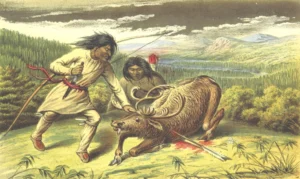
But when the stakes rise, the tricks get sharper. These Naskapi hunters in Canada didn’t actually find caribou by relying on experience. So how did they do it?
—They practiced divination.
In the Naskapi hunters’ culture, passed down from generation to generation, there is a divination ritual. During the ritual, hunters heat a caribou shoulder blade over a fire until cracks appear, or burn part of the bone to create patterns. They believe these cracks and patterns are maps given to them by the heavens. Once they interpret the specific directions represented by the cracks and patterns, they follow the “map” to hunt caribou.
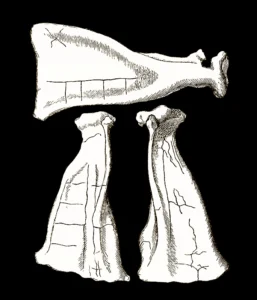
And amazingly, when they followed the route produced by divination, they often really did find caribou. The divination results seemed uncannily accurate!
How does that make sense? Were the heavens really protecting them?
The Core Secret of Divination
The secret is actually quite simple: The pattern of cracks burned into the bone depends on the bone’s size and shape, the temperature of the fire, the ambient temperature during cooling, the heating process, and countless other details. All those details pile up, and the resulting pattern is effectively random.
And randomization is the winning move in this kind of “you guess me, I guess you” strategic game!
Because random means—even I don’t know what I’m going to do next. If I don’t know what I’m going to do, how could you possibly predict it?
The hunters’ routes became randomized through divination, so the caribou had no way to infer the hunters’ behavioral pattern. As a result, the odds of the two encountering each other rose dramatically.
That is the logic behind divination working.
This case also contains a wonderfully strange piece of logic—
Divination survived as a culture, passed down from one generation of hunters to the next, because they believed it could accurately calculate where the caribou were.
But divination actually works precisely because it cannot calculate anything at all. It works because its results are fundamentally random.
In short, the reason divination ultimately looks “accurate” is that it is actually incapable of being accurate.
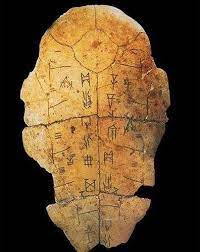
Maybe it is this strange logic that has given divination a place in traditional cultures all over the world. For example, people in China’s ancient Shang dynasty burned turtle shells and used the resulting cracks for divination—a method almost identical to that of the Canadian hunters. The Shang people may have had many reasons for using turtle shells, but imagine that when fighting an enemy, they also used divination results to decide military strategy. Objectively speaking, their strategy might then have looked unpredictable to the enemy, because the results of turtle-shell divination were random too.
For another example, farmers in parts of Indonesia once divined which fields to cultivate in the coming season by observing birds’ behavior. The results were random too, but they also got lucky: In an era when science was underdeveloped, much of the farmers’ knowledge was simply wrong. If they chose fields entirely based on experience, the results were actually worse. Randomly choosing farmland according to divination therefore happened to improve their harvests.
From these principles and examples, we can summarize the right way to use divination.
The Right Way to Use Divination
When should we draw a lot?
My general rule is this: When your behavioral pattern is fairly fixed, and you want to break out of that fixed pattern, you can draw a lot and let the divination result decide what you do.
So when do we especially need to break out of fixed behavioral patterns? I can think of two broad situations—
1. When you’re playing a strategic game against someone else.
When hunters hunt, they don’t want caribou to detect their behavioral pattern; in a competition, a coach doesn’t want the opposing coach to predict their tactics; when setting an exam, a teacher doesn’t want students to guess what topics will appear; in war, a general doesn’t want the enemy to predict the deployment of their troops…
In situations like these, if you believe that keeping your behavioral pattern from being seen is crucial to winning—in other words, if you don’t want the other side to “read your mind”—you can draw a lot and use the result to decide which tactic to adopt, which range of questions to put on the exam, or how to deploy your troops.
Remember, the core secret of divination is randomization. And randomization is the strongest shield against “mind-reading.”
This logic is actually a lot like the strategic battle between Albus Dumbledore and Gellert Grindelwald in Fantastic Beasts: The Secrets of Dumbledore. Grindelwald could predict Dumbledore’s side’s actions to some extent. How did Dumbledore respond? He found a group of people, each of whom had no idea what they were doing, and had them hound Grindelwald relentlessly. Dumbledore was using the Canadian hunters’ trick: If I don’t know what I’m going to do, how could you possibly know what I’m doing?

When I watched the film a few days ago, I also thought the plot was ridiculous: A group of people who were completely clueless the entire time somehow foiled the big villain’s conspiracy. But afterward I thought about it and realized—wasn’t this just using randomization to resist “mind-reading”? The underlying logic actually holds up.
Resisting an opponent’s “mind-reading” during strategic games: that is the first situation in which we need to break out of fixed behavioral patterns.
The first situation is fighting with other people; the second is examining your own mind.
The second situation is—
2. When you notice that your own behavior has become too rigid.
People slip into their comfort zones very easily. You order takeout, and before long you’re stuck with the few restaurants that suit your taste best; you read, and before long you only want to read a few familiar genres.
Over time, your horizons, experiences, and boundaries of knowledge get locked down by your own rigid behavior.
So if you notice that your behavior has become rigid—and that this is starting to make you a little uncomfortable—you can try handing some everyday decisions over to divination.
Before ordering takeout, draw a lot and let divination decide what to eat for lunch; sitting in the library reading room, draw a lot and let divination decide which row of shelves to borrow a book from; on your weekend off, draw another lot and let divination decide which corner of the city to explore. Using divination to break out of rigid behavioral patterns may be the starting point for discovering a new world.
That is the right way to use divination.
You may be about to ask: What does the actual procedure look like? How do you use tarot cards to decide on tactics, the trigrams to choose a book, or Plum Blossom Numerology to choose takeout?
—How would I, a complete layman when it comes to divination, know the details?
But I don’t need to know them. Since the core secret of divination is randomization, all we really need is a process for drawing lots.
Download a random-draw app from the app store, enter all the options, and tap the “Draw Lots” button.
Complete those few steps, and you’ll instantly transform into a great wizard on a par with all the masters of fortune-telling and divination throughout history.
Leave a Reply