This episode is also on Bilibili too.
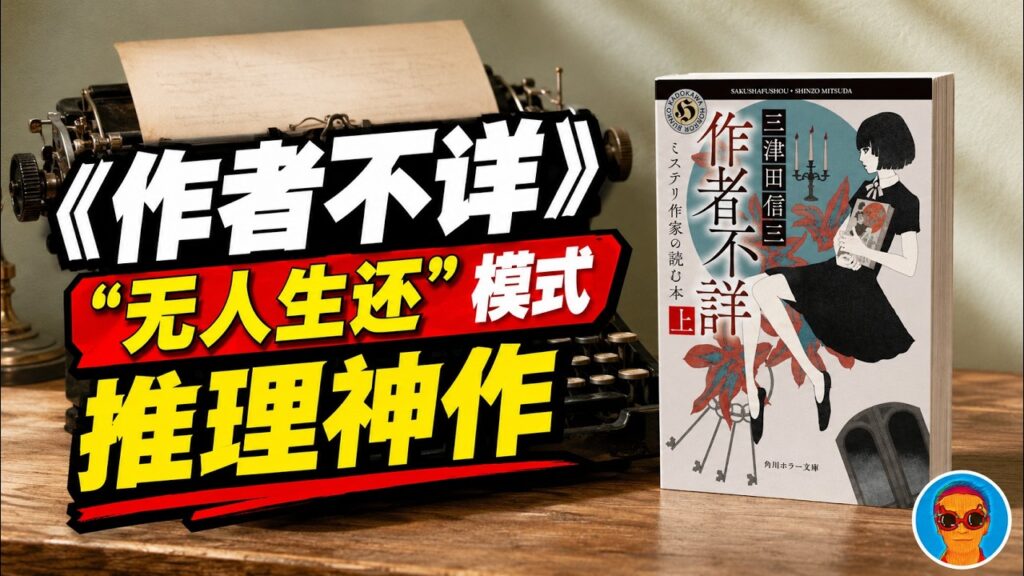
The Suzaku Demon, a chapter in Shinzo Mitsuda’s Unknown Author, is the best And Then There Were None-style novel I’ve read so far. Below, without giving away the solution, I’ll talk about the book as a whole and what makes this short story shine.

The author of Unknown Author (what an awkward phrase~) is the celebrated Japanese novelist Shinzo Mitsuda. Mitsuda writes both mystery and horror, and Unknown Author is his attempt to fuse the two genres. You get startled while solving the case: double the thrills, double the fun.
Unknown Author is one of Mitsuda’s earlier works. He later expanded this mystery-horror hybrid style into the famous Yakushiji series, whose best-known book, The Headless Cursed Thing, is regarded by many mystery fans as one of the finest mystery novels ever written. At the end, the detective uses a single keyword to solve 23 mysteries at once, followed by three jaw-dropping twists. Without Mitsuda’s experiments in Unknown Author, this gem of a mystery novel might never have existed.
And Unknown Author isn’t merely historically important; it is also a rare, genuinely excellent mystery.
Overall Rating
I give Unknown Author an overall rating of 5 stars, with The Suzaku Demon getting 5 stars. I score one story separately because the book has an unusual structure: one long novel links together 7 short stories.
7 short stories, 7 cases. The quality rises and falls, but most are excellent—and the best is The Suzaku Demon.
Translation Quality
Translation quality for Unknown Author: 5 stars.
At present, this book has neither a Simplified Chinese nor a Traditional Chinese edition. I read an online fan translation made by some anonymous wizard, a true labor of love. The translation is remarkably good—respect to everyone who translates for love! Unknown Author doesn’t contain much that would be especially difficult to publish in China, so a Chinese edition will probably appear eventually. If you want to try it now, search for “Unknown Author fan translation” and you should be able to find it.
Reading Threshold
Reading threshold for Unknown Author: medium.
Actually, the book is effortless to read: horror plus mystery, and very stimulating.
The threshold comes from the fact that this is a “meta-mystery” novel—a mystery novel about mystery novels. The book contains a great deal of thought and discussion about the mystery genre itself.
The protagonist is a detective responsible for solving cases, but he also resembles a professor explaining the structure, history, and writing techniques of mystery fiction to students in a literature class. While solving cases, the detective also shares his understanding of the genre itself.
So if you’ve read some mystery fiction before and know the genre’s usual tricks, you’ll find it easier to appreciate what makes this book special—that’s where the reading threshold lies.
On the other hand, mystery fans may already feel they’ve gotten their money’s worth just from the book’s analysis and discussion of mystery fiction itself.
Story Overview (Spoiler-Free)
Now for the actual contents of the book.
The story of Unknown Author goes like this—
The protagonist is a book editor. One day, he and his bookworm best friend happen to hear a strange rumor: a cursed old book has appeared, and everyone who obtained it has disappeared without exception.
Naturally, the two of them choose to make a spectacularly bad decision and get their hands on the cursed book.
What kind of old book is it? A collection of short mystery stories: 7 stories, each describing a case, but every case has only a mystery and no solution. After reading the first story, the two protagonists realize something is wrong. It takes place in a forest covered in dense fog, and then they discover that the fog has invaded reality. In the real world around them, a fog only the two of them can see begins to appear—and it keeps getting thicker.
The bookworm best friend slaps his forehead: If this fog gets any thicker, we might just disappear from the world! How about we try solving the case in the story?
The bookworm best friend is the detective of the book. In no time at all, he reveals the solution to the first story. Sure enough, once the case is solved, the dense fog disappears.
The two of them suddenly understand: the people who disappeared earlier simply weren’t smart enough. Since our brains are clearly top-notch, why not keep tempting fate?
So they read on, one story at a time, and solve one case after another.
That is why Unknown Author has the unusual structure of “a book within a book, a case within a case.”
As the two protagonists keep tempting fate, the bookworm solves cases while occasionally discussing all kinds of mystery-fiction knowledge with his editor friend—the book’s meta-mystery element.
What’s unusual is that the protagonist’s many discussions of mystery fiction aren’t just showing off. They connect directly to the cases. In Killing for Entertainment, one of the seven cases, the three suspects happen to be mystery fans who each favor a different type of mystery fiction. Solving the case therefore requires an understanding of mystery subgenres. Using knowledge about mystery novels to solve a mystery is a pretty fun setup.
The Suzaku Demon—the strongest And Then There Were None story (spoiler-free)
Finally, let’s talk about the book’s best chapter, The Suzaku Demon.
Here’s the basic setup:
A group of middle-school students go on vacation to a mountain villa, but this is no happy getaway. The story is mainly seen through one girl’s eyes. At school, she is bullied, led by the villa’s owner—her classmate, a nasty rich girl. Even on the way to the villa, the rich girl keeps bullying her in front of everyone.
Once they reach this isolated villa, the murders begin, one after another, and the students are killed one by one.
Just when we readers think the bullied heroine is taking revenge, she too is murdered—completely, unmistakably dead.
Even stranger, by the end, everyone in the villa—in other words, every character who appears in the story—has been murdered. Every last one of them is thoroughly dead. So who is the killer?
Any mystery fan will recognize this as a classic And Then There Were None-style case. The pattern was first created by the Queen of Mystery, Agatha Christie, in And Then There Were None. At the end of that story, all ten people on an isolated island are murdered—and they are the only ten people on the island. Logically, the killer should survive to the end, but the story ends with And Then There Were None.
This is a very distinctive mystery-fiction pattern. In Unknown Author, the detective says an And Then There Were None-style mystery must satisfy four conditions—
First, the stage where the events occur is completely cut off from the outside world.
Second, the suspect pool is limited entirely to the characters who appear in the story.
Third, after the events end, every character who appeared is dead—at least, readers must believe so.
Fourth, none of them can be the culprit—at least, readers must believe so. …
The first two conditions also work in another classic mystery pattern, the locked-in-by-a-snowstorm setup. Everyone is gathered in an isolated space whose connection to the outside has been sealed by a blizzard, so the murder occurs in a completely cut-off environment and the killer must be among the characters.
The And Then There Were None pattern is an alternative upgrade built on that snowstorm setup. As I understand it, in the snowstorm setup, people are killed one after another and the living become fewer, but there can’t be too few survivors; otherwise, the suspect pool becomes tiny and readers lose the fun of guessing the killer.
The detective in Unknown Author also says that authors of And Then There Were None stories often have to make the survivors look incapable of committing the crime—some have alibis, some couldn’t possibly enter the locked room, and so on. In short, in the snowstorm setup, the cast is limited, but the number of deaths is limited too.
The And Then There Were None pattern is different. In the detective’s own words from Unknown Author:
(In the And Then There Were None pattern), the cast really does shrink, and there are no locked rooms or alibis to conceal the culprit. On the contrary, locked rooms and alibis can be broken down; only death cannot be broken down. Characters who should have become suspects receive, one after another, an unbreakable alibi: death. That is the greatest difference between the two setups. Fulfilling the third and fourth conditions, especially the fourth (that none of the characters can be the culprit), is what matters most.
So fulfilling the third and fourth conditions, especially the fourth (that none of the characters can be the culprit), is what matters most. And Then There Were None eliminates the people originally identified as killers one by one through their own deaths, until readers discover that no one could possibly have committed the crime. Thinking through where this contradiction lies is the enormous pleasure of the pattern—and the key test of the author’s skill at designing tricks.
For example, a common trick is for the killer to disguise suicide as murder, hiding their identity as the killer. When many veteran mystery fans see an And Then There Were None setup, they immediately start guessing which victim might have used what method to fake a suicide.
I won’t spoil whether The Suzaku Demon uses a similar idea. I can only say that Shinzo Mitsuda devised an exceptionally clever way to hide the killer in this story. The method is fitted seamlessly into several key premises. In my reading experience, this is the cleverest sleight of hand I’ve encountered in an And Then There Were None story.
Only when the solution is revealed do readers finally realize that the real killer has been waving right in front of us from beginning to end—and somehow we never noticed who they were!
If I go on, I’ll spoil it, so I’ll stop here. Please forgive my abrupt exit.
That’s about all I have to say about Unknown Author. I hope the Simplified Chinese edition comes out soon.
Leave a Reply