For many people, the answer is “no”—there is no objectivity in artistic standards. You think the latest Douyin hit is the best thing ever, while I think Beethoven’s symphonies are what art is all about. Both are subjective judgments, with no right or wrong.
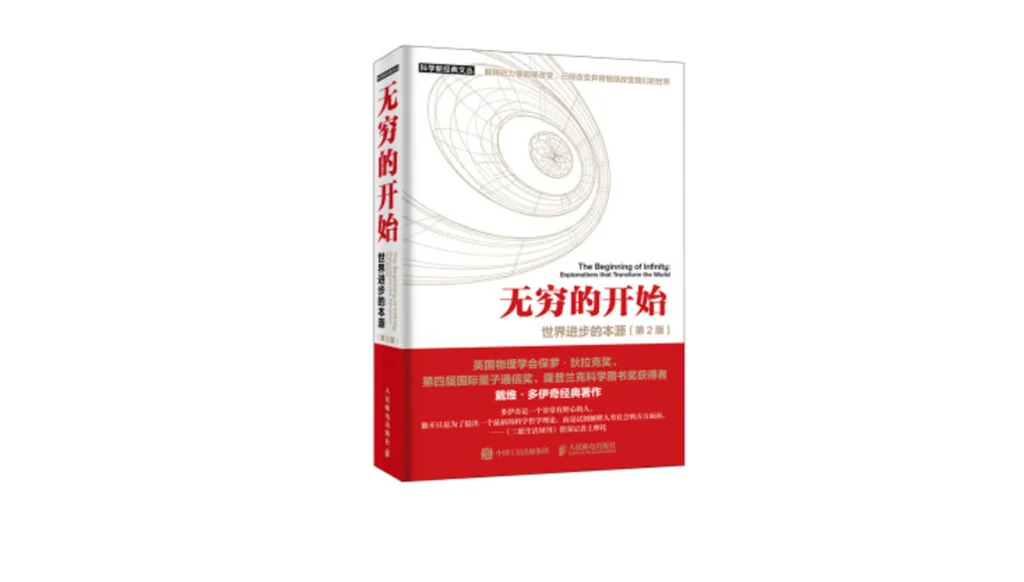
However, David Deutsch proposes a conjecture in The Beginning of Infinity (and compared with everything else in the book, this part really is only a conjecture): beauty may have standards after all. Some objective beauty exists in the world; we just still can’t quite say what those standards are.
So why does David Deutsch think beauty might have objective standards?
Because the very best things often give people the same feeling: add a little more and it’s too long; take a little away and it’s too short.
The very best works of art, for example, can feel as though the creator has found the correct solution to a math problem. After appreciating them, you can’t help having a thought like this:
“How could this sentence possibly be expressed in any more suitable way?”
“This character could only have ended up this way! How could their fate have been arranged more convincingly?”
“If it wasn’t him, who else could it be? It couldn’t possibly be anyone else!”
“How else could the colors on the canvas have been combined? Even a 0.1% increase in the color difference would make it impossible for the image to remain this pleasing!”
In other words, beautiful works of art are like “good explanations”: once proposed, they are extremely difficult to change. For a long time before a new leap in understanding occurs, they give you a feeling of being self-evident, absolutely correct, and leaving no other possibility.
David Deutsch writes in the book:
“‘Change just one note and the beauty of the music would be diminished. Change one passage and the whole structure of the piece would collapse.’ This is how Peter Shaffer’s 1979 play Amadeus describes Mozart’s music. It brings to mind what Wheeler says at the beginning of this book, when discussing the anticipated unified theory of fundamental physics: ‘An idea so simple, so beautiful, that when we … grasp it, we will all say to one another, how could there have been any other possibility?’”
“Shaffer and Wheeler are describing the same property: it is difficult to change something while preserving its usefulness. In the first case, it is a property of good music in the aesthetic sense; in the second, a property of good explanations in science. And while Wheeler says that scientific theories are difficult to change, he also says that they are beautiful.”
“If beauty really is objective, then a new work of art is like a newly discovered law of nature or mathematical theorem: it adds something new to the world that cannot be reduced any further.”
Put another way, perhaps the reason we love David Lynch, Wang Xiaobo, and Albert Einstein is the same. One makes films, one writes novels, and one studies physics; on the surface, they have almost nothing to do with one another. But what they have in common is that they all “add something new to the world that cannot be reduced any further.” Whether it’s David Lynch’s Twin Peaks, Wang Xiaobo’s The Bronze Age, or Einstein’s theory of relativity, each is a good explanation that is difficult to change.
When they appear in the world, you can’t help exclaiming from the bottom of your heart: “How could there possibly be any other possibility?”
We love, from the bottom of our hearts, the people who explain the world to us!
Note
- This article in the “New Insights in Psychology” series was a short popular-science essay/meditation written at the time to accompany the related content of Zhichao Wei: New Insights in Psychology. It was published on the now-closed platform Fatuan, and the original link no longer exists.
Leave a Reply