
This episode is also on Bilibili too.
In this episode, we wrap up Fear of Death: The Driving Force Behind Human Behavior.
Let’s start with a painting. This is Gustav Klimt’s famous work Death and Life:
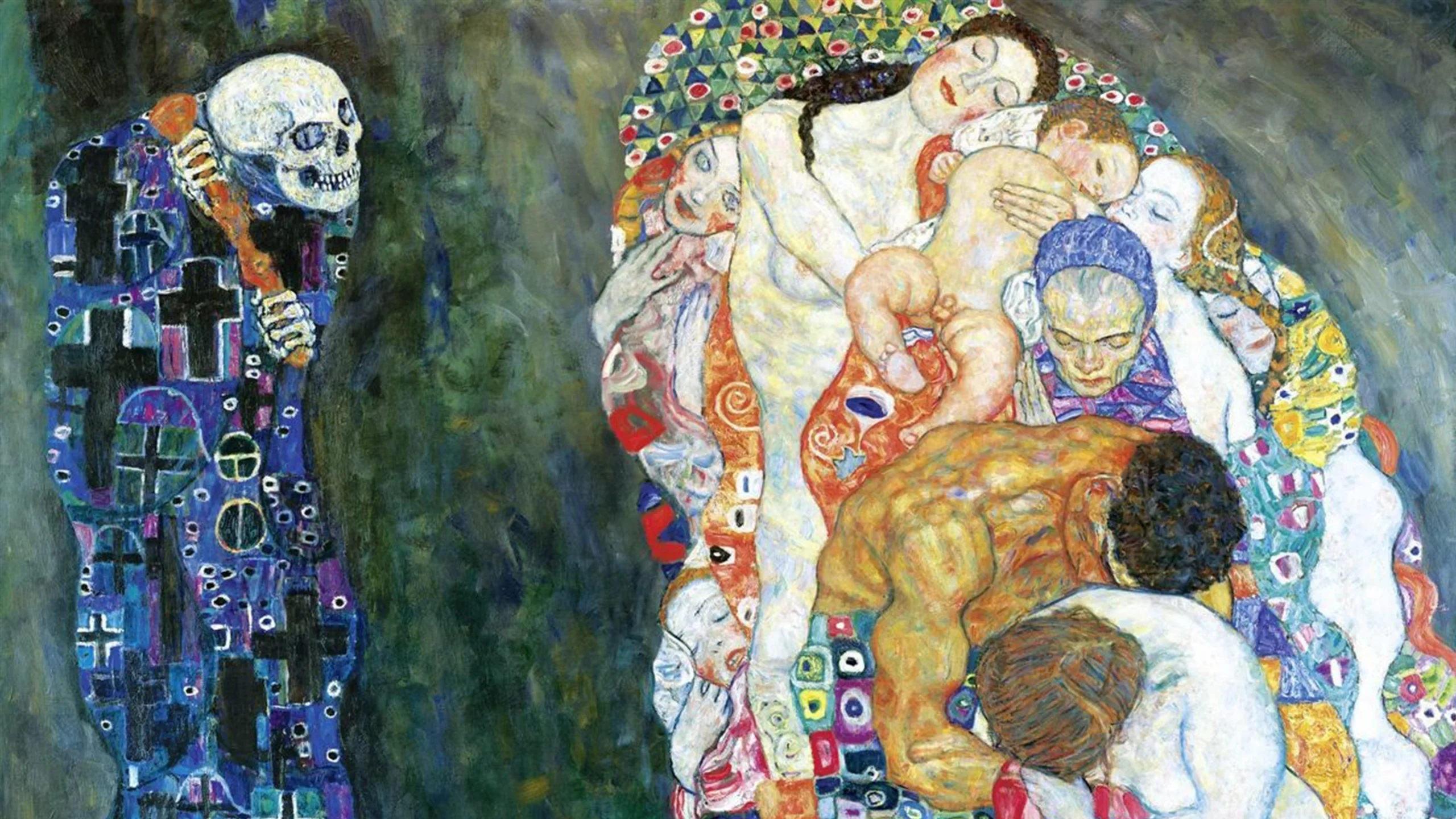
In this painting, most people are asleep, completely unable to see the truth of death. But there’s one young woman who is awake. Her eyes are open, and she faces death head-on. After listening to the previous episodes, we’re now a little like that woman in the painting: our eyes are open, and we’ve seen death. So, faced with death, what can we actually do? How should we deal with our fear of death?
Of course, there’s no simple answer to that question.
Let’s start with the thoughts of some philosophers.
First of all, many philosophers, independently of one another, have come to the same conclusion: we shouldn’t run away from our fear of death. We should face it head-on.
If we accept the reality that we are destined to die, that can actually reduce our panic about death. It can also make us cherish the ordinary details of each day more. This attitude is what’s known as “living toward death.” In other words, many philosophers have a very low opinion of the “proximal defenses” I talked about last time—those self-deceptive “not me, not now” maneuvers.
Across different eras and places, human beings have found many different ways to face death. Medieval European monks kept a skull on their tables. Tibetan lamas used skull bowls in rituals to remind themselves of life’s impermanence. Some sages in both the East and the West liked to sleep beside coffins—or inside them. The Stoic philosophers of ancient Greece and Rome made “All mortals must die” a core tenet.
The philosopher Michel de Montaigne argued that death is an enemy we cannot evade and can only face. He once wrote:
—Let us stand our ground bravely and fight it. To take away its greatest advantage over us, we must fight it by means entirely opposed to the usual ones. Let us first strip away our unfamiliarity and ignorance of it. Let us talk with it, get acquainted with it, and think of it as often as possible. On every occasion, we should summon its image into our imagination. When the horse we’re riding stumbles, when a roof tile happens to fall, or even when we’re pricked by a tiny needle, we should immediately think about it and ask ourselves: “What would I do if death came right now?”
Montaigne continued:
Even in the middle of a lavish feast, we must constantly remember how fragile our lives are, so that we don’t become overly immersed in pleasure. But whenever we have some free time, we should reflect on how easily our pleasures can lead to death, and how death threatens the insignificant pleasures of our lives.
The philosopher Martin Heidegger believed that everyone should recognize themselves as a “being-toward-death.” Since everyone must experience their own death, bravely recognizing and accepting the reality of death, and living authentically, are things everyone must do.
From a psychological perspective, I can understand these philosophers’ advice. The psychological principle behind living toward death is actually the contrast effect: we use death—the biggest possible source of misery—as a contrast against the things that bother us in daily life. Suddenly, those everyday troubles don’t seem quite so terrible. In this way, fear of death can actually make you savor your ordinary life.
From this perspective, the philosophers’ advice is sound, and plenty of people really do practice this way of living. I do it pretty often myself.
But the philosophers’ version of living toward death isn’t necessarily suitable for everyone. It comes with some negative effects.
After the previous episodes, we know that unconscious fear of death can activate distal defenses: embracing self-esteem, embracing our worldview—or, put another way, becoming even more desperate to find meaning in life.
But meaning in life isn’t that easy to find. What happens if you can’t find it?
In fact, many people compulsively keep asking themselves: What am I alive for? Where is the meaning of my life? They ask and ask, but never get a satisfying answer. Eventually they fall into nihilism, feeling that nothing in this world has any meaning, and that their own lives have no meaning either. At that point, they’ve entered a special depressive state called existential depression.
So, for some people, if they follow the philosophers’ advice and keep confronting death, the first possible negative effect is that they may be at risk of falling into existential depression.
In psychotherapy, there’s a school called existential therapy, which is specifically aimed at this kind of existential depression. Its main approach is to help patients develop a less grandiose view of life, encouraging them to focus their energy on everyday matters closely connected to living—in other words, to pay more attention to the small joys of daily life and a little less attention to the meaning of life. As you can see, this advice is almost directly at odds with what those philosophers said. Existential therapy is essentially about getting patients to activate proximal defenses, using daily affairs to push thoughts of death out of conscious awareness.
This direct opposition also shows us that there may be no one-size-fits-all solution to dealing with fear of death. How should we balance living toward death against paying more attention to the small joys of daily life? It depends on the person and the situation. You’ll have to figure it out for yourself.
The philosophers’ advice to live toward death has a second negative effect: it can make people narrow-minded. In the previous episodes, I talked about many experiments that revealed the same pattern: unconscious fear of death makes people cling even more fiercely to their own values, while rejecting and belittling values different from theirs. Clearly, that may not be a good thing.
In the classic 1941 horror film The Wolf Man, there’s a line of dialogue that goes like this: “For some people, life is simple. They decide for themselves that this is good and that is bad… There are no shades of gray or shadows in the world; everything is either black or white… But some of the rest of us see good and bad, right and wrong, as multifaceted and complicated. We try our best to see every side of things, but the more we see, the harder it becomes to be certain about the good and bad, black and white, right and wrong in things and people.”
This dialogue reflects two different worldviews. One is rigid, and the other is flexible.
A rigid worldview is an all-or-nothing worldview. Only what I believe is absolute truth; everything else is twisted nonsense. This worldview is the most effective at warding off fear of death. But all-or-nothing beliefs have caused countless atrocities and killings throughout human history.
The opposite of a rigid worldview is a flexible worldview. A flexible worldview acknowledges the world’s ambiguity and uncertainty; it accepts that all beliefs and creeds contain some degree of uncertainty. People with flexible worldviews may take their own beliefs very seriously, but they are willing to remain open to other people’s views. They don’t assume that truth can only be held in their own hands. Clearly, this is a worldview more conducive to cooperation and resolving conflict. But it creates a problem: from the perspective of a flexible worldview, all meaning and value in human life are ambiguous and unsettled. So people who hold a flexible worldview often feel deeply uncertain and uneasy inside.
And so we find ourselves in a bind. A rigid worldview can provide plenty of psychological comfort, but it can also make us blind and narrow-minded. A flexible worldview may make us more compassionate, but it can instead intensify our anxiety about death.
Should we live toward death, or focus on the small joys of daily life? That’s one trade-off. The choice between a rigid worldview and a flexible worldview is another. Can we hold firmly to the values we believe in while also making room for other people? This question has no definite answer either. You’ll have to feel your way toward your own point of balance.
All right, that brings us to the end of our discussion of fear of death and all the key ideas from Fear of Death: The Driving Force Behind Human Behavior. Earlier in the show, I left a dangling thread—I said I planned to make a series called “Death and Consciousness.” Now that we’ve finished discussing Fear of Death: The Driving Force Behind Human Behavior, I’ve at least taken the first step toward tying up that thread.
We’ve talked about fear of death at length, but we actually skipped over its core: consciousness, which I mentioned in the very first episode. It’s precisely because we are conscious, and know that we exist in space and time, that we’re so afraid of not existing someday. Without consciousness, there would be no fear of death.
Consciousness is a topic I’m even more interested in—and one that becomes more terrifying the more you think about it—than death itself. It involves philosophy and the ultimate question of existence. Philosophers, neuroscientists, and psychologists have already arrived at some startling speculations and conclusions about consciousness. So the series “Death and Consciousness” isn’t over yet. We’ll pick it up again in the future.
Written by: Zhichao Wei
Leave a Reply