[This article was written years ago after the entire run of LOST had concluded. It contains major spoilers, so if you haven't finished the series, enter at your own risk!]
The Launch of the Dharma Initiative
Last time, I said that humanity’s unprecedented technological progress brought Jacob both a challenge and an opportunity—if human power had grown strong enough to start coveting the realm of the gods, why not borrow human science to give himself a hand? Maybe the power of human science could help him find a once-and-for-all way to eliminate the Man in Black. That would be the ideal outcome. But even if science couldn’t reach that lofty goal, it might still help him find some temporary way to restrain the Man in Black and become an ally.
So Jacob decided to bring human scientific power onto the island and let them study the various strange properties the Source of life had bestowed on it. Science thus became an important supporting strand in Jacob’s candidate plan.
But who would run this scientific project? Jacob was good at tracing the tracks of fate, so the easiest method was to follow a strand of fate close at hand. Just as he did when finding candidates, he could follow that strand from one person to the next until he found a suitable candidate. So Jacob started with Richard, then followed Richard’s fate to Captain Hanso, who had brought him to the island, and from Captain Hanso’s fate to Alvar Hanso, one of Hanso’s descendants still living in the modern world. Alvar was an arms dealer. Jacob saw that he was a suitable choice: he had money, and perhaps he could use his position as an arms dealer to obtain the U.S. military’s accumulated information about the island.
So Jacob appeared before Alvar Hanso and, whether by displaying divine power or by psychological manipulation, ultimately succeeded in recruiting him as a subordinate.

Jacob said to Alvar:
Your task is to establish a scientific research organization whose subject is an island. Its strange properties go far beyond your imagination. Your job is to figure out as much as possible about everything on the island: the properties of its magnetic field, its spacetime characteristics, and its physiological and psychological effects on people and animals—everything on the island is an object of your research.
One thing to note is that on the island you may encounter a “monster” hostile to you. It is one with the island’s power, and the more thoroughly you understand the island’s properties, the more likely you are to find a way to deal with it. You can begin your research with the U.S. military’s discoveries from several years ago. They happened upon the island and accumulated a body of information about it. That information will be the foundation of your research. I will help you use your identity to obtain those materials, which the U.S. military no longer cares about. I will give you enough money to get your research off the ground. Do not let your subordinates know the true purpose of the research; they only need to know what they are supposed to do.
And so the Dharma Initiative, led by Alvar Hanso, was formally established.
Dharma’s first station was in the basement of a church somewhere in Los Angeles. It was named the Lamp Post station. Its research was based on the materials obtained from the U.S. military—the information they had accumulated around the time they discovered the island. The Lamp Post station’s main purpose was to determine, by some method, the location of the island while it was hidden in spacetime, and establish a connection between the island and the outside world, preparing the way for later stations and research projects. Years later, this part of the plan succeeded thanks to the efforts of a “smart person” (as Ms. Hawking put it).
Members of the Dharma Initiative began arriving on the island.
True to Jacob’s style, he did not tell Richard or the Others the truth about Dharma. In fact, Jacob wanted Dharma and the Others to keep each other in check. Conflict between the Others and Dharma was therefore inevitable. But under Jacob’s subtle intervention, the Others and Dharma later reached a truce and avoided any major conflict for quite some time—until the Purge. These two forces were sworn enemies, yet in reality they served the same boss; they simply didn’t know it. I discussed the relationship between Dharma and Jacob in my article “Jacob’s Chessboard.” Some of the evidence there needs correcting, but the broad idea still holds. In short, my view is that Dharma was entirely arranged by Jacob.
Dharma’s management style inherited Jacob’s, which was: keep everything mysterious. Basically, the Dharma staff working on the island later knew nothing about the overall project beyond the little task they were assigned. The entire operation was packed with lies and rumors, and everyone was being conned into doing their work. Even so, the research moved forward. Some projects made considerable progress. For example, Dharma actually invented a sonic fence to keep out the Black Smoke. Jacob’s other henchman, Widmore, later put this achievement to use. But that’s a story for later.
The Numbers
When Dharma was established, Jacob also handed Alvar Hanso a note bearing a string of numbers: 4, 8, 15, 16, 23, 42. Jacob said to Hanso: After you get to the island, build a radio transmitter there and broadcast this string of numbers. Don’t ask about their meaning; just keep broadcasting them. As for how to explain it to your people, make up any reason you like.
So Alvar Hanso took this string of numbers, mixed it with the atmosphere of the Cold War, and cooked up a cover story about “the world being on the verge of destruction, with only the Valenzetti Equation capable of saving it.” Dharma’s research goal, supposedly, was to alter the parameters of the Valenzetti Equation. This was used to fool the staff of the Dharma Initiative, while the made-up Valenzetti Equation also served to explain a string of numbers whose meaning Alvar himself did not understand.
Alvar Hanso’s video about the Dharma Initiative:
Later, Dharma arrived on the island, built the radio station Jacob had requested, and repeatedly broadcast the numbers. Dharma staff were told that if the numbers did not change, it meant the research had failed—although in reality the numbers had absolutely nothing to do with whether the research succeeded. Inside Dharma, however, the numbers had been given great significance by that fabricated cover story, so they appeared like a totem throughout Dharma’s facilities: on the hatch door of the Swan station, for instance, and as the password entered into the Swan’s computer.
The numbers really do have great significance, just not here. As I said in the previous installment, their true significance is this: the candidates represented by the numbers were Jacob’s favorites and, in the end, the candidates most likely to become his successor. So why did he give the numbers to Alvar Hanso and have them broadcast from a radio station? To answer that, we have to return to Jacob’s fate-guidance plan for the candidates.
Launching the Fate-Guidance Plan
As I explained earlier, after using threads of fate to identify the candidates, Jacob did little more than observe them at key points in their lives. He did not interfere much with their fates; he simply waited for the right moment. Once that moment arrived, Jacob released a signal and activated a mechanism of fate guidance, drawing the fates of the candidates on his list back together and ultimately bringing them all to the island.
The signal that activated the fate guidance was this very string of numbers.
The right moment to activate fate guidance was 1988. On one day that year, Jacob temporarily lifted the island’s spacetime shielding, allowing radio signals from the island to be received by the outside world for a very short time. Jacob’s power attached itself to the signal, and from that moment began changing the candidates’ fates. The string of numbers was received by Rousseau’s scientific expedition, which happened to be near the island, and by Leonard Simms, who later met Hurley in a psychiatric hospital. From that moment, the fate-guidance plan was officially launched.

The Curse
But something unexpected happened. Jacob underestimated the power of the Black Smoke. In that brief instant when the island’s shielding was lifted, the evil-source power within the Black Smoke also took the opportunity to be released along with the power guiding fate. As a result, the numbers acquired a destructive power in addition to their power to guide fate—the numbers carried a curse. Perhaps the Black Smoke realized that Jacob was using this method to summon the candidates and intended to use it to eliminate them. Unfortunately, the candidates were already protected by the seal, so the Black Smoke could not harm them directly. Instead, the people around the candidate who came into direct contact with the numbers—Hurley—began suffering one mishap after another.
But whatever the case, Jacob’s fate-guidance plan ultimately succeeded, and most of the candidates were eventually brought to the island.
That is the relationship among Jacob, Dharma, and the numbers. It is one of LOST’s most difficult mysteries: if the numbers were the identification numbers Jacob assigned when choosing the candidates, how did they become Dharma’s “totem” and happen to be received by Hurley? What I have offered here is a logically coherent conjecture about these mysteries.
John Locke
Before the fate-guidance plan got underway, one other event of some importance took place: the birth of John Locke. Locke was also one of the candidates Jacob found by following the chain of fate, but he was unusual. And his unusual nature may have originated in a misunderstanding. That misunderstanding was the later spacetime jump. During the great spacetime jump triggered when the wheel jammed as Ben left the island, Locke was sent back to Richard in the 1950s. To prove who he was, he told Richard the time and place where he would be born several years later. But before Richard could recover, Locke was whisked away. Naturally, Richard remembered the encounter vividly. Several years later, he went to the hospital Locke had named. It was 1956, and Richard did indeed witness the birth of a baby named John Locke.
Little Locke was a severely premature baby who should have died, but miraculously survived. This astonished Richard and further convinced him that Locke was someone extraordinary. But without any concept of time travel, Richard could only explain his ghostlike encounter with Locke using the framework of knowledge he already had—he mistakenly assumed that the baby Locke was the reincarnation of the adult Locke he had met years earlier. Richard probably thought that the Locke he had met before was a Buddha-like sage who had seen through past and future lives and could therefore predict the time and place of his own rebirth.
So when Locke was five, Richard visited him again. When Richard saw a drawing of the Black Smoke on the wall, he became even more certain that the Locke before him was the reincarnation of some island deity. Richard therefore tested Locke according to the Tibetan Buddhist ritual for identifying a tulku, asking him to identify an object that “already belonged” to him. Naturally, the object was the compass that the future Locke would hand Richard. But little Locke, who could draw the Black Smoke, did not “remember” ever possessing the compass. Richard was deeply disappointed, decided he had misjudged the boy, and left in a fury.
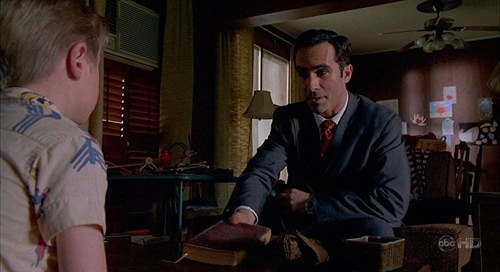
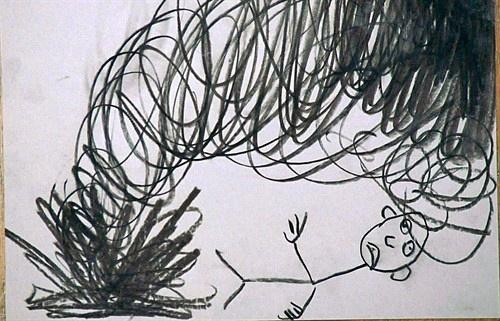
This is another of LOST’s major mysteries. Why could little Locke draw the Black Smoke? Little Locke had never been to the island before. The fact is that Locke would not set foot on the island or encounter the Black Smoke until decades later, in the future.
So the simplest explanation is: little Locke had seen the future!
Assuming little Locke really had seen the future, was anyone else in LOST able to foresee the future? What did they have in common? Could little Locke’s case have been like theirs?
Besides little Locke, there were indeed two other people in LOST who saw the future (Jack did too, actually, but I’m leaving him out here; I’ll get to him later). They were Desmond and Juliet.
Strictly speaking, Desmond and Juliet did not see the future. They formed a kind of psychic connection with their afterlife selves in the purgatory world (that is, the Flash-sideways world in Season 6). And the self in that afterlife world was not predicting the future, but “looking back” over the whole world of life before death.
LOST’s Worldview
Here I have to pause and say a few words about LOST’s worldview.
LOST’s entire worldview is divided into three parts: the real world of life, the purgatory world of the afterlife, and the Nirvana world. In LOST, when people die, if their souls are not trapped in the world of the living for some reason (like Michael), they enter a purgatory world after death. This purgatory world is the Flash-sideways world in Season 6. It is called “purgatory” not because it is a place where people suffer, but simply because that was the term the writers themselves used (it originated when viewers guessed that the people on 815 were actually already dead and that the island was a purgatory world, after Naomi said in Season 4 that everyone on 815 was dead. The writers came out to debunk that idea at the time, saying the island was not purgatory—only for everyone to discover later that the Flash-sideways was).
People who first arrive in the purgatory world have no memories of their lives before death. The purgatory world is not a fixed place; here, the human mind is the world. It is projected by every soul within it. Each person’s purgatory world may be different: some people who do not know their own sins accept punishment for them here (such as Kimmy and Mikhail); some atone here for the sins of their lives before death (such as Ben); some make different choices here (such as Sawyer); some remain obsessed with what they were obsessed with in life and cannot move on (such as Ms. Hawking); and some continue unfinished relationships from life (the black-and-white couple and Jin and Sun).
God may have arranged such a place to give people a chance to recover the most precious memories of their lives, reunite with the people they valued most, and make up for their greatest regrets or wrongs. When some kind of catalyst touches them, the souls in purgatory remember everything that happened in their lives. Then, grateful for that most precious experience, they let go of everything from life and welcome Nirvana. The purgatory world is a way station for a soul before it finally reaches Nirvana. Only those who finally recover what was most precious in their lives there can move on into the third world—the world of Nirvana. There, sunlight shines over a peaceful paradise, the most beautiful place in the world, and the soul’s final home.
In this way station called the purgatory world, there is no concept of time or space. It is both the past and the future. People from different times meet again here. Those whose relationships were unfinished in life, regardless of the order in which they died, project their souls into a shared purgatory world, where they relive things and make new choices until one day they awaken to the truth. The purgatory world is one of continual cycles of rebirth. Those who have not awakened (Ana-Lucia), or who have awakened but still have not let go (Ben and Ms. Hawking), continue cycling through it. Ben will meet his daughter again; Ms. Hawking will again watch her son become a musician, a painter, and so on. As for the people around them then, they may be others who have likewise not awakened, such as Ana-Lucia, or figures projected from their souls, like Jack’s son. In short, only when someone finally lets go during one of these cycles can they leave purgatory and move toward Nirvana, while everyone else remains to keep cycling there.
This is LOST’s worldview.
Desmond’s Glimpse of the Future
Normally, a soul enters the purgatory world only after death. But under one highly unusual set of circumstances, a living soul can connect with its afterlife self. I thought it through and realized that two conditions must be met at the same time. First, the person must be close to death—in other words, with one foot through death’s door, his soul practically out of his body. Second, this half-dead person must be within the energy field of the island’s Source of life.
Let’s start with what happened to Desmond.
Desmond was once caught in the center of the Swan station’s electromagnetic storm (one of the island’s “pockets” of the Source), blasted so hard that his clothes were blown off, yet his remarkable constitution somehow brought him back from death’s door. At the moment of his death, his soul had actually entered one of the purgatory world’s cycles.
Remember, the purgatory world has no concept of time or space. It is both past and future, so these souls who accidentally intrude while they ought to be in the world of the living may intersect with any point in the purgatory world. At first glance, the cycle Desmond entered looked very much like the world he had lived in, except that certain details felt dreamlike (such as the microwave’s sound and the house number given by the deliveryman). The strangest thing was that when he decided to change his “future,” Ms. Hawking appeared out of nowhere—a person he had never met—and told him not to try to change this world. The world had arranged a destiny for everyone, she said, and he should not resist.
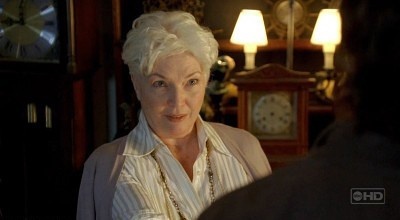
When Desmond ultimately decided to change his “future,” he suddenly jumped from the purgatory world back into reality, and from then on he had the ability to foresee the future.
Now we know that Des was not, as he himself believed, returning to his own past. He had entered the purgatory world, in a cycle that may have occurred before the Season 6 Flash-sideways. In that cycle, Ms. Hawking had already realized that she was in a purgatory world after death, before anyone else had awakened. The greatest guilt of her life had been the death of her son, Dan. Seeing Dan happy in this new world was therefore her greatest unfinished wish—and the fixation she could not see past. Ms. Hawking would rather watch her son live a happy life again and again in purgatory than leave it and enter Nirvana.
To that end, she protected the illusion of the purgatory world at any cost. She would not allow anyone who threatened her ability to keep “dreaming” to awaken the people in purgatory. Desmond, full of doubts about the purgatory world, was therefore Ms. Hawking’s greatest threat. What she feared most was that one day Desmond would awaken her son too, ending her “dream” before she was ready to let go. So when Desmond began questioning the purgatory world, Ms. Hawking, sensing what was happening, appeared to persuade him to accept the world’s arrangement.
After Des returned to the world of the living, he gained the ability to see the future. As I said earlier, this is less a matter of foresight than of looking back. Although the purgatory world has no concept of time or space, it is still the world after death. In that world, those who have awakened can of course “look back” over everything that happened during their lives. Because the living self overlapped with the afterlife self in purgatory, the living Desmond glimpsed the past that his purgatory self had “once” seen.
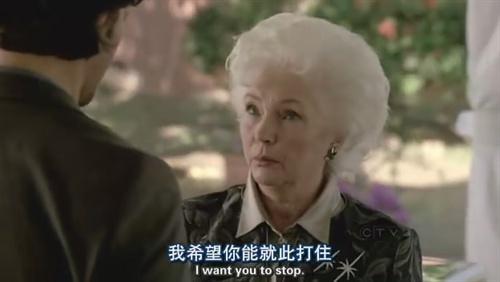
Desmond’s second visit to the purgatory world came after Widmore nearly killed him with an electromagnetic blast in Season 6. At the moment of death, Desmond’s soul once again entered the purgatory world and overlapped with his afterlife self. This time, he arrived in the Flash-sideways world projected collectively by most of the 815ers in Season 6. Ms. Hawking in this cycle tried the same old trick, hoping to stop Desmond from awakening everyone. But this time Des succeeded, and the others awakened. Des knew that Ms. Hawking had not overcome her inner obstacle, however, so he did not awaken Dan, leaving mother and son to continue cycling through purgatory.
Juliet’s Glimpse of the Future
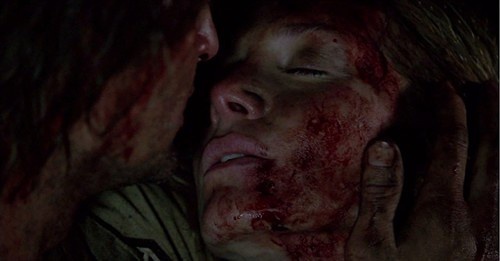
Juliet fell into the well beneath the Swan station and triggered an enormous eruption of energy in the pocket with a nuclear bomb. This not only returned everyone to normal time and space, but also exposed her to the energy field of the Source of life. On top of that, the badly wounded Juliet was at the moment of death, so she met the two conditions for crossing into the purgatory world. Her soul also entered purgatory and overlapped with her soul there. At the moment of death, she said to Sawyer, “We can go Dutch”—the same thing her afterlife self later said to Sawyer in purgatory. When Juliet told Sawyer, “We made it,” it was because, while overlapping with her afterlife self, she either looked back at the world of the living and saw how things turned out for the people she loved, or learned the ending of the whole story from the afterlife Sawyer. That was how she knew they had “made it.” This was how she saw the future at the moment of death. If Juliet had survived, she would have predicted the future just as Desmond did.
Little Locke’s Glimpse of the Future
All right, so the other two people in LOST who glimpsed the future did so because, at the moment of death, they were exposed to the energy field of the Source of life. What about little Locke?
One: Locke did have a moment of death—that was when he was born prematurely, with his life hanging by a thread.
Two: The critically ill infant Locke was indeed within the energy field of the Source of life, because Richard—the man who had been infused with the Source and granted immortality—was standing nearby when Locke was born. It was Richard who placed Locke, at the moment of death, within the Source’s energy field.
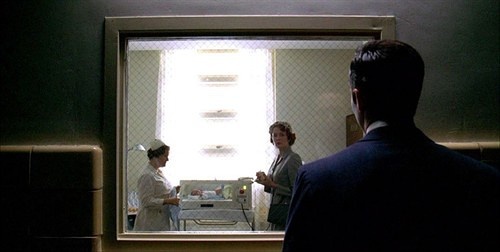
So infant Locke actually went through the same thing Desmond and Juliet would later experience. Infant Locke’s spirit had traveled through purgatory, and so, like Desmond and Juliet, he had once “looked back” at images of the future.
He was simply too young for those images to remain in his memory in any meaningful form. Perhaps for little Locke they later became no more than scenes from dreams, and eventually, once he grew up, he forgot them entirely. That is why little Locke could draw the Smoke Monster. If Richard had pressed him at the time—“Where have you seen it?”—Locke might have answered, “In a dream.”
That is my theory about the great mystery of how Locke could draw the Smoke Monster.
The Consequences of the Swan Station’s Electromagnetic Storm
Now, back to what happened after the Dharma Initiative came to the island.
When Dharma arrived on the island, it was already the 1970s. After they got there, they went through a period of conflict with the Others. The two sides then reached a truce: no aggression, no interference, and no contact.
Ben, who would later become the leader of the Others, came to the island with his father, who had been recruited by Dharma. Richard noticed Ben when he was a child because Ben could see the dead. Ben later became an undercover agent among the Others.
Young Ben and the Others had an encounter with Sawyer and the others who had traveled back to the 1970s. I won’t go into the details here. It ended when Juliet detonated the nuclear bomb. As far as Dharma was concerned, they assumed Sawyer’s group had been killed in the Swan station’s electromagnetic storm. The nuclear explosion did not cause a large-scale disaster. In fact, it merely triggered an eruption of the Source’s energy, creating some kind of distortion in space-time that transported Sawyer and the others away, without inflicting fatal damage on the island. But from then on, the magnetic pocket beneath the Swan station became extremely unstable. Dharma did not want to abandon the station because the pocket was a precious research resource. Rather than release it all at once, they designed a control mechanism to stabilize it, though the electromagnetic field had to be released periodically.
That was the situation in the Swan station later on: every 108 minutes, the staff entered a sequence of numbers to release the electromagnetic field.
This electromagnetic storm may have caused some kind of disruption in the Source of life. From then on, pregnant women on the island were doomed to die—the island could no longer give birth to new life. That left the Others, who liked to “start the revolution with the children,” with no children to recruit. So the kids who later arrived on the island became hot commodities that the Others fought over—this is why the Others later took such delight in playing creepy uncles and snatching children.
The Massacre
“Peace” was broken in 1993. Something crucial may have changed that year, making Jacob feel it was time to get rid of Dharma. This crucial change was either that Dharma could no longer make any progress in its research on the Island, or that it had made too much progress—so much that it could strike a devastating blow against the Island at any moment. In the first case, Dharma was no longer useful; in the second, although Dharma might have posed a threat to the Smoke Monster, it would also have threatened Jacob and the Island.
Whatever the reason, that year, at Jacob’s urging, the Others broke the truce. Working with the inside man Ben, they wiped out Dharma on the Island. Dharma’s people and resources outside the Island did not retaliate either, and the off-Island Dharma resources (the Lamp Post station, the submarine, and so on) soon fell into the Others’ hands. Clearly, this was also the result of Jacob threatening, ordering, or otherwise outmaneuvering Alvar Hanso behind the scenes.
The Swan Hatch’s Oddities
Strangely enough, two Dharma members on the Island survived the massacre: Stuart Radzinsky and Kelvin Inman, who were working in the Swan Hatch at the time.
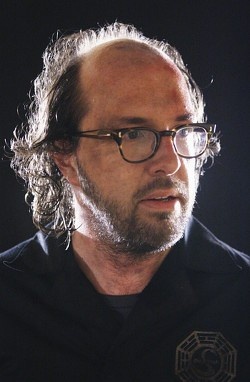
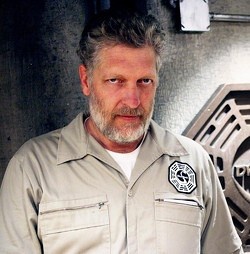
Radzinsky designed the Swan Hatch. He was something like a mid-level Dharma cadre, knew a few more secrets, and belonged to that special category of people who were half conned and half con artists themselves. Kelvin, on the other hand, was recruited later and was a pure victim of the con.
The Swan Hatch’s job was unbelievably boring, yet had to be carried out by the book. So the Swan Hatch had its own system of brainwashing to force its workers to do the job. One method, for example, was Dharma’s all-purpose cover story: saving the world. Kelvin once genuinely believed that pressing the button was saving the world, and later used the same story to con Des. Another method was to create an atmosphere of isolation, turning the Swan into an island within the Island. Naturally, Swan Hatch personnel were the most thoroughly conned of all Dharma employees. They may never have been allowed to interact with other Dharma personnel on the Island, and may not even have known those other members existed, because they had also been told that the Island was filled with deadly toxins. They therefore wouldn’t leave the hatch casually, or even go very far from it—the source of that “quarantine” label on the hatch door. If the whole crumbling Island was poisonous gas and the hatch was the only cozy safe haven, who wouldn’t willingly become a shut-in? And so the promising young Kelvin was conned into pressing the button under Radzinsky’s supervision.
Because the Swan Hatch was cut off from the world, the people inside were also extremely wary of the outside, making it difficult for the Others to approach. So it was hard for the Others to take the hatch by force. Besides, the Others had used poison gas in their massacre, while the people in the Swan already believed that everything outside was poison gas. Were you really going to try poisoning them with poison gas? They could grab a gas mask without even thinking. More importantly, the Others were wary of throwing stones at a rat—they knew the Swan Hatch was sitting on top of a ticking time bomb. If something went wrong during an attack and caused an electromagnetic storm, who knew what the consequences would be?
Still, since the people in the Swan were already cut off from the outside world, why not simply let them keep working there? As long as someone pressed the button, it didn’t necessarily have to be one of the Others. The Others only needed to keep an eye on them. As luck would have it, the Swan was also a cover for one of Dharma’s psychology research projects: the situation inside the Swan could be monitored at any time from the Pearl station. So the Others simply let Radzinsky and Kelvin remain in the Swan. Even better, the logistics department outside the Island, responsible for regularly air-dropping food and medicine to the Island, had never received the news that Dharma had shut down. It kept dropping supplies, ensuring food for the Others while also allowing the Swan Hatch to hold out indefinitely without any other outside help.
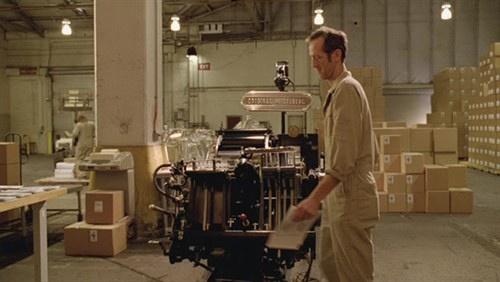
Of the two people in the Swan Hatch, Kelvin was a complete idiot, while Radzinsky understood half of what was going on. He probably discovered the massacre of Dharma not long afterward, but with all contact with the outside world completely cut off, there was nothing he could do. All he could do was hide in the Swan Hatch.
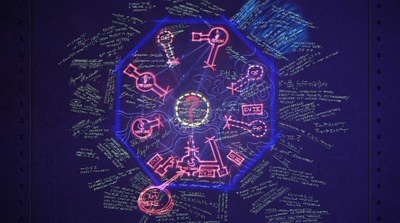
Radzinsky was a good comrade with a strong sense of responsibility. Trapped behind enemy lines, he still wanted to preserve the results and materials Dharma had painstakingly accumulated over the years. But hiding them from the enemy while passing them on to future generations was no easy task. So Radzinsky thought of using special ink to draw some of Dharma’s most important information on the doors of the Swan Hatch’s various rooms. He and Kelvin spent years painstakingly painting the information onto the hatch doors, where it could appear only under ultraviolet light. Radzinsky hoped this would preserve Dharma’s materials while keeping them out of the Others’ sight. Basically, this was the same trick we learned in elementary-school textbooks, the one used by Li Ning while in prison: write with milk in the seams of a sheet of paper, pass it to a comrade, then heat it over a flame and watch the words appear. But if Radzinsky had known one thing, he would have been seriously depressed: the Others could actually see his every move from the Pearl station. Because Dharma loved its mysterious style, the leader of the Swan Hatch had no idea what the Pearl was up to. So this elaborate deception was entirely a waste of effort.
Desmond Arrives on the Island
After painting murals for several years, Comrade Radzinsky finally broke down and shot himself. The commander died before fulfilling his ambitions, and Kelvin took up the revolutionary gun. But Kelvin gradually began to figure out some of the truths about the Island too—for instance, that the “quarantine” was complete nonsense. At this rate, Kelvin was bound to break down as well. Fortunately, just as he was nearing the breaking point, Desmond unexpectedly arrived. Desmond had also been drawn to the Island by the pull of the destiny project, except that he was not a candidate. He was a secret weapon who could be deployed in reserve against the electromagnetic field. By then Kelvin had grown into a master con man. He tricked Des into taking over the button-pressing (he was still afraid the world might actually be destroyed), while planning to escape on Des’s boat himself. Des caught up with Kelvin and accidentally killed him. As a result, he missed the time for pressing the button.
Jacob’s force of destiny pulled Des with one hand toward that moment when he would miss the button, while with the other it drew the candidates into all kinds of coincidences that put them aboard Flight 815. At the moment 815 flew over the Island’s region, those two hands finally converged. Des missing the button caused the Island’s electromagnetic field to briefly run out of control. The Island was exposed to the outside world, while the field tore 815 apart in the sky.
Flight 815 crashed—and so, my God, after writing more than twenty thousand Chinese characters, I had finally reached the beginning of the series LOST.
(To be continued.)
Leave a Reply