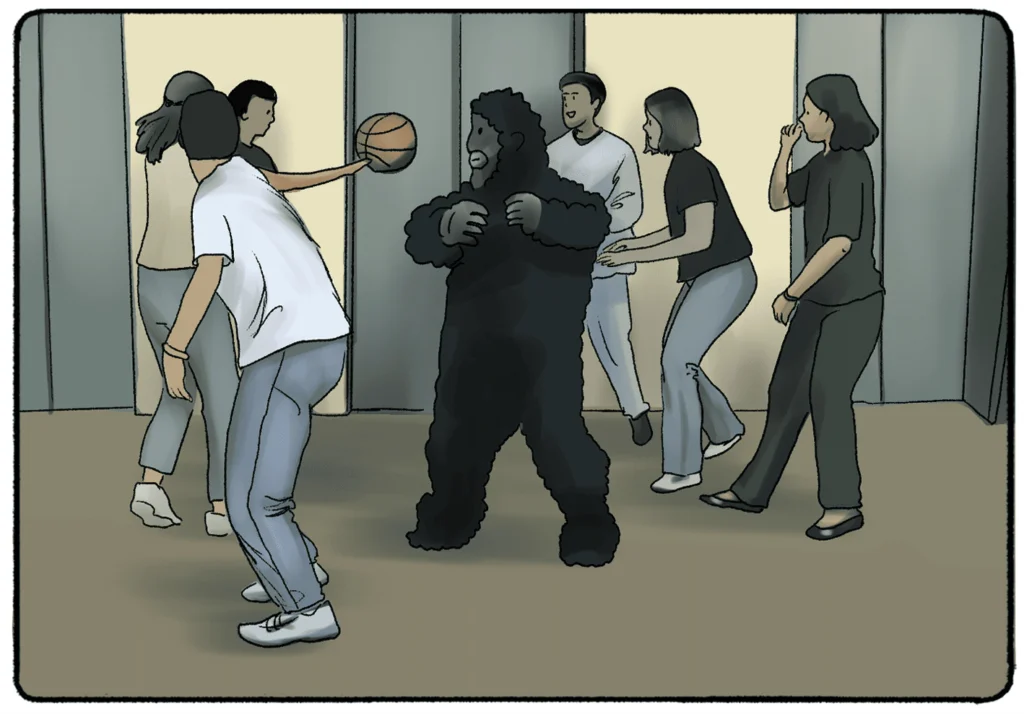
You may have heard of a psychological phenomenon that sounds completely nonsensical at first: inattentional blindness. In the experiment that first demonstrated this phenomenon, participants were asked to focus carefully on a group of people playing a passing game on a screen and keep track of how many passes they made.
Halfway through the video, a person wearing an oversized gorilla costume walked from the edge of the frame to the center, thumped their chest a couple of times, and then left through the other side. Surprisingly, a sizable portion of the participants failed to notice that a gorilla had just walked across the screen at all.
Because their attention was so tightly focused on the passing, they were completely blind to an object that was practically impossible to miss. That gives you some idea of just how narrow the range of human attention can be.
The invisible gorilla later became one of psychology’s most famous running jokes.
Not long ago, two new papers replicated this phenomenon in touch and hearing. We might call the effects “inattentional numbness” and “inattentional anosmia.” The Research Digest website published a summary of both studies.
In one of the studies, participants placed both hands on a tabletop, and one hand received light tactile stimulation from a bone-conduction device. Each participant had only one hand stimulated—the left or right was chosen at random—but both hands had to lie flat on the table. A cloth curtain was also placed above their hands to block their view and prevent visual interference.
Their task was to count how many times their hand was tapped in total. They were divided into two groups. The low-attentional-load group only had to keep track of the number of taps. The high-attentional-load group received two types of stimulation, continuous and pulsed, and had to count them separately—which obviously used up more attentional resources.
The experiment lasted 16 rounds. In the first 15 rounds, the same hand was tapped every time. In the 16th round, the researchers suddenly gave the participant’s other hand a single tap as well.
After the experiment, the researchers asked the participants whether they had felt the tap on their other hand. In the low-attentional-load group, as many as 92% noticed it. But in the high-load group, an astonishing 69% failed to feel the tap on their other hand.
In real life, this would be like someone patting you on the shoulder while you fail to notice their other hand slipping into your pocket—the pickpocket may have been exploiting this principle all along.
****
In the other study, the researchers divided participants into a high-visual-attentional-load group, which had to pick out hard-to-distinguish letters, and a low-visual-attentional-load group, which had to pick out easy-to-distinguish letters. They found that many participants in the high-visual-attentional-load group failed to smell the coffee odor in the experiment.
Once their attention had been captured visually, their sense of smell became duller too. What’s more, the effect was delayed in time—even after the experiment had ended, the high-visual-attentional-load group still had more difficulty detecting the coffee odor.
Still, in both studies, the stimuli were entirely harmless, whether it was a light tap on the palm or the smell of coffee. If the coffee odor were replaced with the smell of smoke from something burning, the participants might have reacted very differently.
Even so, these two studies offer a vivid demonstration of just how astonishingly narrow the range of human attention really is.
References:
- Murphy, S., & Dalton, P. (2018). Inattentional numbness and the influence of task difficulty. Cognition, 178, 1-6.
- Forster, S., & Spence, C. (2018). “What smell?” Temporarily loading visual attention induces a prolonged loss of olfactory awareness. Psychological Science.
- Emma Young. Beyond the invisible gorilla – inattention can also render us numb and anosmic (without smell).
Note
- This article in the “Psychology New Knowledge Mini-Lessons” series was written as a popular-science essay/rambling short piece to accompany the related content Zhichao Wei: Psychology New Knowledge Course. It was published on the now-closed platform Fantuan, and the original link no longer exists.
Leave a Reply