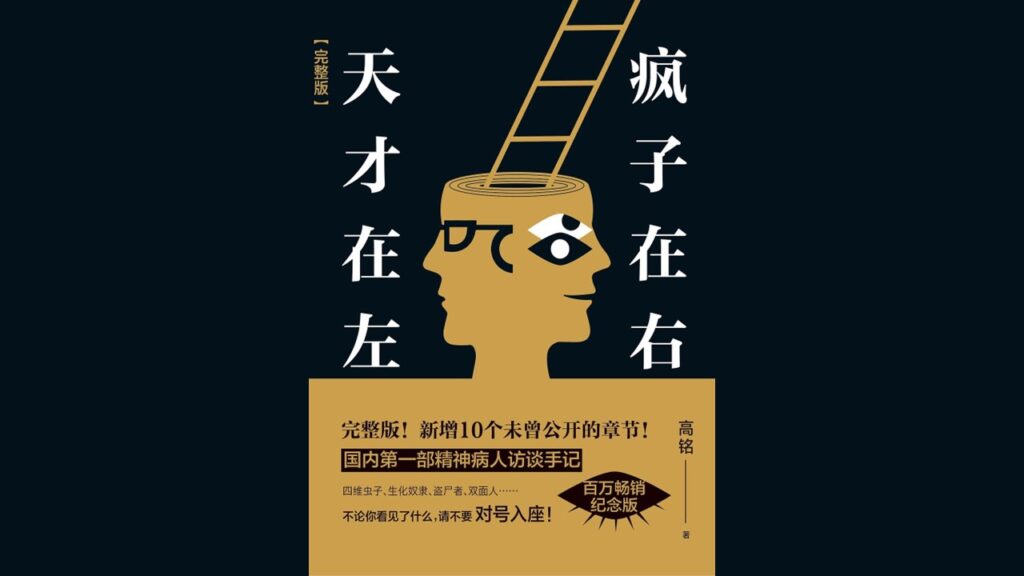
Let me throw out a thought experiment: what would Geniuses on the Left look like with a scientific completion plan—filling in the hard knowledge from psychiatry and psychology that it leaves out?
The way Geniuses on the Left strikes you depends on whether you read it as a novel or as a popular-science book.
Reading it with the expectations of a novel, or with those of a popular-science book, produces two utterly different experiences.
Let me take them one at a time.
If you read it as a novel, it is a remarkably good one… I suppose you could call it a setting-driven novel?
Each episode throws out one powerful premise, and cranks the sense of wonder all the way up.
The subjective worlds of people with mental disorders form a series of other worlds, each radically different from ordinary experience. The reader gets dropped into one astonishing other world after another, and it is genuinely thrilling. Quite a few episodes would make excellent material for horror films; you can practically reconstruct the images in your head straight from the text.
But if you treat it as a popular introduction to psychiatry and psychology, its value is very limited.
In early editions of the book and in its early promotional copy, the publisher deliberately emphasized its documentary quality while blurring the line around fiction, strongly misleading readers into believing that everything in the book came from real interview records. That is why even today, many readers still read it as popular science.
In reality, the book is only responsible for presenting the spectacle of mental illness (and much of it is fictional at that), while barely touching on the pathological and psychological science behind the spectacle.
In other words, Geniuses on the Left has only the riddle, not the answer.
—And that is a real shame.
Behind those other worlds lies a treasure house of psychiatric and psychological knowledge, and the appeal of these answers may be no less fascinating than the spectacles presented by the riddles.
So what if we gave Geniuses on the Left a scientific completion plan, filling in the missing hard knowledge from psychiatry and psychology? Wouldn’t that let literature and science both bloom, turning it into a completed form that stands up both as literature and as popular science?
Here is my outline for the scientific completion plan—
Scientific Completion Plan for Geniuses on the Left, Madmen on the Right
Episode in the book: The Three Little Pigs (San Zhi Xiao Zhu)
The protagonist’s mind splits into multiple personalities, which jointly fight a demon.
- Scientific completion: Who, exactly, created multiple personality?
- Multiple personality may be a disease people are led to believe they have—a disorder created jointly by the suggestion of psychotherapists and the subtle influence of the surrounding culture.
Episode in the book: Birds and Beasts (Feiqin Zou Shou)
The protagonist can see people as animals. Strangely enough, the animals’ habits line up perfectly with those people’s personalities.
- Scientific completion: Lycanthropy
- Lycanthropy is an extremely rare delusional disorder whose typical symptom is the belief that one is an animal. The werewolf legends of European history are closely connected with this disorder. And even rarer is lycanthropic intermetamorphosis, in which everyone else is seen as an animal.
Episode in the book: Stealing Time (Touqu Shijian)
The protagonist believes there are time thieves in the world who can pat someone on the shoulder, steal that person’s lifespan, and transfer it onto themselves.
- Scientific completion: An instinctive intuitive belief—the law of contact
- People instinctively believe that as long as two things come into physical contact, something on the spiritual level can pass from one to the other.
Episode in the book: In the Mirror (Jing Zhong)
The protagonist has an intense fear of mirrors and believes that another world exists inside them.
- Scientific completion: Why do mirrors so easily provoke fear?
- The visual illusions triggered by mirrors; and another intuitive belief—the law of similarity—which can lead people to believe in the superstition that mirrors and photographs can capture a person’s soul.
Episode in the book: The Problem of Roles (Juese Wenti)
The protagonist believes the world is not real. He thinks the people he meets and the events he experiences are all part of a novel he has made up himself.
- Scientific completion: The Truman Show delusion
- Some people genuinely believe they are living inside The Truman Show, and scientists have actually used The Truman Show to name this kind of mental disorder.
Episode in the book: The Twins (Shuangzi)
The protagonist can see his deceased twin sister. The eerie part is that her husband can see her too. Are they both crazy?
- Scientific completion: Shared psychotic disorder
- This story is not about telepathy between twins; it is about how a mental disorder can be contagious. The couple really are both crazy—their condition is called shared psychotic disorder.
Episode in the book: Mr. Shadow (Yingzi Xiansheng)
The protagonist repeatedly dreams that a mysterious person drags her into jumping off a building. The nightmare leaves her physically and mentally exhausted.
- Scientific completion: The value of nightmares
- Why are dreams generally anxious? What value do nightmares have for ordinary people?
Episode in the book: Death Weekly (Siwang Zhoukan)
The protagonist murders his girlfriend, but then sees her resurrected in his hallucinations. He becomes trapped in an infinite loop of murder and resurrection.
- Scientific completion: How love and hate become intertwined
- Theories involving oxytocin: why is oxytocin both the love hormone and the hate hormone?
Episode in the book: The Lonely Watcher (Gudude Shouwangzhe)
Every few years, the protagonist has a strange dream. In it, he is the only person left in the entire world. It gives him an experience of absolute loneliness and leaves him utterly desperate.
- Scientific completion: Loneliness makes us hide; loneliness makes us yearn
- Loneliness has two sides. Turning I into we, there is connection in loneliness; turning we into I, there is freedom in loneliness too.
Episode in the book: In an Instant (Shana)
The protagonist analyzes déjà vu.
- Scientific completion: The déjà vu phenomenon
- Several scientific hypotheses and explanations for the experience of déjà vu.
Episode in the book: Along with the Moon (Bansuizhe Yue)
On nights with a full moon, the protagonist sees other people turn into monsters.
- Scientific completion: Why does the full moon make people crazy?
- Connecting madness with the full moon is a long-standing tradition in Western culture. Is there really some kind of heaven-human resonance? Or is there an interesting misunderstanding at work?
Episode in the book: Surface Phenomena (Biaomian Xianxiang)
The protagonist of this story is highly unusual, and even when the story ends, it is difficult for the reader to figure out whether he is actually crazy.
- Scientific completion: Three ways to interpret delusion
- This one could be given a Nolan-style reading! As long as you place the boundary between fiction and reality in different places, you can arrive at three interpretations of the protagonist’s illness.
Episode in the book: Immortality (Yongsheng)
One of the best chapters in the whole book. The protagonist remembers his past lives, keeps reincarnating and dying, and endures endless suffering. He is in terrible pain.
- Scientific completion: Time is not your enemy; eternity is
- Pairing it with the masterpiece Planescape: Torment, a game on the same theme, we can analyze why the immortality people truly want may be a form of immortality with forgetting included. Endless time is not your enemy; endless memory is.
Episode in the book: The Taste of an Apple (Pingguo de Weidao)
The protagonist likes to occasionally shut himself away at home for solitary spiritual practice. After cutting himself off from all kinds of sensory stimulation, he gets the feeling that he has seen the Way.
- Scientific completion: How enlightenment in the wasteland works
What effect does sensory deprivation have on the brain? Can placing yourself in a perceptual wasteland really help you see the Way?
Episode in the book: An Afternoon Conversation about Mental Illness (Youguan Jingshenbing de Xiawudui Tan)
The finale of the book. It may be the most realistic section in the whole thing. The author talks with a psychiatrist about all sorts of mental illnesses.
- Scientific completion: The origins of mental illness
- Here we could introduce some of the interesting hypotheses scientists have today about the causes of mental illness—for example, its evolutionary origins. If we look at these mental illnesses from the perspective of humanity’s long evolutionary history, we discover a fascinating possibility: at certain points in the ancient past, these conditions may not have been illnesses at all. They may actually have been helpful to the humans of that time.
—So, can you feel the literature-and-science double bloom happening yet?
P.S.:
This scientific completion plan has actually been completed~~. It has been recorded as audio and released on Ximalaya. If you are interested, click here to take the portal and listen to Geniuses on the Left, Madmen on the Right, a strange psychological audio drama:

All three stars—Feng Yuanzheng, Ni Ni, and Guo Xiaodong—join me and physicist Li Miao in a scientific interpretation, acting up a storm together and using their voices to portray the inner worlds of madmen. Listen at night and you get an indescribable horror filter; the effect is remarkably strong.
Leave a Reply