
Over the past few years, the term “deliberate practice” has become hugely popular. It refers to sustained, deeply focused practice in all kinds of skill training: you have to push beyond your comfort zone and keep working at a difficulty level that challenges you just enough, so that you can maximize the gains from training.
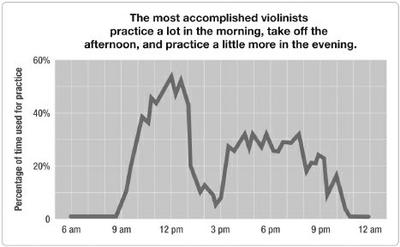
In fact, according to research data cited in the book Act According to Circumstances (Jianji xingshi), “deliberate practice” needs to be paired with “deliberate rest” to achieve its full effect. Take violin practice as an example. The chart below shows the daily practice curve of top violinists. The horizontal axis shows how the time changes over the course of a day; the vertical axis shows the percentage of each hour spent practicing.
As you can see from the chart, expert violinists begin practicing at around 9 a.m. Their practice intensity peaks later in the morning. They rest in the afternoon, then continue practicing at a moderate intensity for several hours later in the afternoon and into the evening.
This study found that the overall practice patterns of top violinists and slightly less accomplished violinists were basically the same. Their biggest difference was that the top performers deliberately set aside a period of complete rest in the afternoon—around 2 to 3 p.m. in the chart, with some taking a nap during that time—while the slightly less accomplished violinists lacked this kind of complete rest.
So, today’s conclusion is:
Long live the midday nap!
A few years ago, some public opinion argued that China (though it really should have specified northern China) ought to follow developed Western countries and get rid of the midday break. In recent years, that trend has reversed. Now, it is actually the high-tech companies of Silicon Valley that have begun recognizing the benefits of midday naps and introducing nap policies. China’s current midday-break system is a little extreme: in the north, people finish work at 12 p.m. and return at 2:30 p.m., which really does waste time, while in the south, a one-hour break is barely enough for lunch. Maybe splitting the difference between north and south would be just right.
Note
- This series of “new psychology insights” articles was written at the time as popular psychology essays and casual commentaries related to Zhichao Wei: New Psychology Insights Course. They were published on the now-closed platform Fantuan, and the original links no longer exist.
Leave a Reply