What this episode is about
Trump says it over and over: Canada should become America’s 51st state. But the first person to take the idea seriously—seriously enough to write a whole book about it—was a Canadian, and not just any Canadian: the country’s most famous economic nationalist. Her entire public life has been about opposing foreign capital buying up Canadian companies and resources. And it was this diehard patriot who brought in a mergers-and-acquisitions expert, treated Canada and the United States as two companies, and ran them through the standard investment-bank acquisition process from beginning to end: the extra assets Canadians would be putting into this deal are worth $16.9 trillion.
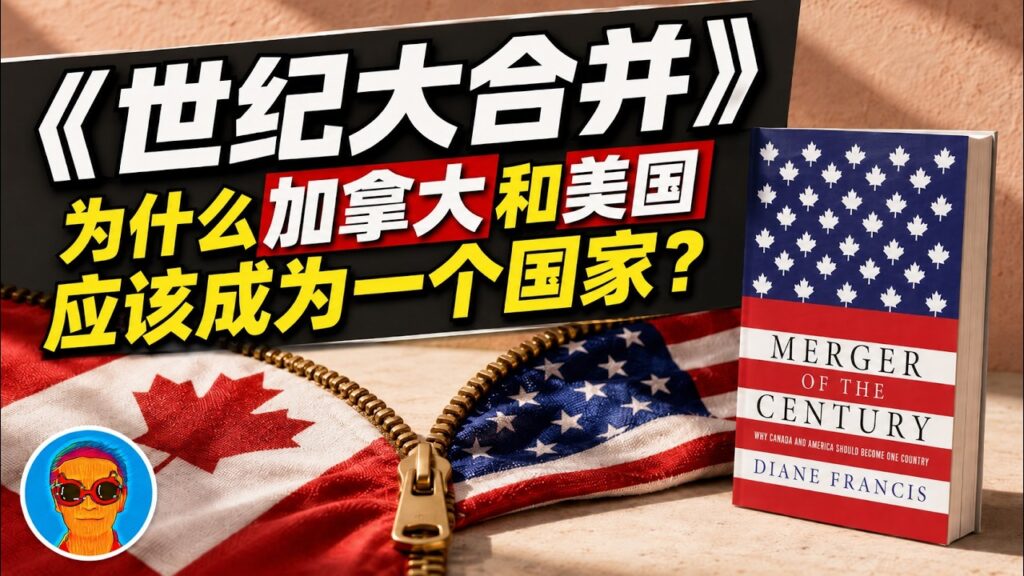
This episode covers Merger of the Century: Why Canada and America Should Become One Country, published in 2013 by Canadian business journalist Diane Francis (still available in English only). It isn’t a thought experiment. It’s an acquisition proposal, complete with a valuation model and a closing plan.
Francis’s read is this: Canada is holding an unbeatable hand—half the world’s potash, a fifth of its fresh water, oil sands second only to Saudi Arabia’s, $9 to $15 trillion in undeveloped minerals, and an Arctic shipping route thawing open overhead. Guarding all of it: thirty-odd million people, sixty-eight thousand active-duty soldiers, and a part-time militia patrolling the Arctic with their grandfathers’ rifles. In a zero-sum world of resources, the real question was never whether Canada gets to stay independent, but when, by whom, and in what manner it gets carried off piece by piece. Sinopec, CNOOC, Abu Dhabi, Korea Gas, and the Russians planting a flag on the seabed at the North Pole are already at it. Better to go looking for a white knight yourself than to be taken in a “creeping takeover”—and to close at market price.
America needs Canada just as badly: energy self-sufficiency would cut a huge chunk out of the military budget that goes to protecting Middle East oil routes, and Wall Street’s risk-hungry money is exactly what could wake up the mines, gas fields and hydro plants up north that nobody else can afford to build. The two countries fit together seamlessly—what one lacks is precisely what the other has too much of. Which brings us to the book’s signature move: by population Canada would be a tenth of the new country, but by assets closer to a fifth, and the difference gets paid out in cash the way any merger would, which works out to $490,000 per Canadian, funded with twenty-year Treasury bonds and secured against the very resources under Canada’s feet that are about to be woken up.
So why is this seemingly perfect match almost impossible? Because the price is negotiable and the identity is not. Add one line to the survey—“merging means losing your cultural identity”—and Canadian support drops from 41% to 5%. And folding in thirty-odd million left-leaning Canadian voters could mean there is never another Republican president in the White House. Trump, who talks about annexing Canada every other day, happens to come from the one party that could never allow a merger to happen.
At the end of 2024, Trump really did start shouting about the merger, and the first person to stand up against it was Francis herself. She ran the valuation model all over again: $23 trillion. “Mr. Trump, you may be able to afford Greenland, but you cannot afford Canada.” What she objected to was never selling. It was giving it away. Trump probably got as far as chapter four, “The Benefits of Merging,” slapped the table in delight, closed the book and went off to tweet—so he happened to miss chapter five: what this deal would actually cost.
Highlights
- Why an economic nationalist who opposed foreign takeovers of Canada ended up writing a book that teaches America how to “buy” it
- Canada’s assets and Canada’s soft spots: world-class reserves of food, fertilizer, minerals, oil sands, fresh water and shipping routes, set against an Arctic defense of roughly zero and a development capacity locked down by thirteen provinces
- Who is already in a “creeping takeover” of Canada: Sinopec shipping out crude in proportion to its stake, CNOOC buying Nexen outright, Abu Dhabi liking that there is “no Patriot Act,” Koreans surveying Arctic gas fields, Russia planting a flag on the seabed at the North Pole
- Valuing two countries the way an investment bank would: how the $16.9 trillion in compensation is calculated, how it gets paid off with twenty-year bonds and a mortgage on the resources, plus three merger templates—Germany, the EU and Switzerland
- Why it is almost impossible: cultural identity is a veto, and folding Canada in would mean permanent Democratic rule; after blasting Trump, the author raised the price to $23 trillion
Jump to a section
- 00:00 Opening: Trump shouts “51st state,” but the first to take it seriously was a Canadian patriot
- 03:10 A zero-sum world of resources: the 2003 supercycle, the 2008 food crisis, and the dress rehearsal in Madagascar
- 06:38 What Canada owns: farmland, potash, minerals, oil sands, fresh water and the Arctic route
- 07:59 Wolves at the door: China, Abu Dhabi, Korea, Russia, and an Arctic defense that exists on paper only
- 12:31 Starving with a golden bowl in hand: provincial chokeholds, no people and no money, political landmines, and the “creeping takeover”
- 14:52 What America gets out of buying: two chronic illnesses, the military budget and health care
- 17:20 What Canada would get: Wall Street’s money, a reversed brain drain, the world’s best defense
- 21:32 The signature move: the investment-bank valuation model, a $16.9 trillion dowry, and a twenty-year bond mortgage
- 24:38 Three merger templates: the German model, the EU model, the Swiss model
- 25:30 Why it is almost impossible: identity as a veto, the political spectrum, and some advice for Carney
- 29:02 End of 2024: the author blasts Trump and reprices the deal at $23 trillion
- 30:28 Closing: Trump probably never finished chapter five
The book
- Title: Merger of the Century: Why Canada and America Should Become One Country
- Author: Diane Francis
- Publisher: HarperCollins Publishers Ltd
- Publication date: 2013-10
- ISBN:9781554688753
Leave a Reply