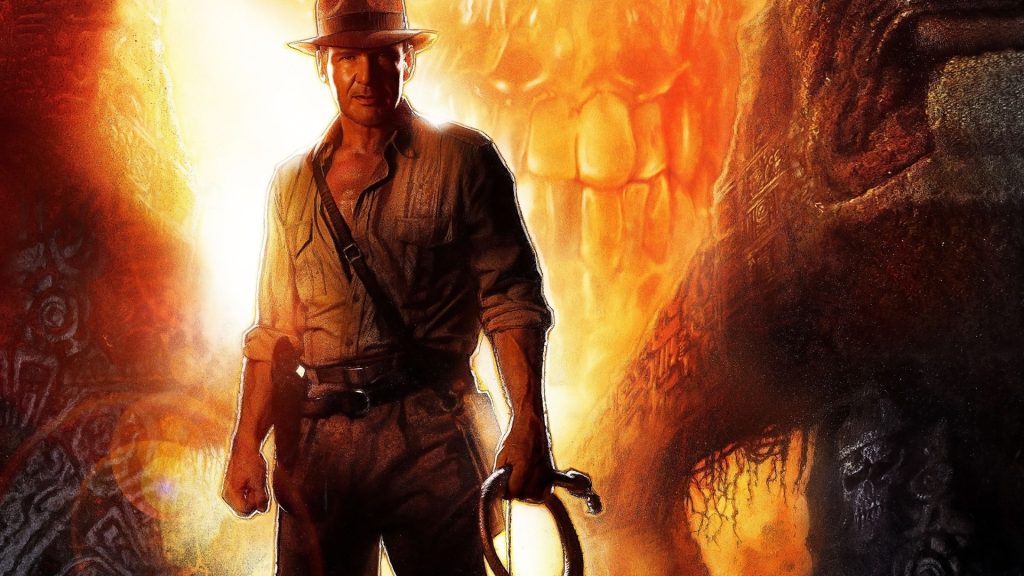
[I accidentally wrote what may be my longest article apart from my dissertation. The second half is basically an autobiography, so take your time if you’re interested; if it’s too long, just read the “second half”—the “first half” can be skipped ^_^]
Part One: Indiana Jones and the Kingdom of the Crystal Skull — A “Not Pink Enough” Reminiscence
The Resentment of “Yesterday Revisited”
In psychology, there’s a phenomenon called “rosy retrospection”: after going through a period containing roughly equal amounts of pleasure and pain, people tend to remember the pleasant experiences and forget the painful ones. So unless someone’s past is truly unbearable, the past is always beautiful, the human heart is always nostalgic, “things were better in the old days” remains an eternal truth, and “yesterday revisited” an eternal hope.
Classics always belong to the past. In many people’s eyes, works from the past ten years seem forever unqualified to be called “classics.” Once enough time has passed, the “new work” they cursed back then becomes an old “classic”—although if yesterday really were revisited, it might not be quite so beautiful. Rosy retrospection is, after all, just a pleasant distortion. If you don’t believe me, go rewatch some cartoon you were obsessed with as a child.
The Indiana Jones series is one of those classic works that once left a deep mark on our lives. To Americans, it is their 1983 version of The Legend of the Condor Heroes and their 1987 version of Dream of the Red Chamber: sacred and untouchable. Built by two of Hollywood’s grand masters, the series was exceptionally good to begin with. Even revisiting it decades later, it hasn’t fallen behind; and now, after being gradually elevated and beautified by several generations of film fans’ rosy collective memories, it has become a temple-grade classic.
Recreating such a beautiful yesterday is no easy thing. Just as, even if quite a few details in the 1987 Dream of the Red Chamber look a little awkward to an objective eye, you could predict that whatever Li Shaohong remade it into, people would still spit on it.
So the rosy retrospection in film fans’ hearts is a force of resentment—the terrifying resentment that all the poor fools who revive an old classic must respect!
The Wachowskis’ Tragic Death and Michael Bay’s Rebirth
There are two ways to fight this resentment.
One is to cooperate with rosy retrospection in form: faithfully restore the old classic as far as possible. When film fans see the classic images and plot points from their memories reappear, they will undoubtedly like the new work much more. The trouble is, first, that even if you do it just as well as before, it still won’t be good enough in fans’ eyes. To avoid losing to the original, you have to exceed its standard and then add the bonus supplied by rosy retrospection. Second, if the old classic has actually become completely outdated, and its classic feeling is purely the result of rosy retrospection, then faithfully restoring it is bound to be unbearable. The Wachowski siblings tried to faithfully recreate the effects of an old Japanese cartoon that now looks painfully awkward in Speed Racer—and died a horrible death.
Michael Bay, meanwhile, anticipated that recreating the big, blocky robots from the animated Transformers on the big screen would be laughable. So he decisively adopted the second method: avoid rosy retrospection in form as much as possible, creating an effect that remains loosely connected to the old classic. He catered to old fans’ remembered points of excitement in certain details, while drawing a complete formal line between himself and the crude, simple, outdated original. Thus the Wachowskis died an unfortunate death, while Michael Bay was reborn, fortunately.
Indiana Jones and the Kingdom of the Crystal Skull vs. Indiana Jones 1/2/3
George Lucas and Steven Spielberg use the first method this time. Their situation differs from that of the Wachowski siblings: the earlier Indiana Jones films had not become outdated in form, and the classic sequences of the first three still seem wonderfully entertaining today. Even the effects scenes are not obviously inferior to what modern computer effects can achieve. Besides, Indiana Jones is a very, very old series, so everyone’s memories of it are especially “pink.” How old is it? Old enough that when George Lucas first began developing the story, I was still a few chemical substances scattered across the Earth; old enough that when Spielberg filmed the first movie, I was still liquid; old enough that the first movie and I are the same age… When the young Dr. Jones was bouncing around on the screen, I was still sucking on a pacifier. Now I’m past the bouncing-around age, while Dr. Jones is still bouncing around. Just thinking about that is incredibly exciting.
So George Lucas and Steven Spielberg let themselves go and did their best to cooperate with fans’ memories, restoring every detail of the first three Indiana Jones films. There are countless examples of this inheritance: Dr. Jones still teaches in the same classroom, and every time he starts a class, someone is bound to burst in (the first two times it was his colleague and good friend Marcus; this time it’s the dean). Old fans will all smile knowingly at these familiar little details.
Still, the problem with the first method is that restoration alone isn’t enough. On top of restoration, there has to be enough innovation to cancel out fans’ resentment. Does Indiana Jones and the Kingdom of the Crystal Skull have that quality? We might as well compare it with Indiana Jones 1/2/3: what it restores, inherits, and changes, and which installment does each part better. Once we’re done comparing, everyone will have an answer.
Opening:
In terms of story structure, Indiana Jones and the Kingdom of the Crystal Skull faithfully inherits from the first three films. Every Indiana Jones story, without exception, begins with a treasure-hunting adventure basically unrelated to the main plot. Only after the little opening climax dies down does it slowly lay out the story and begin the real treasure hunt. Although the fourth film’s opening is closely connected to what follows, from Indiana’s perspective it is merely an unexpected incident; this installment’s treasure hunt truly begins later.
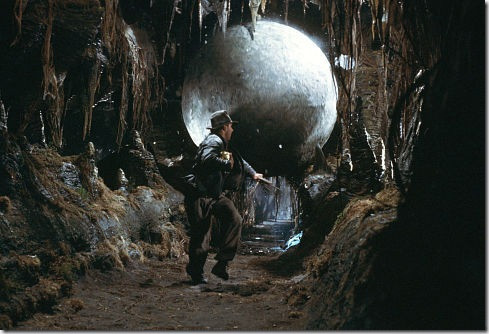
In terms of how exciting the openings are, the third film’s “Cross of Coronado” is best. It reveals why Dr. Jones fears snakes, where the whip came from, and introduces his unbelievably goofy father; it also spans decades, with a perfect amount of information and explosive action. The first film’s “South American Jungle Idol” comes next: its charm lies in how amusingly calm and disdainful Dr. Jones remains while dealing with mutinous guides, spiders all over him, and deadly mechanisms. By comparison, the second film’s opening, “Nurhaci’s Ashes,” is a little weaker. Apart from the final emergency landing on an inflatable raft, it has few outstanding scenes.
The fourth film’s opening, “Area 51,” is “a direct continuation of the first film.” At the end of the first film, the Ark is sealed away by the U.S. government in a mysterious warehouse so huge its edges cannot be seen. Nearly 30 years later, the fourth film reveals the warehouse’s true identity: it is the famous U.S. Air Force base Area 51. The opening ends in a nuclear explosion, while Indiana, only a few hundred meters from ground zero, somehow survives by hiding in a refrigerator.
A scene this absurd would be nonsense in any other movie, but in the Indiana Jones series it could not be more normal. That’s because its action scenes have one singular feature: “They don’t seek realism; they seek fun.” Many Indiana Jones stunts would be pure suicide in real life, let alone impossible in most thrillers with limited levels of exaggeration. But Indiana has an indestructible streak of dumb luck. The more recklessly he plays, the more fun it is. Take the inflatable-raft landing and mine-cart ride in the second film: an ordinary person would be dead even with nine lives, but Indiana enjoys himself immensely.
So the refrigerator hiding from a nuclear blast in the fourth film is completely an upgraded version of Indiana Jones’s “not realism, but fun.” Overall, this opening lets us revisit many classic Indiana Jones elements, but it is not especially outstanding. Its excitement falls somewhere between the first and second films.
Opening ranking: 3, 1, 4, 2.
Jones Girls:
Indiana is an American-made lady-killer of a radish, the same sort of vegetable as Britain’s 007 and China’s Lu Xiaofeng: there is never a shortage of women around him, one per installment, and most outrageously, the fate of his previous girlfriends is never explained. This inevitably brings to mind Xue Bing, a perfect match for Lu Xiaofeng, who in Gu Long’s original novels somehow ended up dead without even leaving a body. It still feels like a terrible shame.
In Indiana Jones, Indiana’s “Xue Bing” is undoubtedly Marion, the cool young woman in the first film who went to Nepal to outdrink people and punch Indiana, then went to Cairo to smash a frying pan into someone’s head. This spirited girl has far more charm than the idiot in the second film or the deadly beauty in the third (though both of those women are blondes). Sadly, like all the Bond girls and Lu girls, she vanishes into thin air in the second and third films.
Fortunately, George Lucas and Steven Spielberg are not as ruthless as Gu Long in the fourth film. They finally bring Marion back to Indiana’s side—and throw in a son for free. Sadly, that lovely young woman is now a middle-aged auntie. Sigh. This sequel should have been made 15 years earlier. (Incidentally, Indiana’s expression when he sees his old flame again is unbelievably adorable.)
Jones Girls ranking: 1, 4 (time is merciless), 3, 2.


Companions:
In every installment, Indiana has companions who help him and companions who help him into trouble. The first has the Egyptian brothers: useful enough, but not very distinctive. The second has Short Round, who is both useful and full of personality, making him Indiana’s best partner so far. In the third, Indiana’s companions are practically all there to cause trouble, yet they steal the show: his father is an eccentric bookworm who never quite matches his son, while colleague Marcus is a muddlehead who can get lost even in a library. These two cause trouble at every turn and generate endless jokes, while leaving Indiana utterly helpless. So among the first three films, the companions rank 3 above 2 above 1.
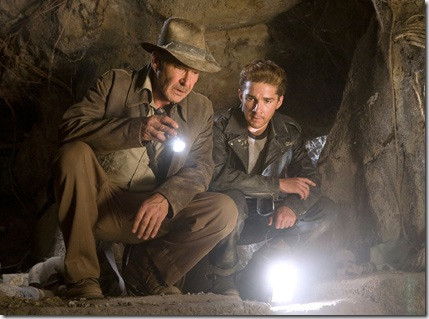
In the fourth film, Indiana’s son is no less capable than his father and currently looks like a pretty good helper. But if he is to become Indiana’s successor, his personality still needs work. Overall, he falls between the first and second films. (Actually, I think Short Round in the second film feels more like Indiana’s son.)
Companions ranking: 3, 2, 4, 1.
Opponents:
The main villains in the Indiana Jones series are actually much of a muchness. Indiana’s principal opponents are generally one-dimensional bad guys who will stop at nothing to achieve their goals, and they are fairly flat. Cate Blanchett in the fourth film is not especially outstanding either, despite her distinctive look.
So the opponents are unranked.
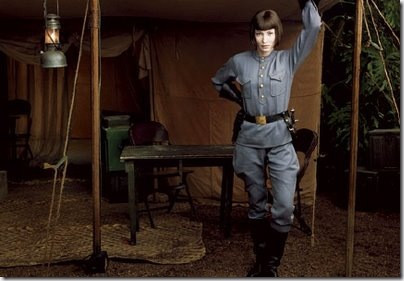
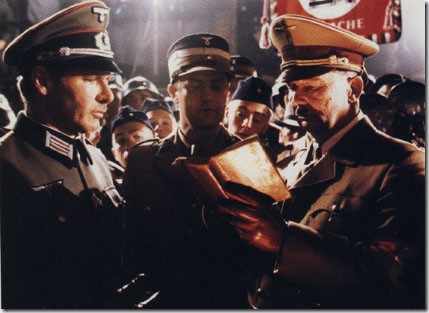
That said, the series often produces some wonderfully entertaining bit-part characters. For example, the swordsman in the first film who spends ages showing off his opening moves before being dispatched by a single shot, and Hitler signing Indiana’s autograph in the third. These two bit parts created the most classic gags in Indiana Jones. As I recall, the fourth film has no bit part quite that entertaining.
Climax:
Every Indiana Jones movie has a big climactic set piece. The first has the jungle chase, the second the mine-cart roller coaster and the flood, and the third the all-out tank battle in the desert. The best of them is the tank battle in the third movie: Indiana, fighting alone, is kept frantically busy by his partners’ “close cooperation” in getting in his way, turning the whole fight into a wonderfully entertaining sequence of constant peril.
The fourth movie’s climactic scene is probably the jungle sequence of “chasing the red ants to the waterfall.” Its intention to pay homage to the first three Indiana Jones movies is unmistakable. The jungle chase here closely resembles the one in the first movie, and the waterfall sequence also appeared in the second. Still, the progress in special effects is obvious: 20 years earlier, it would have been hard to film a sword fight with one man straddling two cars speeding along. That’s a small step beyond nostalgia.
The fourth movie’s climax still embraces those distinctly “Indy” action scenes that ask only to be fun, not realistic. The more interesting thing here is that, before, only the audience could enjoy the absurdity; Indiana himself still worried about staying alive. Those wildly unrealistic scrapes happened because he had been forced into a corner. In this climax, though, Indiana briefly seems to become an outsider who knows he cannot die, quietly enjoying himself while his son waves a sword around, as if saying, “See? He’s Indiana’s son, so obviously he won’t die.” His old flame is the same, voluntarily performing an insanely difficult car jump off a cliff while saying, “Trust me, it’ll be fine.” I rather like this setup, because audiences with years of moviegoing experience are never going to worry about the heroes of a comedy like this anymore. So why not let the characters transcend reality too, and take Indiana-style “treating danger as fun” up another level?
Climactic-scene ranking: 3, 2, 4, 1

Checkpoint:
Indiana Jones is like a video game: every movie has to clear a final checkpoint before it can win.
At the end of the first movie, God takes care of everything, making that checkpoint the easiest to clear. The second movie’s checkpoint is the rope-bridge fight, won mainly through brute force. The most perfectly designed checkpoint is the third movie’s, made up of the Breath of God, the Word of God, and the Path of God. The third challenge in particular, “The Path of God,” is absolutely jaw-dropping, and fully deserves to be the final checkpoint before the Holy Grail’s resting place.
The final bridge sequence in the fourth movie is actually somewhat similar to the third: you have to clear a path into the final treasure chamber. Unfortunately, compared with the third movie’s ingenious checkpoint, the fourth’s design feels pretty slapdash. To a large extent, that is dictated by the plot. If Indiana was a “raider of lost treasure” in the first three movies, then in this one he is a “returner of lost treasure”: his main task is not to find the artifact, but to return it (even the sentient artifact itself tells Indiana it wants to be returned). In the old treasure hunts, Indiana and the artifact were on opposite sides, and the guardian wanted to keep it hidden, so obstacle after obstacle had to be placed in the treasure hunter’s way. This time that conflict no longer exists, so overly complicated checkpoints would make no sense. In my view, changing “raiding treasure” into “returning treasure” was a failed change.
Checkpoint ranking: 3, 2, 4, 1
Artifacts:
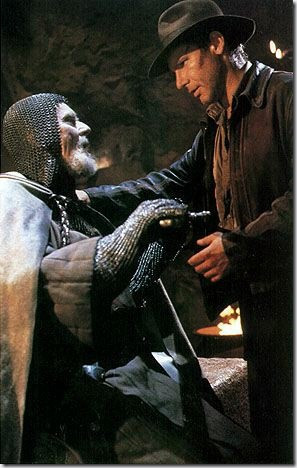
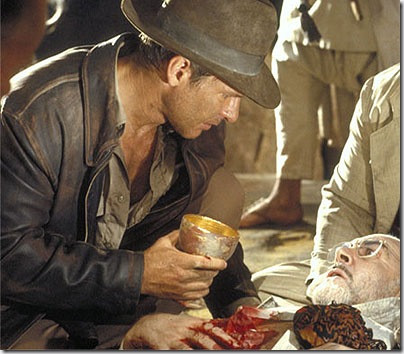
The artifacts Indiana Jones goes after are never ordinary treasures; they are “artifacts” with serious provenance. The first movie has the Ark of the Covenant containing the Ten Commandments, the second Shiva’s sacred stone, and the third Jesus’s Holy Grail. In terms of sheer stature, the second movie’s artifact is clearly the weakest. Shiva may be the greatest god in Hinduism, but his name recognition and influence worldwide are still quite limited. The artifacts in the first and third movies come directly from Christian legend, and thanks to Christianity’s broad influence, the Ark and the Grail naturally inspire far more fascination. The Grail especially has inspired countless folk legends and literary works from ancient times to the present; even those of us raised outside a Christian environment have heard many of its stories before.
One shared understanding in the first three Indiana Jones movies is that the treasure hunt ends at the “artifact” itself. They never try to explore what the “god” who possesses the artifact is. Indiana Jones never tries to tell us what sort of divine being Yahweh, who wrote the Ten Commandments, might be, or why the Grail Jesus drank from has supernatural power. God is God: an abstract, mysterious presence that needs no explanation. I love that kind of mystery.
But in the fourth movie, George Lucas and Steven Spielberg break that mystery, poke through the last thin sheet of paper, and reach their tentacles toward God for the first time. (Judging from their plainly visible shared taste for weirdness, even friends who have not seen the movie can probably guess what they imagine “God” to be.) And I am extremely unhappy with their take on “God”! Indiana Jones has always been about archaeology, pointing toward the ancient, historical sense of mystery. This time, George Lucas and Steven Spielberg suddenly turn that sense of history into a sense of the future. The setup is not especially jarring on its own, since it has plenty of widely known legends, conspiracy theories, and literary works behind it. But placed in the Indiana Jones series, I think it destroys the “ancient flavor” preserved by the first three movies and wrecks the series’ most important charm.
When I first heard that the fourth movie would be about crystal skulls, I was excited for quite a while, because the “crystal skull” was an important part of my own “intellectual awakening” (more on that in the next part). But seeing George Lucas and Spielberg’s crystal skull today, and realizing it has absolutely nothing to do with the crystal skull I was once fascinated by, I cannot help feeling a little disappointed.
Artifact ranking: 3, 1, 4, 2
To sum up:
Compared with the first three movies, Indiana Jones and the Kingdom of the Crystal Skull comes out with basically middling-to-low scores across the board. If this sequel had been released 15 years ago, it would absolutely have counted as a passable sequel. But today, I’m afraid it is a “not pink enough” reminiscence, and it is hard for it to live up to the expectations that old fans have built up over 19 years.
Part Two: The Crystal Skull and My Brief Intellectual Awakening
After using up a whole lot of saliva to finally finish the actual topic, I’m going off-topic now…o(∩_∩)o~
Why go from Indiana Jones to my own intellectual awakening? Because the artifact in this movie, the “crystal skull,” was an important part of that story. By “intellectual awakening,” I mean how a whole series of metaphysical ideas—my worldview, view of the universe, view of ghosts and gods, view of science, view of religion, and view of life and death—took shape and changed in me.
Let me start at the beginning.
【The following account of my painful green youth is completely true. If it resembles your experience, that’s purely your bad luck. Haha.】
Heavenly Soldiers and Generals
When I was very young (probably in the lower grades of primary school), my parents told me about two strange things that had happened to them.
The first strange thing went like this:
When I was little, I once watched a very silly American superhero TV show (I think it was about some goddess who dressed very revealingly; I have forgotten what it was called). Its slightly fantastical flavor brought back a memory for my dad.
My dad said that when he was still very young, one evening he went out to play with his older brother (my eldest uncle). As they were leaving, they suddenly saw two “heavenly soldiers and generals” (his exact words) flying through the sky. The moon was very bright that night, and the two “heavenly soldiers and generals” they saw were roughly as large as the moon. After “flying” for more than ten seconds through the sky parallel to the moon, they suddenly disappeared.
The story sounds like complete nonsense. But my dad was certain it was not his imagination. More importantly, my eldest uncle later confirmed that it really happened. If only one person said this, it could very well have been a hallucination; the problem is that there were two eyewitnesses. Surely both of them could not have hallucinated, right? So even now I still believe the experience was real.
The question then becomes: what exactly did they see? According to their description, the “heavenly soldiers and generals” were wearing ancient clothes. They were small but clearly distinguishable, somewhat like costumes in a theatrical performance. So could it have been some kind of mirage, reflecting a stage somewhere on the ground into the sky? Impossible: my hometown is in central Zhejiang, and there are no historical records of mirages there. Then was it some extraordinarily powerful projection device? I don’t think equipment capable of using clouds as a screen had even been invented yet (and there did not seem to be any clouds that day). Even if it had, how could it have appeared in that poor backwater several decades ago?
So I still have no explanation for this strange incident.
The Seven Fairies
The second strange thing:
When my mother was already pregnant with me, she went with my dad to visit his rural hometown. As luck would have it, the village was welcoming the “Seven Fairies.” This “welcoming the Seven Fairies” was actually a form of spirit writing, different in form but essentially the same as the saucer fairy, the pen fairy, and rice divination. Many years later, after studying psychology, I learned that spirit writing is just a peculiar hypnotic phenomenon: the spirits supposedly attached to the saucer and pen are really the result of the operators’ unconscious minds working together. But what did I know as a child? I thought the “Seven Fairies” were unbelievably magical! And judging from my parents’ description, what they saw then also seemed impossible to explain entirely in terms of the unconscious.
In our village, welcoming the “Seven Fairies” was a fairly popular folk form of spirit writing; in some places it is called “inviting the Seventh Sister.” Unlike the saucer fairy and pen fairy, welcoming the Seven Fairies took place only on certain festivals each year. Roughly speaking, a stick was tied beneath a small bamboo winnowing basket, incense ash was sprinkled underneath, and incense was lit in the room. Two people held up the basket, probably recited some incantations, and waited for the Seven Fairies to descend to the human world.
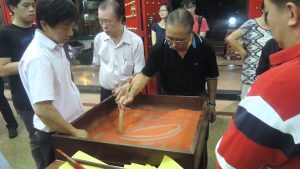
Anyone who has played the pen fairy will find these procedures familiar. From a psychological perspective, the incantations and incense are merely ritual devices for reinforcing hypnosis. The strange thing comes next…
Last year, when I went home, I happened to run into an elder who had invited the Seventh Fairy that year. She told me that when the Seventh Fairy descended to the mortal world, a peculiar thing happened: the incense smoke in the room had been drifting about randomly, but at the very instant the Seventh Fairy descended, all the smoke rose straight upward. At that same instant, the winnowing basket began to move by itself. The basket’s involuntary movement is not hard to understand; it is exactly like the way the pen and planchette move on their own when people play with a spirit pen or spirit planchette. In psychology, both can be explained as ideomotor action in a hypnotic state. But what about the smoke that kept rising straight up? Surely the unconscious mind could not be so precise as to alter tiny bodily movements, thereby affecting the room’s microscopic air currents and making the smoke rise vertically, could it?!
After inviting the Seventh Fairy, you could ask her questions. At the time, my grandmother had breast cancer and was undergoing treatment. My mother asked, “Where is my grandmother sick?” The “Seventh Fairy” then drew a human figure in the incense ash and stopped at the breasts. My mother asked whether she could be cured. The “Seventh Fairy” vigorously scattered some incense ash outward. My mother collected the ash and later gave it to my grandmother to drink. (My grandmother is still in excellent health to this day.)
None of these actions by the “Seventh Fairy” was strange in itself. When we played with a spirit pen, we got it to do things far more complicated. But what was miraculous that time was that my mother was not one of the people holding the basket!
The people holding the basket were two elders on my father’s side. They had only just met my mother, and one of them later insisted that he had known absolutely nothing about my mother’s family situation at the time. My parents also insisted that they had never mentioned it to our barely contacted relatives back home. Under those circumstances, the Seventh Fairy’s accurate knowledge of my grandmother’s condition seemed downright baffling. I can explain it by supposing that the two elders holding the basket may have learned about my mother’s family situation inadvertently—for instance, my parents might have discussed my grandmother’s condition while the elders overheard it vaguely from a distance. The information could have left an unconscious imprint that was difficult to notice consciously, only to be retrieved later in the hypnotic state of inviting the Seventh Fairy. But this hypothesis is still very hard to make completely convincing to myself. For one thing, I do not believe the unconscious mind has such enormous power; for another, it would require a fairly substantial coincidence to work.
So this incident remains unexplained to me as well.
And so my young, blank-slate mind was initiated by these two strange incidents. When it came to education, my parents were hardcore laissez-faire liberals, so they paid no attention at all to these two initiation rites that so obviously led me astray. And that was how I set out along the narrow, winding path of mysticism…
UFO
Actually, before I heard about these two strange incidents, I may have seen a flying saucer when I was even younger… ahem.
It was a moonless night. I think my father was carrying me along the riverbank when some people nearby saw a “star” in the sky, blinking as it “flew” along a spiral-shaped path. I saw it too and asked my father what it was. Completely irresponsibly, he told me it was a satellite (…). I was still a little kid in kindergarten; even if I had been a prodigy, I had no way to argue with him. I later learned that a satellite probably could not be seen with the naked eye, and even if it could, it could not possibly follow a flight path like that. So that “star” must have been an airplane. But I have never again seen any aircraft fly along a spiral-shaped path in my entire life. Even if a pilot had eaten too much and felt like showing off with aerobatics, his boss would never have allowed it. Besides, this was the night sky over some small town in the early 1980s—how could there have been aerobatics?
So what, exactly, did I see?
My Mystic Cousin
I had a cousin ten years older than me who was very interested in mysticism, and at the time she was also an artsy young woman. That was a dangerous combination: persuasion armed with knowledge has formidable power! So the mysticism education she gave me struck straight at my soul with devastating precision and turned me into a full-blown mystic. She told me about Sanmao’s experience seeing flying saucers in the desert (Sanmao was also a hardcore mystic), how Indian monks used yoga to treat strange illnesses, the “Big Four Mysteries” (flying saucers, wild men, the Bermuda Triangle, and the Loch Ness Monster), and every mysterious incident and unsolved mystery she had heard through the grapevine… She even took me to the library once to borrow a book called The Big Four Mysteries, though we failed to find it.
Under such powerful persuasion, I inevitably grew into a committed mystic. For a long time, I obsessively followed every scrap of news about flying saucers, the wild men of Shennongjia, the Bermuda Triangle, the Loch Ness Monster, and other unsolved mysteries in newspapers, magazines, and on television. I remember one time a newspaper reported that British special forces had successfully lured and captured the Loch Ness Monster with an ultrasonic weapon. I was thrilled for quite a while, until I realized it was simply a completely bogus April Fools’ story when no other media outlet followed up on it.
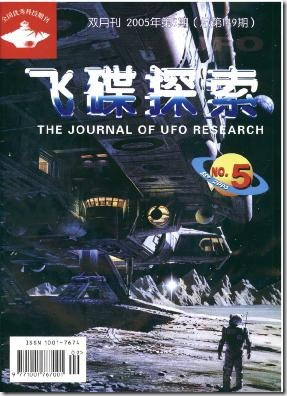
I even subscribed to a UFO magazine that claimed to have the world’s largest readership—Flying Saucer Exploration. The quality of its articles fluctuated wildly. Sometimes it ran utterly unreliable “news” about discovering entrances to underground cities on Mars or finding Bermuda Triangle-disappearance airplanes in Martian orbit, but it also published some genuinely good popular-science pieces. As a child, of course, I had no idea how to separate the wheat from the chaff. Every article left me completely bamboozled.
When I was little, my family also had a set of two or three books with a title along the lines of Strange Tales from Around the World or The World’s Unsolved Mysteries. I barely touched the 100,000 Whys for Primary School Students that my dad put on my bookshelf, or the comic-book version of Zizhi Tongjian that my uncle gave me, but I absolutely wore out this trashy set of books.
As I grew up, I gradually learned that 90% of flying-saucer incidents were hoaxes or illusions, and that the mysteries of the Bermuda Triangle and Loch Ness were shameless fake advertisements by locals trying to stimulate tourism. But as a child, these unsolved mysteries and mysterious incidents had me utterly spellbound.
Come to think of it, George Lucas and Steven Spielberg must have been just as spellbound when they were young. Otherwise, we would never have seen E.T., Close Encounters of the Third Kind, Star Wars, and Indiana Jones.
The Great Qigong Master
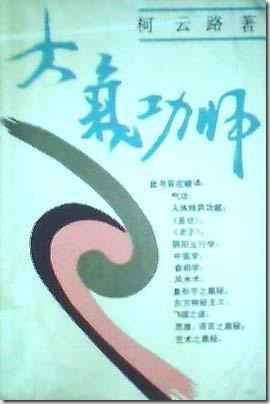
Back to my cousin. She later generously lent me one of the books in her collection—Ke Yunlu’s The Great Qigong Master. Although it was only a novel, the book caused a huge sensation and controversy amid the qigong and human paranormal-abilities craze that swept mainland China at the time. The story was fictional, but all the qigong masters in it were based on real people; you could see the shadows of qigong celebrities such as Zhang Hongbao, Zhang Baosheng, and Yan Xin everywhere. In the book, these qigong masters were not only immensely powerful—basically at Sun Wukong level—but also paragons of moral virtue, while the scientists were portrayed as prejudiced bullies who lived to persecute others. Ke Yunlu even introduced, with a perfectly straight face, a theory called “symbolic physics,” attempting to incorporate qigong into the scientific system. Today, “symbolic physics” looks like metaphysics with no logical basis, using a few scientific terms to bamboozle people. But as a child, I fell for it all over again. When the scientists in the book made life difficult for the great qigong masters in every possible way, I was positively bursting with righteous indignation!
Thanks to my parents’ hands-off-about-everything policy, this wicked book became the first novel I ever read. (Looking back, finishing a book like that in elementary school was actually not easy.) It is still lying on my bookshelf, but if my son ever tries to sneak a look at it, I will definitely give him a good beating!
Ghostly Voices at Midnight
People who practice Buddhism have to do their own cultivation in addition to reading scriptures. By the same token, mystics have to run into a ghost themselves instead of merely listening to other people spout nonsense everywhere!
My experiences with ghosts are extremely scant. There is probably only one incident from childhood that vaguely resembled a haunting. It happened late one night in second or third grade. My family lived on the third floor, and I was suddenly awakened by a very strange “crying and screaming” from downstairs. I could not tell whether it was made by a person, because apart from that one time I had never heard a human make such a sound, yet it could not have come from any machine either. After waking up, I was terrified. The sound was extremely loud and seemed to be coming from downstairs, and it must have been well into the night, because apart from this “ghostly voice,” there was not another sound anywhere.
My parents slept in a room on the other side of the apartment. They were not woken up, but I did not dare call them either, afraid that the “ghost” downstairs would hear me and come up to grab me. The “ghostly voice” continued for several minutes before gradually fading into the distance. I only fell asleep after I stopped being afraid.
After class let out the next morning, I told my classmates about it. A girl who lived near my house said she had heard it too. We were chatting happily when our homeroom teacher happened to catch us. I told her about my encounter with a ghost, and she was afraid I was spreading superstitious nonsense, so she lectured me that it must have been the cry of a lunatic wandering the streets.
I remain skeptical about this to this day, because I never heard such a “ghostly voice” again.
A Psychic Relative
Once, around the time before New Year’s, my male cousins and female cousins—including my Mystic Cousin—took me out somewhere. On the way, we stopped to rest at the home of a distant relative who ran a general store. They were a married couple, and I have now forgotten what I was supposed to call them. My cousins told me that these two distant relatives were devout Buddhists—lay Buddhists, in today’s popular terminology—and that they even had psychic abilities!
My cousins told me some of the lay Buddhists’ miracles. For example, while reciting scriptures, the male lay Buddhist could direct the course of incense smoke—the kind from burning incense for Buddhist worship—which eerily matched the Seventh Fairy incident! The female lay Buddhist, for instance, once saw the flame of a candle unfold into the shape of a lotus seat while she was worshipping Guanyin, and then saw Guanyin rise up on that lotus seat! She personally confirmed this experience that very day. I know it sounds utterly ridiculous, but the female lay Buddhist really did not look anything like a lunatic.
This was my first close encounter with Buddhism. Very mystical, very ridiculous.
Surrounded by these strange relatives, it would have been hard for me not to grow into a mystic.
The Bible Code
Time flew. Having completed my initiation into mysticism, I began junior high school. Junior high should have marked the beginning of my scientific education, but instead I kept straying farther down the wrong road of mysticism.
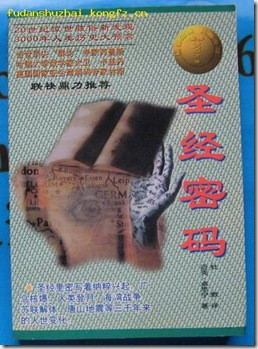
This was when I bought a strange book called The Bible Code! It claimed that hidden within the original Hebrew Bible—specifically the Five Books of Moses—were codes predicting humanity’s future. If you used a computer program to search the characters at regular intervals (that is, an equal-spaced letter sequence), some meaningful words would emerge. Then, searching the text around those words in the same way would turn up other words related to them. Taken together, these words supposedly pointed to an event in human history—or one yet to come! For example, after searching the Bible for “Kennedy,” you would find nearby words overlapping with it, including the year of the assassination and the assassin’s name.
The conclusions in The Bible Code cited the research of several mathematicians, which made me completely surrender to this apparently scientific “Bible code.” Combining it with my mystical inclinations, I decided that the Bible must have been written by aliens! The aliens had hidden prophecies of every event in humanity’s future development inside the Bible. For some reason they couldn’t tell humanity directly, so they encoded everything in the Bible and disguised it as stories, allowing it to be passed down through the ages without giving away the secrets of fate. It was fucking brilliant!! (Only later did I learn that the research cited in the book had already been refuted, because you can find this kind of “code” in any book.)
This was my first intimate encounter with Christianity. Still mystical, still complete bullshit. (Actually, I had already seen Indiana Jones and the Last Crusade before this; I just felt absolutely nothing about the Holy Grail, the Crusades, and all that stuff in the film.)
Incense Qigong Takes Off
In middle school, the qigong craze—which seemed to have quieted down for a while—was revived by the popularity of Incense Qigong, and this time it spread like wildfire, setting half the country ablaze.
I’m embarrassed to admit that, as a mystic, I practiced Incense Qigong too. Looking back, the whole country was being foolish together, so I didn’t look quite as foolish myself. They said you were supposed to smell incense while practicing it, but during our community’s long qigong sessions, the only time incense ever appeared was when a neighborhood auntie used too much laundry detergent while doing her washing next door.
Today, Baidu Baike describes Incense Qigong like this: “The founder claims that Incense Qigong originated in Buddhist Zen and Esoteric Buddhism, and is a superior Buddhist cultivation method. It is also said to have been created more than two thousand years ago by a high-ranking monk, with masters such as Padmasambhava, Xuanzang, and the Living Buddha Jigong among its successors.” This spectacularly over-the-top description is like saying someone is a joint graduate of Harvard, Oxford, Stanford, and Princeton. The credentials are so grand they become deeply suspicious!
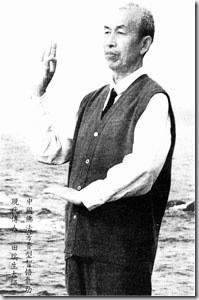
Still, when I saw those photos of Incense Qigong’s BOSS, Tian Ruisheng, performing “miracles” such as halos shining from his head, I was once again completely spellbound. If those photos were released today, they’d probably cause an even bigger sensation than Zhou the Tiger, right? Photoshop apparently didn’t exist yet. I really feel for the people who made those photos.
My Magic-Powered Aunt-by-Marriage
Thankfully, I wasn’t yet a completely hopeless little brat. I was actually a model student, so my scientific awakening was quietly taking place under the radar. Physics was especially my strong suit—I was the kind of person who could often get a perfect score with my eyes closed. (As an undergraduate, I studied engineering; it was only after starting graduate school that I made a massive career pivot into the supposedly hopeless humanities.) After middle school, my commitment to scientism gradually took shape, but it still hadn’t completely broken through the blockade of mysticism. After all, a thick layer of ice doesn’t freeze in a single cold day.
The summer after graduating from middle school, my best friend and I traveled to Hangzhou, and stayed at my great-uncle’s home for several days. My great-uncle was perfectly normal, but my great-aunt-by-marriage was practically a wizard! If those two distant relatives of mine still seemed a little like amateur enthusiasts, this aunt was a genuinely devout Buddhist. During the days I stayed at her house, I saw with my own eyes how she worshiped Buddha. Her devotion probably surpassed that of many actual monastics.
And my great-aunt-by-marriage was also a qigong master! That’s right—qigong again! If I remember correctly, she practiced Lotus Qigong. They said she had reached the astonishing level where people within her energy field would feel heat radiating through their bodies while she practiced. When I was staying at her house, she heard that I had chronic rhinitis, so she activated her powers and rubbed the bridge of my nose vigorously…
To this day, I still remember the burning sensation in the bridge of my nose. Although I still depend on nasal drops to get through life, there’s no denying that this aunt was definitely my most formidable relative! And a relative who loved me very much! My progress toward scientism was briefly interrupted by this enormously powerful aunt.
This was my second intimate encounter with Buddhism. This time, the encounter felt just like my burning nasal bone: very good, and very warm.
The Chinese Teacher Who Spread Rumors
During high school, my scientific outlook continued advancing by leaps and bounds, with far fewer fresh doses of mysticism interfering. The mystical fantasies and enthusiasms of my childhood gradually faded and cooled.
But around then, I somehow learned about The Centuries, that wicked book. The world’s most famous book of prophecy declared that July 1999 would be the end of the world. Why not earlier? Why not later? July 1999 just happened to be when I was taking the college entrance exam! Other people could simply laugh off this nonsensical prophecy. But for someone like me, already thoroughly poisoned by mysticism, it wasn’t quite so funny. Somewhere in my subconscious, I vaguely worried for a while that the world really would be destroyed while I was taking my exam.
Still, pretending to be a tough guy is one of my specialties. At the time, our Chinese homework required us to write informal essays, so I wrote one with the swaggering title, “If the end of the world arrives, we can always be the last batch of quasi-college students on Earth.” From a psychological perspective, this was a classic case of using the opposite behavior to conceal inner fear.
My informal essays stood out because I never followed the rigid eight-legged-essay format expected of middle school students, so they had already been passed around among my Chinese teacher and her circle of friends. This teacher, who thought highly of me, boldly published the “end of the world” essay in the school newspaper. So the first piece of mine ever turned into printed type was, unfortunately, a wicked piece of fearmongering. But I figured that, since the Chinese teacher was the one spreading the rumor, the guilty party had a name and a face. If panic at our school hurt the college entrance exam results, nobody could blame me.
Fortunately, nobody read the school newspaper anyway. And the world didn’t end. My mystical foundations consequently suffered a major blow.
The Mystery of the Crystal Skulls
I think it was after I entered university that I bought the strange book The Mystery of the Crystal Skulls. Human memory is peculiar: we often misremember many past experiences as having happened earlier than they really did. Take The Mystery of the Crystal Skulls. I thought I had read it in middle school, but it must actually have been published when I was in my final year of high school. Maybe, somewhere in my subconscious, I wanted to believe I had become mature at an earlier age. I didn’t want to admit that I was still being bewitched by books like this during university.
To be fair, part of the book consisted of fairly objective archaeological material, but it also contained plenty of fearmongering and claims unsupported by evidence. Books like this are especially seductive, and unfortunately I was seduced all over again. The book focused on an extraordinarily exquisite crystal skull called the “Mitchell-Hedges Crystal Skull,” supposedly a legacy of the Aztecs from thousands of years ago. (The discovery story described in the book was full of holes, and other scholars later proved it to be entirely fictional.) The book also described having the skull examined by several professional institutions, which supposedly found no traces of human carving. Indigenous peoples of the Americas were said to have legends that their ancestors left behind thirteen crystal skulls, concealing ancient wisdom within them. If they were ever gathered together again one day, they would reveal the secrets of humanity’s past and future.
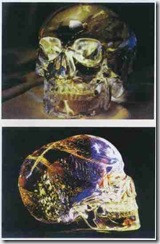
The book even went to great lengths to gather together the crystal skulls that had surfaced around the world by then. The most seductive passage described a medium communicating with the “Mitchell-Hedges Crystal Skull.” The medium placed a hand on the exquisitely crafted skull and delivered a long stream of words that sounded profound but were, in reality, so vague they could mean almost anything. That was presumably the skull’s “ancient wisdom.”
Later I learned that so-called “mediumship” is probably the longest-running trick in human history. From shamans in primitive societies to spirit-medium performances today, it is all just a matter of subconscious suggestion or a hypnotic state. After reading that passage, what bewitched me most was the idea of “ancient wisdom.” Back then, I was very willing to believe that humanity had once possessed an “ancient wisdom” surpassing anything we had today, a wisdom capable of explaining everything, only to have it buried by the passage of time. Later I came to think that any wisdom surpassing the present can only exist in the future, and wisdom capable of explaining everything must be the result of human civilization continually advancing and accumulating knowledge. So-called “ancient wisdom” is merely a whole people’s “rose-tinted nostalgia.” The Chinese nation revered “ancient wisdom” and stagnated for two thousand years; Indigenous peoples of the Americas revered “ancient wisdom” and were nearly wiped out.
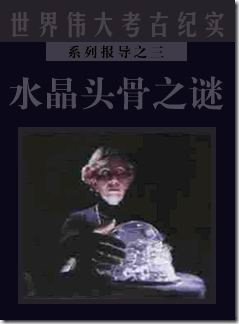
I knew that the crystal skull in Indiana Jones and the Kingdom of the Crystal Skull was really the result of George Lucas and Steven Spielberg combining their usual taste for bad jokes with the “Mitchell-Hedges Crystal Skull” from The Mystery of the Crystal Skulls. The film’s premise that the skull concealed ancient wisdom, along with the scenes in which Indiana communicates with the skull, came directly from the book’s descriptions.
The “Fairy” Who Taught Me to Play Spirit Pen
During my freshman year, I reconnected with a beautiful female classmate whom I had drifted out of touch with, simply because we were attending university in the same city. She had been my classmate in kindergarten and again in my first year of high school, and was probably the dream girl in the eyes of half the boys her age in the small city where I grew up.
This “city-toppling fairy” once came to my dorm and taught me to play Spirit Pen. You took a pencil, wrote the numbers one through ten on a sheet of paper, added “yes” and “no,” and drew a “spirit cave.” Then two people held the pencil together and placed it inside the “spirit cave,” chanting, “Spirit Pen, Spirit Pen, please come out of the spirit cave.” The pencil would then start moving on its own. You could ask the Spirit Pen questions, and afterward invite it to leave. Then you had to snap the pencil in two, or else you would supposedly lose years off your life. They said Spirit Pen worked best at night, when yin energy was strong, and that girls were more likely to summon it.
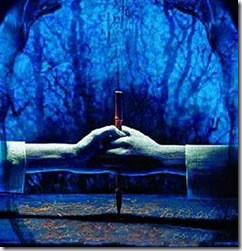
Now I know that all those suggestions about losing years off your life and yin energy were actually no different from the suggestions used in psychological hypnosis. The more mystical the wording, the more suggestible people became, and the more likely they were to enter a hypnotic state. The similar game of Spirit Plate involved an even more elaborate series of rituals, which were really just ways of intensifying the hypnotic effect. The incantation “Spirit Pen, Spirit Pen, please come out of the spirit cave” served exactly the same purpose as a hypnotist saying, “When I count to three, you will disappear”: it was the key phrase used to initiate the hypnotic state.
Friends who have never studied psychology may have been misled by all sorts of movies and TV shows about what a hypnotic state is. In fact, hypnotic states come in many layers, and in many cases they do not mean that consciousness disappears completely. More often, after being brought out of hypnosis, the hypnotized person can still remember exactly what happened while they were under hypnosis; they just find it hard to explain their unusual reactions at the time. A hypnotic state is characterized by a certain degree of separation between consciousness and the subconscious. So spirit writing with a pen is also a kind of hypnotic state: when people play it, the pen seems to move autonomously, meaning that the hand is actually being controlled by the subconscious while the conscious mind cannot perceive that it is the one moving the pen.
When the pen spirit answers questions, it is usually accurate when the players themselves know the answers, and wildly unreliable when they do not. That alone pretty much says it all. Still, even though I know the pen spirit is merely a kind of hypnotic state, I continue to find the experience of the pen moving by itself utterly bizarre.
After the “fairy” left, I went through a phase of spreading the pen spirit all over my class, to the point that, in the eyes of the girls in our class, I became something of a “fortune-telling huckster.”
My “Brother” Roommate
By college, my scientific outlook had fully awakened. I had started reading books on philosophy and physics, and had also gone fairly deep into the natural sciences. I was studying at an engineering university with insanely demanding requirements in the basic sciences, so although I was not a physics major, I had dabbled in things like relativity and quantum mechanics. My worldview at the time was this: I already believed the world was driven by one unified set of physical rules. People and social phenomena might be complicated, but reduced to the most basic level, they were merely complicated combinations of physical rules. I began to believe that this was a world where ghosts and gods, being in violation of physical law, had nowhere to hide.
During my sophomore year, something strange happened in our dorm: the smartest guy among us became a “brother”—he got baptized and became a Christian! This guy had been so smart he was practically hateable. There were courses we could attend for an entire semester and still fail, while he could cram for a few nights before the exam and walk away with a high score. But after his baptism, we felt he had gotten dumber. Discussing metaphysical questions with him had once been fascinating, but now he was forever dragging them back to the Lord. He also showed us an evangelistic pamphlet written by a Taiwanese priest, most of which consisted of accusatory questions along the lines of, “How can you not believe?!” That made us “gospel brothers” even more hostile. I later learned that one of the distinctive features of Christian doctrine is that it asks only for wholehearted belief and has no room for the slightest doubt. The moment you start questioning things, the “brothers and sisters” look at you with deep pity, thinking that anyone who questions God is truly pitiable.
One thing in that evangelistic pamphlet did genuinely interest me: intelligent design. You could say intelligent design was Christianity’s powerful counterattack after science had driven Christian doctrine into retreat on every front. Science kept revealing nature’s astonishingly ingenious laws, while God seemed to have nothing to do in the face of those ingenious laws. So Christianity said: nature is just too ingenious—how could something this ingenious not have been designed by some kind of “intelligence”? And that “intelligence,” naturally, was Jehovah. At the time, I believed that although the world was a rule-governed place where gods had nowhere to hide, the rules themselves must have been established by some kind of force. The universe was a rule-governed world, and above it stood a rule-maker: that was my own version of intelligent design. Although membrane theory (a new development of string theory) now suggests that the universe may simply be the random result of several membranes colliding, what about whatever lies beyond that? I firmly believed that existence must have a reason—and the beginning that made us “exist” was what I called “God.” This is also the flaw in Christian intelligent design: the rules are sublimely beautiful, but if Jehovah designed them, he should not keep casually breaking them.
One of the main events in our four-person dorm was faith debates during our late-night talks—a one-against-three war of attrition. In one debate, I seized on the flaw in intelligent design and tried to convince our “brother” that if God was a creator of rules, he could never arbitrarily violate the rules he had created. Yet the Bible is full of descriptions of “miracles,” and a “miracle” is obviously a wanton violation of the rules. Unexpectedly, the moment I landed that point, our late-night debate came to an abrupt halt. He never said so outright, but I could clearly feel that I had shaken some of his ideas about Christianity. After that, he never evangelized to us again.
This was my second intimate encounter with Christianity. This time, I was cocky and victorious.
The Real Moses
While debating this “brother” roommate, I had vaguely come to understand that much of the Bible was a blend of history and legend. The famous Dead Sea Scrolls, for example, proved that many biblical accounts had a historical basis. But exactly how history and legend were combined in the Bible remained unclear to me.
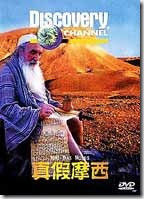
Then I discovered a masterpiece of a documentary on the Discovery Channel: The Real Moses. From an archaeological perspective, it reconstructed the entire process by which Moses historically led the Jews out of Egypt. Its demolition of classic scenes from Exodus, such as the parting of the Red Sea, was breathtaking. I had always liked Discovery documentaries more than the BBC’s or National Geographic’s. Discovery chose more ferocious topics and reached bolder conclusions; compared with it, the BBC’s programs on similar subjects were much more conservative.
Freud’s Moses and Monotheism
As for the Exodus in the Bible, if The Real Moses gave me a convincing historical truth from the perspective of what happened, then Moses and Monotheism, which I read in graduate school, revealed the psychological rationale for his leading the Jews away from Egypt.
Using psychology to analyze the course of history, social events, myths and legends, and the development of art was probably something only the psychoanalytic school of that era had the nerve to do. Contemporary psychology has completely lost that kind of audacity. In this work, written late in his life, Freud used psychoanalysis to speculate that Moses was not Jewish, and went on to explain the psychological motives behind his leading a foreign people away. His conclusion may not have been historical fact, but whenever I think about that terrifying power of deduction, I still bow down in awe!
By this point, I was completely convinced that the Bible was not, as Christians believed, the inviolable word of God in every single letter. Its development and final form were actually determined by all kinds of social and historical factors, so the human will in the Bible was probably far more abundant than the divine.
The Philosophy Teacher Who Wrote A History of Inventing Physics
In graduate school I met an unbelievably formidable philosophy teacher. He taught two courses at the university: dialectics of nature and computer programming! His own research topic was the history of physics! The dialectics-of-nature course he taught us was a case of going off topic twice. He had intended to wander from dialectics of nature into the philosophy of science, but in practice he wandered from the philosophy of science into the history of physics. As a result, the course scared off most of the students with humanities backgrounds. But I, a graduate of that devilish engineering university, listened with enormous enthusiasm.
This philosophy teacher also brazenly assigned his own book, A History of Inventing Physics, as the reference book for the exam, and hawked it in class—a performance entirely in keeping with his formidable style. In all fairness, though, the book really was a wonderful introduction to the philosophy of science through the history of physics. It inspired me enormously, to the point that I later approached many questions from the starting point of the philosophy of science.
I had already made a complete conversion from mysticism to scientism, but I no longer saw the two as mutually exclusive; I had become more tolerant of both. From the perspective of the philosophy of science, the religion of mysticism and the science of scientism are both simply theories for explaining phenomena. Theories are not absolutely right or wrong, but we can use certain standards—Occam’s razor, the falsifiability principle, the trade-offs a theory makes along the continuum from concrete to abstract, and so on—to choose better theories. Science is merely the “better” theory in many situations, while mysticism usually has a hard time winning that comparison.
Take the monumental work of mysticism The Centuries (Zhushi Ji). Tested against falsification theory, it is unfalsifiable. The implication of the falsifiability principle is that a theory should be able to make predictions. The irony is that this book of prophecies has never once successfully made a prediction in advance; only afterward can people force historical events to fit its vague poems. It is like someone predicting, while drawing cards, that they will draw the ace of hearts. If they do not draw the ace of hearts, they say the predicted event has not happened yet. Then, after drawing countless times, they finally get the ace of hearts and say: “See? My prophecy came true.”
The Hypnosis Lecture by a Kung Fu Professor and the Qi-Gong Master’s Energy-Transmission Demonstration
In graduate school, a British friend of my advisor came to visit. This guy was a China obsessive. After watching Bruce Lee movies as a child, he could not tear himself away, and eventually took up martial arts under a teacher! What he admired was Bruce Lee’s practical kung fu, not the performance-oriented traditional Chinese martial arts, so what he actually learned was full-contact fighting. He was good enough that, besides teaching psychology at a university, he also moonlighted as a combat instructor! He once demonstrated his fighting techniques for us: extremely spicy, extremely vicious, nothing but practical moves for street thugs beating each other up! He also knew something about Chinese kung fu movies beyond Bruce Lee’s. When I was showing him around campus, we passed Shaw Building, and I told him it had been funded by Run Run Shaw. He actually knew whom I meant.
His current research asks what implicit rules outfielders use on a baseball field to judge where a ball will land. His papers on the subject are so good that he publishes in Nature all the time. But when he was young, he studied hypnosis, so he gave us a lecture on the subject, mentioning along the way that other countries have things like the pen spirit too. Because of my experiences with the Seven Fairies and the pen spirit, I asked him what good research paradigms existed for this special hypnotic phenomenon that only appears when several people cooperate. He babbled at me in English for a long time, but unfortunately his British accent was so heavy that I could not understand a word.
Speaking of this, I’m reminded of the qigong demonstrations that swept the country in the 1980s and during the Xianggong craze. In a qigong demonstration, a qigong master would “send energy” to everyone in the audience. Some spectators would start dancing uncontrollably or become ecstatic; in more exaggerated cases, chronic illnesses would disappear in an instant. These seemingly unbelievable phenomena were really just collective hypnosis, in psychological terms. Many counselors trained in hypnosis, as well as psychology experts, can give this kind of “qigong demonstration,” hypnotizing students in their classes without anyone being the wiser. Those so-called qigong masters were really just skilled hypnotists. Some of them may not even have realized that they were using hypnotic techniques, and genuinely believed they possessed some kind of “energy power.”
And hypnosis really is a case of “faith healing.” When illnesses are cured in an instant, it is actually the patients’ own psychological power doing the healing, not the efficacy of qigong. Psychology has an experiment on qigong: some qigong masters claimed they could send energy to knock over people several meters away, and those who fell insisted that they had indeed been knocked over by a force. So psychologists hung an opaque curtain between the people being pushed and the qigong masters, making sure the former could not see the latter’s movements, while confirming with the masters that the curtain would not affect the results. They then varied the intervals between the masters’ displays of power at random, so the people being pushed could not predict when one would happen. The results were fascinating. Some of them fell over before the master had even done anything, and insisted they had been pushed. Others stayed upright no matter how long the master pushed. The contrast with situations in which they could see the master’s movements was obvious. This showed quite clearly that it was all the result of suggestion: they had really “pushed themselves over.”
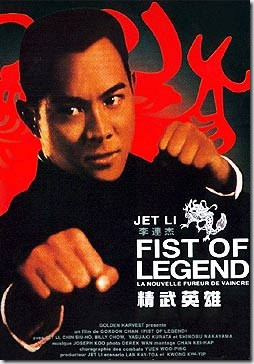
As that hypnotic kung fu professor was leaving, I asked whether he had seen Jet Li’s Fist of Fury. He said he had only seen Once upon a time in China, so I went out and bought him a pirated DVD of the English-dubbed version of Fist of Legend. It was probably the most Chinese gift I could have given him.
A Conflicted Worldview and View of Existence
Speaking of which, I can summarize my current worldview and view of existence.
My worldview is this: I believe the world is governed by a unified set of physical laws, and that nothing within it can violate those laws. So the strange supernatural phenomena I was obsessed with as a child mostly have no room to exist in this world. The “god” in my mind is the creator of those laws, not a personified “God,” because it created the rules without breaking them itself.
This worldview was pretty much perfect—at least from God’s point of view. In God’s eyes, how orderly this world must be.
But then an immensely serious problem appeared. If all living things in the world are generated by the same equal physical laws, why is there, among all these countless beings, one “me” who is writing this article right now? And the existence of self-awareness is clearly unique.
So my worldview tells me that everything in the world is equal under God, while my view of existence tells me that self-awareness exists only once in time and space, making it utterly unique. And so “I” became the rule-breaker in this world.
I tried to find an answer to this contradiction in psychology, only to discover that there was no answer at all: psychology has never addressed a question at this level. I then tried philosophy, but even philosophers have not dared to touch this proposition.
Just when I thought the contradiction between my worldview and my view of existence would remain forever insoluble, I suddenly realized that Buddhism—which I had twice encountered at close range in the past—had an unusually passionate interest in the concept of “self-existence.” I suddenly understood that the ultimate truth might lie in this “ancient wisdom” I had once despised. This may lead me, a person almost completely dominated by scientism, back to my mystical roots from an angle I never could have anticipated.
The Tibetan Book of Living and Dying
And so, the present-day me is embarking on my third close encounter with Buddhism.
Buddhism differs from Christianity in several ways. Christianity starts by demanding that people believe completely and without reservation; apart from faith, there is nothing else, and even other ways of thinking may be seen as conflicting with faith. Buddhism makes no such stubborn demand. Although some Buddhist scriptures are storybooks like the Bible, concerned mainly with faith, a much larger portion consists of theory. The Bible is there to be believed, while Buddhist scriptures can be studied, interpreted, and contemplated. Christianity only asks you to believe in God’s existence, while refusing to let you prove it. Buddhism tells you certain principles and then gives you a set of practices, allowing you to experience those principles for yourself along the way. That is much more convincing than demanding blind belief from the outset. These features of Buddhism make me rather fond of it.
That said, Buddhism is an enormous system, with countless schools and a vast body of scriptures. Where should one begin? After a rough survey, I realized that the answers I needed probably did not lie in Chinese Buddhism. The Pure Land school within Chinese Buddhism seems more like a moral code urging people to do good, while Chan is less a philosophy than a kind of absurdist verbal art.
The answers I wanted should lie in Theravada Buddhism and Tibetan Buddhism.
Theravada Buddhism is early Buddhism, and its scriptures ought to be the most reliable. But starting there directly is simply too difficult. The Chinese translations of the Āgama scriptures, for instance, are extraordinarily obscure—classical Chinese within classical Chinese. It’s not just that I couldn’t get through them; even Jin Yong, who once planned to convert to Buddhism, found the Chinese Āgamas too difficult and switched to English Buddhist scriptures translated directly from the original Pali.
At that point, I was obsessed with Taiwanese stage plays and happened to read Taiwanese theater master Lai Sheng-chuan’s The Creative Learning of Lai Sheng-chuan. In it, Lai hinted that The Tibetan Book of Living and Dying, a Tibetan Buddhist classic, had influenced him more than any other book. I later learned that the Taiwanese edition had a foreword by Lai’s wife. So I thought: this would be my introduction to Buddhism.
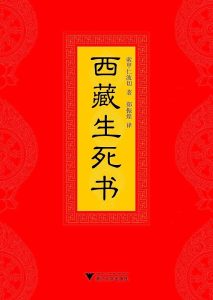
After finishing this classic, I felt I had gained quite a lot. The book is actually a mixture of pearls and problems. Much of what it says should not be accepted blindly. For instance, its repeated advocacy of unconditional surrender to and worship of one’s guru seems rather dubious to me. I believe genuine practice should focus on the teachings, not the person. There is no reason to prostrate oneself before someone first, and only then receive the Dharma from them. Still, much of the Buddhist teaching itself in the book cannot be dismissed out of hand, since I have not yet practiced or experienced it for myself.
This unusual book introduces the Tibetan Buddhist theories of the process and meaning of death, beginning with Padmasambhava’s Liberation Through Hearing During the Intermediate State. Using the Tibetan Buddhist view of death as its central thread, it interweaves an introduction to basic Buddhist principles and methods of practice. It can indeed be considered an introductory book to Tibetan Buddhism.
The book shows that Tibetan Buddhism has developed a remarkably vast and complicated theory of the “bardo.” Put crudely, bardo refers to the period after a person dies and before the instant of rebirth. In reality, the concept is far more complicated than that. If we set aside the question of how this theory was originally derived, it is extremely seductive on its own terms. It is said that meditation can allow people to experience some of the bardo states described by the theory. Unfortunately, I still have absolutely no idea how to meditate properly.
But viewed purely through the lens of logic, this extraordinarily complicated bardo theory has problems. No matter how thorough the argument is, a flawed foundation makes everything pointless. It is like geometry built on false axioms: however precise the reasoning, the conclusions are bound to be absurd. In my view, the problem with this book is that it never clearly explains how this immensely complicated theory of the bardo was originally derived. Take reincarnation, the first axiom of the bardo theory. The author writes at great length, yet never manages to offer convincing evidence that reincarnation exists. He is a highly renowned rinpoche, or living Buddha, and he mentions in the book that he was identified as the reincarnation of another rinpoche. So if he had mentioned even once that he himself had experienced a bardo state or remembered a past life, I would have found it much easier to believe. Unfortunately, the book contains no first-person experience confirming the bardo theory, which leaves me somewhat puzzled.
The evidence for reincarnation in the book is extremely weak, but one aphorism by Voltaire quoted by the author completely stunned me! It goes like this:
“Being born twice is no more astonishing than being born once.”
Exactly. In my view of existence, existing once is already the greatest impossibility. Once existence has happened, what is so much more astonishing about existing twice?
So perhaps we should retain a sense of awe toward a theory that is impossible to fully prove through logic. When it comes to life and death, and to existence itself, we might as well allow a little more room for uncertainty.
And so this book about death rather mysteriously opened my journey of exploring the ultimate meaning of life. I hope I can continue this remarkable journey until, one day, the ultimate meaning of life unfolds before me.
May I attain liberation in this lifetime!
Epilogue
That brings my brief history of enlightenment to a close. I’m reminded again of a few childhood encounters with mysticism—such as the time my hands-off, spectacularly irresponsible father took me, a first-grader, to watch a videotape at the home of one of his drinking buddies. They put on a Japanese horror movie. If I remember correctly, it was called The Grudge. I was so terrified that I carried the psychological scars for at least four or five years afterward; whenever I closed my eyes, I saw the wronged female ghost from the film hunting down her unfaithful husband for revenge.
Many people in the world are afraid of ghosts, just as I was back then. But thinking about it now, the most terrifying thing in this world is actually that we can’t see ghosts at all!
Version History
This article was written in 2008 during my visiting-scholar period in the United States. It remains exactly as written, with nothing added or removed.
Leave a Reply