1. God
There are three films that, ever since I first saw them as a kid, I have rewatched at least once a year. I never get tired of them, and every time I watch them, I do so with the solemn feeling of a pilgrim paying respects. One is Terminator 2: Judgment Day, one is Swordsman II, and one is the 1987 version of A Chinese Ghost Story. I eventually learned, of course, that there are plenty of films better than these—even my own list of the ten best films I’ve seen wouldn’t include them. But if you tell me these films are no good? Then I’ll fight you to the death. This isn’t a case of love making someone blind to flaws. You have blasphemed against my gods.
My memory is limited, and I can’t recall much of what happened even a few years ago. Once I told my girlfriend at the time that I had a bad memory and often forgot the things we’d experienced together. I planned to keep a diary, writing down our story so I wouldn’t forget it. These days, whether I remember those things hardly seems important. Once, an image suddenly surfaced in my mind: me standing on a cliff, watching a river flow into the sea. It felt exceptionally real and yet far away, leaving me completely dazed for a while. Only later did I gradually remember that it was probably a view I passed on the way to Sequoia National Park in the United States—the mouth of some important river in northern California. At the time, barely more than a year had passed, and it already felt like a dream. Apparently I should record more in writing. Otherwise, the span of my mind amounts to only these pitiful few hundred days: a wasteland. I hope that by recording things, I can stretch the width of my mind a little. Maybe years from now, when I look back at these notes and remember today, they will feel more solid than that scene did.
Films are a kind of record too. My childhood was so densely interwoven with them that they have become part of me. They are records of my childhood, helping extend the span of my mind and dotting a few colors across the desert. Of the pitiful fragments of childhood I still remember, stories about old acquaintances connected to these films make up most of them.
Most of these memories involve video parlors. Fixed locations, crowds gathering, and a ritual solemnity with a collective-hypnosis effect—the video parlor was the church of us boys born in the late 1970s and early 1980s. And that one film at the center of the ritual: wasn’t it a god?
I remember that the warehouse of the Xinhua Bookstore where my artsy cousin worked was rented out as a video parlor for a while, and I mooched films there during that period. Once, the place was packed, with people standing all the way out the door. They were showing A Chinese Ghost Story II: The Taoist Sorcerer, which I had already seen several times. I’ve forgotten why I was still enthusiastic enough to squeeze into such a spectacle just to watch an old film. I only remember my cousin bringing over a chair, and me standing on it, gazing at Fu Qingfeng as Ning Caichen’s flying kiss turned her into a corpse demon. That gruesome scene felt extraordinarily romantic in my memory.
I remember one day after school, my best friend and I spotted a video parlor by the roadside advertising, in huge letters and on a poster, “Starring Leslie Cheung, Joey Wong, and Wu Ma: the sequel to A Chinese Ghost Story, XX.” We were so excited that we didn’t even go home for dinner—we charged straight into the place. We watched the whole thing without realizing that the male lead wasn’t Leslie Cheung. Only years later did I learn that it was The Fox Spirit (Ling Hu), one of the particularly disreputable knockoffs churned out in those years under the A Chinese Ghost Story banner. In my memory, this was the first time the honest, well-behaved me secretly did something so pathetically “bad” without telling my family.
Back then, to attract business, video parlors would not only put up posters and signs; they would also place a busted speaker facing the street and pipe out the sound of whatever was playing inside. I remember that A Chinese Ghost Story had no Chinese subtitles. So my friend and I, obsessed with everything about the film, spent several days lurking around the video parlor, waiting for the scene containing the poem “Frost fills the sky over a lake stretching ten miles.” We only wanted to figure out exactly which characters made up the third line, “Facing the moon, alone, I gaze at each other.”
When I graduated from elementary school, I don’t know what came over me, but I felt it was a shame for my classmates to simply scatter, so I decided to stage a grand gesture and organize an event. A more promising person might have thought of taking everyone on a trip. I, being spectacularly unpromising, decided that all the boys in the class should watch a video together before graduation. The venue was my uncle’s video parlor. When we were choosing a film, my uncle enthusiastically recommended one about two monks, one old and one young, fighting demons. It was supposed to be fantastic. The film was Bloodshed at the Golden Buddha (Jin Fo Die Xue). Of course I’d already seen it, though it was years before I learned its real title. Looking back, my uncle’s expression was exactly the same as that of certain video-store owners who later recommended porn to me.
There are plenty more memories like that. These stupid things may seem meaningless to other people, but they are among the few surviving fragments of my life. I don’t like Johnnie To’s Vengeance, but I deeply identified with the gradually amnesiac male lead. I can completely understand the desolation of watching the stories of old acquaintances in one’s memory drift away one after another. That is why I treasure them.
The first time I saw A Chinese Ghost Story, it was on a videotape rented by my artsy cousin, with the imposing title The Divine Sword Slays Demons (Shen Jian Zhan Yao). I think I already knew Leslie Cheung and Joey Wong by then, and I knew Tsui Hark too. I knew it was a Hong Kong film, but strangely, the tape had Japanese subtitles. Only later did I learn that the version on the tape was missing chunks of the story. Later still, I realized it was a Japanese transfer, dubbed by a two-person knockoff studio—a man and a woman doing every voice, with all the background sound erased while they recorded. Even so, nothing could stop my god from descending from heaven in that moment.
Looking back now, A Chinese Ghost Story’s initiation of me reached into almost every corner of my still-childish mind at the time.
The most obvious part was my sense of beauty. Even today, the imagery of A Chinese Ghost Story—from the costumes to the art direction to the cinematography—remains my benchmark for classical Chinese visual beauty. I never had any aesthetic training, and my adjectives for beauty are painfully scarce. So even later, when I sneered at the giant red and green cloths in Hero and House of Flying Daggers, I had no suitable words for what was wrong with them. I could only say, “It’s so much worse than A Chinese Ghost Story.” I don’t know whether other people can understand that comparison. Perhaps only I find it precise and self-explanatory. Once you’ve seen the ocean, lesser waters won’t do—that’s probably what it means. From then on, whenever I saw the imagery in a Chinese costume film, I measured it against A Chinese Ghost Story, asking how much worse it was.
A Chinese Ghost Story fostered in me an almost obsessive love of Hong Kong costume films. For a long time, I couldn’t truly like even Jackie Chan’s or Stephen Chow’s films. I stubbornly believed that the enduring quality of A Chinese Ghost Story could only be recreated in costume films.
A Chinese Ghost Story also became, in a wonderfully bizarre way, the starting point for some of my philosophical reflections. For years I couldn’t get over the logic that Xiaoqian had to be reincarnated in A Chinese Ghost Story. I was deeply puzzled by the way the idea of reincarnation values status—life—over practical reality—the existence of the self. What’s so bad about being a wandering ghost? At least you’d still be Nie Xiaoqian. So what if you’re not human? Once reincarnated, you cease to be anything at all. This was also why I later loved the ending of A Chinese Ghost Story III so much. My endless, unanswerable wrestling with “self-awareness” began here.
And finally, love. If A Chinese Ghost Story is also a classic love story, what exactly was it that moved me? I only understood after watching the new A Chinese Ghost Story.
2. Dating and Love
Although I had long suspected that the new A Chinese Ghost Story would be a tragedy, I still didn’t expect to burst out laughing as soon as the opening credits appeared. The English title of the 1987 A Chinese Ghost Story is “A Chinese Ghost Story.” Here, it was somehow changed to “A Chinese Fairy Tale.” Gentlemen at the broadcasting authorities, how haunted must you be to be this afraid of ghosts?
Since it’s a fairy tale, I suppose it’s the kind where a prince and princess fall in love. Let’s set aside the irresponsible details—for example, Ning Caichen gets scared witless in one scene, and then in the very next scene, which follows immediately in the plot, he inevitably reappears with his clothes perfectly neat—and the muddled plotting. Let’s talk only about the love story in the new A Chinese Ghost Story:
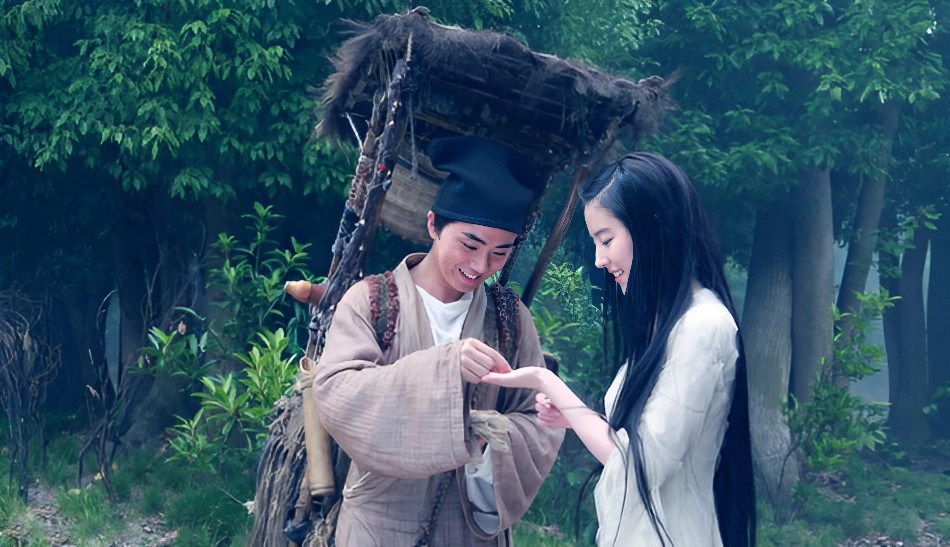
I don’t know whether mainland actors simply aren’t good enough, or whether people in real life are too lacking in honesty and purity, but they have a special talent for turning qualities like sincerity and innocence into “stupidity.” Yu Shaoqun does the same here, turning the supposedly simple and honest Ning Caichen into a middle-schooler radiating idiocy and childishness. I already thought that casting the girlish Liu Yifei as Nie Xiaoqian made her seem too young. I hadn’t expected Ning Caichen to look a whole generation younger than her. I went to A Chinese Ghost Story expecting to watch a lovesick man and a resentful woman caught in an agonizing entanglement. Instead I got a middle-school boy being seduced by an older girl and discovering puberty. The scene where Xiaoqian and Caichen hide from Yan Chixia in the bushes—from the dialogue and expressions to the business of splitting candy—feels so much like “walking home after school.” The Ning Caichen and Nie Xiaoqian of the new A Chinese Ghost Story are merely “dating”; they are not “in love.”
After Yu Shaoqun’s Ning Caichen loses his virginity, he goes from having no smell to having a smell. I suppose that means he has changed from a boy into a man—though he remains childish. I believe Leslie Cheung’s Ning Caichen would still have had no smell even after his tender entanglement in “Please Don’t Come at Dawn.” That is the biggest difference between Yu Shaoqun’s Ning Caichen and Leslie Cheung’s Ning Caichen.
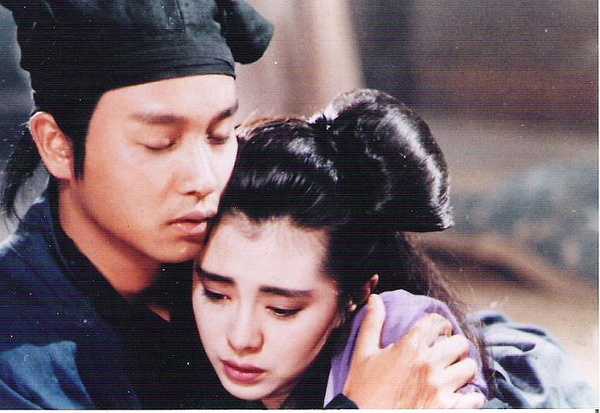
Still, does the “love fairy tale” in the new A Chinese Ghost Story seem so absurd to me merely because Yu Shaoqun’s acting falls short? Or merely because the dialogue and set pieces are so crude? If the new A Chinese Ghost Story had cast a somewhat better young leading man, and a somewhat more reliable screenwriter had made the dating dialogue and scenes more amusing, would this love story have moved me like the old version did?
It seems not.
Only later did I realize that the biggest difference between the love stories in the new and old A Chinese Ghost Story was not the superficial craftsmanship of the acting or dialogue. It was that the male and female leads had completely different identities—in the old version, the loneliness of Ning Caichen and Nie Xiaoqian no longer exists in the new one.
3. Love Among the Lonely
I find that the love stories that move me are almost always loves between people separated from what they belong to. In a love story, at least one of the protagonists is a lonely outsider cast adrift in the world. Before this love begins, their hearts contain the kind of desolation I know well. Love is a little flower blooming in that desert. Precisely because it blooms in a desert, it shines so brightly. What makes love so soul-stirring is not love itself, but the barren background that sets it off.
That is why love belongs to the lonely.
Before Wall-E and Eve dance through space in WALL-E, there must first be a century of loneliness;
Without the loneliness that survives after being casually trampled and despised, Sheldon’s self-sacrifice in “I’m Here” would not be so utterly resolute, would it?
If they weren’t lonely outsiders far from home, Li Xiaojun and Li Qiao in Comrades: Almost a Love Story would only brush past each other;
That one minute of warmth in Fallen Angels could only happen between two marginal people;
In Lust, Caution, the understanding and mutual pity in the despair of “The Wandering Songstress” probably comes from Wang Jiazhi and Mr. Yi both realizing that the world has cast them out.
The same goes for the 1987 A Chinese Ghost Story. Yan Chixia, disgusted by the ugliness of the human world, exiles himself from it and keeps his distance; Ning Caichen is a “good-for-nothing” scholar, eking out a living in troubled times with a pure heart. Even if he hadn’t been driven to Lanruo Temple, his kindness and innocence had already pushed him to the far edge of human society; Nie Xiaoqian is lonely too, stubbornly holding on to her conscience amid the bloodlust of every demon and ghost around her. They are all exiles cast out to the borderlands of the human world, each facing the wasteland inside themselves. What moved me about the love story in the 1987 A Chinese Ghost Story may have been precisely the loneliness behind that love.
And what about the new version?
The old Yan Chixia belonged to no sect and lived his whole life alone, while the new Yan Chixia has both a senior fellow disciple and a master.
The old Ning Caichen stumbled into Lanruo Temple only because he had nowhere else to go, while the new Ning Caichen arrives as a civil servant on official business. He isn’t lonely at all; he’s actually part of an organization.
You can see the old Nie Xiaoqian’s loneliness in the single tear she sheds while luring the nameless scholar to his death. But what about the new Nie Xiaoqian? All I know is that she doesn’t kill good people (actually, she just doesn’t kill slow-reacting virgins). From the way she scolds the two snake demons, I know she’s Grandma’s most capable assistant, but I can’t see how much remorse she feels about killing everyone else. Is she tormented and trapped by circumstance, like the Nie Xiaoqian of old, or is she merely forcing herself through a job she doesn’t enjoy or approve of? I honestly can’t tell.
So in the new A Chinese Ghost Story, one is a civil servant and an ambitious young man, the other a model worker and an exemplary employee. Even if they had never met, their lives would still be perfectly pleasant. The old love story was a dazzling flower blooming in a wasteland; in the new one, their hearts were gardens to begin with.
So I’m afraid I have no choice but to look the other way when it comes to your love. When loneliness no longer exists, love becomes much less likely to sear itself into your memory.
I came into this world alone, and at the end, everything will return to solitude. Before I met you, I lived alone in solitude; after I met you, the two of us could go on living in solitude together. That, I suppose, is love.
Related articles
For more on “the feeling of loneliness,” you can also read the chapter “Solitude: Two Faces of Loneliness” in my book The Alluring Illusion: Secrets of Psychology in Light and Shadow:

Leave a Reply