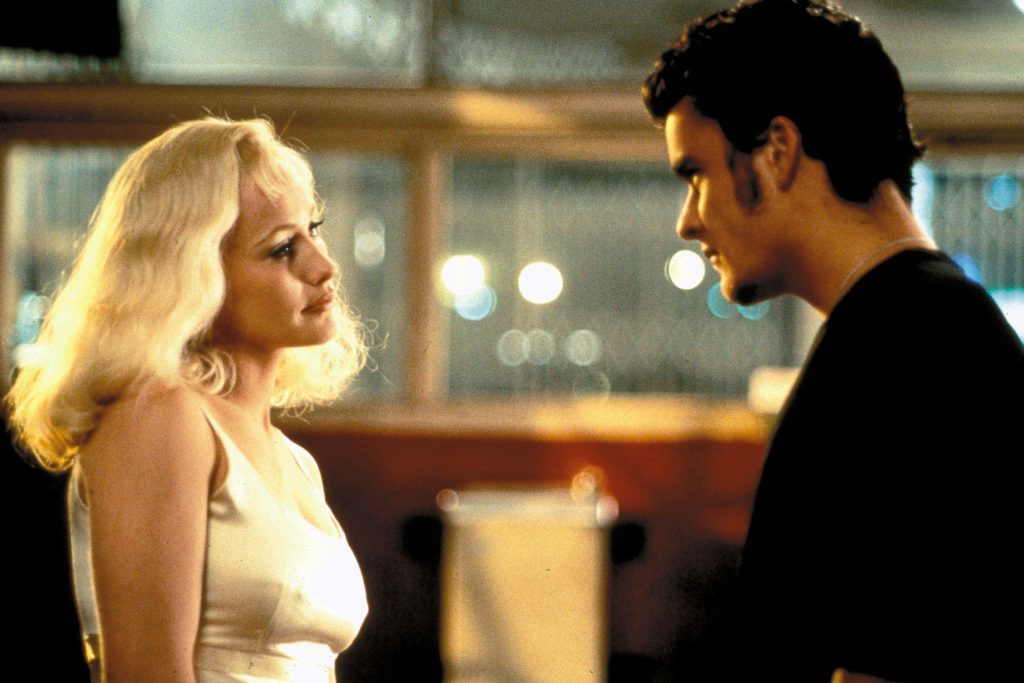
Lost Highway is one of David Lynch’s most intriguing films to date. It may look chaotic and utterly illogical, but once you straighten out the key events, you find that every shot carries weight. You could almost call it rigorously structured and flawless.
If Lost Highway were a psychological patient, I’d impersonate a psychologist for once and take a look at what kind of inner world is hiding beneath that fragmented exterior. Here, then, is the psychological analysis report on Lost Highway.
Plot Analysis Report
I think that no matter what angle you use to puzzle over Lost Highway, you have to start with the plot. Only after the events rise to the surface can you really understand why the director arranged every detail the way he did—and why the characters make those seemingly inexplicable faces and react in those seemingly inexplicable ways.
If you want to figure out what this apparently chaotic film is actually about without too much effort, I suggest dividing it into three parts:
The first part runs from the beginning of the film until the protagonist Fred kills his wife, is arrested, and sentenced to death—this is reality, and it is also the end of the story;
The second part runs from the moment the protagonist Fred’s head changes shape in prison and he turns into Peter, a young auto mechanic, until Peter turns back into Fred in the desert—this is actually a dream Fred has in prison;
The third part runs from Peter turning back into Fred until the end of the film—this is still part of Fred’s dream, but it is half real and half false. Most of its details did happen in reality, before the first part; in fact, it explains how the story began.
So the story of Lost Highway actually goes like this:
Fred discovers that his wife Renee often goes to a motel on a Lost Highway in the desert to have secret meetings with a man named Dick Laurent. He also discovers that she may once have been a porn star who had an affair with Dick Laurent. Fred kills Dick Laurent after one of his dates with Renee. (This is explained in the third part.)
Terrified by the murder, Fred becomes intensely anxious and starts having hallucinations. He also develops another personality—an ominous Mystery Man—and, driven by this personality, sneaks into his own house to videotape it. What Fred finds even harder to tolerate is that after he kills Dick Laurent, Renee seems to be involved with a man named Andy. Fred learns that Andy also knows Dick Laurent, which heightens his anxiety and deepens his distrust of his wife. Finally, in a mental breakdown, he dismembers Renee. He is sentenced to death. In prison, he cannot sleep, and after a doctor gives him medication, he has a strange dream. (This is the first part.)
At the beginning of the dream, Fred replaces himself with Peter, a young auto mechanic, and falls in love with Alice, who looks exactly like his wife Renee. But the dream grows more and more real. The Mystery Man, Fred’s other personality from waking life, also begins appearing in the dream; Peter even turns back into the real-world Fred, and the sweet dream becomes a nightmare. At the end, the police chase him along the highway. With nowhere left to run, his face begins changing shape again—the nightmare is waking up. What awaits him is a reality he can no longer escape. (This is the second and third parts.)
Director Analysis Report
If you agree with my reading of the plot, then what the director is trying to express is actually very simple: nothing more than, “What occupies the mind by day appears in dreams at night.” More precisely, “What causes anxiety by day appears in dreams at night.” Negative emotional experiences that trigger daytime anxiety—fear, for instance—are the easiest things to carry into dreams. Even from the perspective of modern psychology, this old saying remains the most basic principle for explaining dreams. I think David Lynch, guided by this idea, uses Lost Highway to show us a dream, while taking us through the real-world anxieties that came before it alongside the dreamer.
David Lynch only presents us with a fragmented dream and reality; he does not directly annotate them in any way. So whether it is the mirrors that keep appearing, the cabin restored from the flames, or the mysterious videotapes, he leaves all those eerie, opaque details for the audience to puzzle over. That is precisely where his brilliance lies: what he wants to express is actually simple, but he leaves the audience limitless room to imagine.
I’m a Freud fan too, and I think David Lynch is much more sophisticated than Alfred Hitchcock in the way he handles psychological suspense. Hitchcock was unquestionably very fond of Freud’s theories, so in Spellbound he built a dream sequence directly from Freud’s theory of the unconscious and then went to great lengths to interpret it. He even frequently had characters quote Freud’s ideas outright in his films. But that often makes things feel too deliberate and blunt. At least I never found the strange dream in Spellbound especially affecting. By contrast, the anxiety and fear Lost Highway gives its audience feel so real that you might think it was an actual nightmare David Lynch once lived through.
Actor Analysis Report
Among all the actors in this film, Bill Pullman, who plays Fred, is particularly outstanding. If you agree with my reading of the plot, you will also notice how accurately Pullman conveys the extreme anxiety after the murder, the mental deterioration that follows, and the resentment over his wife’s infidelity in the first part. The film’s first proper shot, for example, shows Fred smoking with a heavy heart, visibly unsettled. At this point, the plot has Fred having just killed Dick Laurent, overwhelmed by the anxiety that follows the act. You could say that from the film’s first proper shot onward, Pullman completely inhabits Fred; nearly the entire first part is propelled by his performance. The closest comparison, in this respect, is Tony Leung Chiu-wai in In the Mood for Love, whose plot is driven almost entirely by his eyes. Almost nobody here saw the chill of revenge and the ache of remorse in Leung’s eyes, and almost nobody truly understood In the Mood for Love, but I think the Cannes jury did—or they would not have given Leung the award. Pullman was less lucky. Because Lost Highway is so intensely obscure, neither professional critics nor ordinary viewers have ever seemed to know what exactly he was acting.
Aside from Pullman, Robert Blake, who plays the Mystery Man, is the film’s biggest highlight. His stunning entrance during the party scene—this is the old man who makes everyone watching him feel a chill—has become one of the signature images of a David Lynch film. The character’s deep impression comes not only from the successful makeup and costume design; Blake’s superb performance is indispensable.
Analysis Report on the “Key Symptoms”
① Who exactly said, “Dick Laurent is dead”?
This is the plot point that sends most viewers’ logic into a tailspin. At the beginning of the film, Fred hears the doorbell, someone tells him, “Dick Laurent is dead,” and he then hears sirens. But when he looks out the window, there is nothing there. At the end of the film, Fred rings the doorbell himself and says, “Dick Laurent is dead.” The film thus enters a logically impossible closed loop.
This strange detail is actually nowhere near as complicated as it seems. When Fred hears “Dick Laurent is dead” at the beginning, it is not real—it is his own hallucination. Fred has only just begun hallucinating. The more afraid he is that someone will discover the murder, the more a voice inside him seems to jump out and say, “You killed someone. Don’t think nobody knows.” He hears the sirens for the same reason: he is afraid the murder will be exposed. So this is like his conversation with the Mystery Man at the party: both are Fred’s own fantasies. The second time the scene appears, it is actually Fred’s dream. By then he realizes he has nowhere left to go, so in the dream he tells his real-world self that Dick Laurent is dead; reality can no longer be undone.
So the first occurrence is a hallucination in reality, representing anxiety and fear; the second is a dream, representing despair. They do not happen at the same time.
② The Mystery Man
Whether in the dream or in reality, the Mystery Man is actually another personality of Fred’s. This personality is the embodiment of the fear and unease inside him. It constantly reminds him that reality cannot be escaped, and the more anxious he becomes, the more often this personality appears. At the same time, it is the violent side of Fred’s character. The Mystery Man appears whenever Fred conceives the idea of murder—for example, when he kills Dick Laurent and when he sees Renee acting ambiguously with Andy at the party. At the end, when Fred and the Mystery Man kill Dick Laurent together again in the dream, Fred’s wish to escape reality is completely replaced by despair. The Mystery Man then disappears, merging with Fred as one.
③ The Videotapes
The first two mysterious videotapes were filmed by Fred’s other personality, the Mystery Man—which means they were filmed by Fred himself. Through the tapes, this personality warns Fred, “Someone is watching you. Someone knows what you’ve done.” That is precisely what Fred fears most. If you look closely at the second tape, you will notice that the Fred in the bedroom with his wife does not look like a real person at all. The “Fred” on the tape is stiff, and he has no head! He is obviously a mannequin.
Then how do we explain the third videotape? How could someone film himself dismembering his wife with a moving camera?—The truth is, there is no third videotape. Fred is the only one who sees it. Watching this tape is simply a hallucination, or the surfacing of his other personality, using that form to make him remember the fact that he killed his wife. In prison, when images from this tape flash through Fred’s mind, they turn into color, showing that this is merely his own hallucination.
④ The Cabin
In Lost Highway, the cabin restored from the flames always becomes the turning point between dream and reality. It first appears when Fred is about to enter the dream in prison; the second time is just before Peter turns back into Fred in the dream. From this, we can infer that Fred burned Dick Laurent’s body in the cabin. The scene of the murder appears in his hallucinations and dreams as a substitute for the fact of the murder, telling him that reality cannot be escaped. The cabin being “restored from the flames” represents Fred’s wish that what happened could somehow be undone.
⑤ The Mirrors
There are two scenes in the film involving a mirror. In the first, Fred walks down the dark hallway in his house, looks in the mirror, and comes back out with a grim expression. The next day, he discovers that he has dismembered his wife. Both the hallway and the mirror are highly symbolic. Walking into the dark hallway symbolizes entering the dark side of his own personality; in the mirror, he seems to see another self. When he comes back out of the hallway, it might be more accurate to say that the one who returns is the other self in the mirror—a Fred consumed by resentment toward his wife and stripped of his reason. The second mirror scene is Peter looking at himself in the dream. This is a turning point in the dream. Before it, Peter is riding high, relaxed and carefree; it is a perfect dream, embodying Fred’s wish to escape reality. Perhaps Fred also realizes that it is too far removed from reality. “Is this really me?” And so he sees himself in the mirror. Sure enough, the relaxed and carefree one is not the real-world Fred but the dream Peter. From this point on, fear keeps invading the perfect dream, dragging it step by step back toward the abyss of reality.
Version History
本文撰写于2001-2002年左右。其他版本:
Leave a Reply