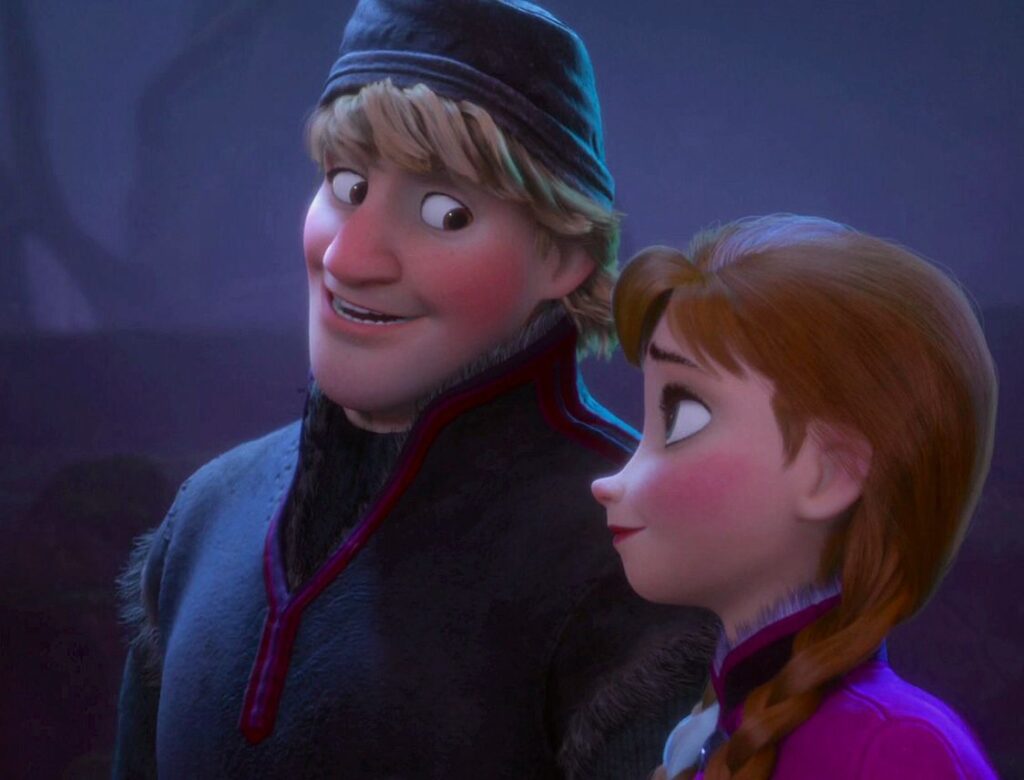
After finishing the previous Fanduan post, I was reminded of a passage about Frozen in Philip Zimbardo’s The Demise of Guys—
Everyone knows the story of Frozen pretty well. In the book, Zimbardo uses it as a little thought experiment: what would we feel if we switched around what the heroine, Princess Anna, and the hero, Kristoff, do in the movie?
The story between Anna and Kristoff in Frozen goes roughly like this:
On her way to find her sister, Queen Elsa, Anna runs into Kristoff and asks him to help her find her. During their adventure together, Kristoff nearly loses his life, and his only livelihood—the sleigh—is destroyed. He then kindly takes the injured Anna back to the castle to see the man she loves. Throughout the whole process, Anna basically doesn’t say a single word of apology or thanks. Even when the man she loves, Prince Hans, reveals his true villainous nature, Anna still doesn’t think of Kristoff. It isn’t until the end, when Olaf reminds Anna that Kristoff might like her, that she finally remembers him.
Now let’s switch Anna and Kristoff around and see what happens. Let’s imagine a movie called Reverse | Frozen:
In Reverse | Frozen, there is a prince named Kristoff. On his way to find his brother, he meets a poor woman named Anna and asks her to accompany him. During their adventure together, he destroys Anna’s only possession and nearly gets this woman killed trying to save him. Then, after she willingly does everything she can to help him, he doesn’t even offer an apology or a word of thanks before leaving her to go find the girl he loves. Even when the girl he loves reveals her true colors and tries to kill him, he doesn’t think of Anna. It isn’t until Olaf reminds him at the end that Kristoff remembers Anna.
All right, so if you saw this Reverse | Frozen in a movie theater, what would you think?
Wouldn’t you feel that this prince was utterly inhuman? Wouldn’t you think he was a terminal case of toxic bro culture, a piece of trash, a scumbag, a beast?
Chances are you would, right? But strangely enough, everything this prince does is exactly the same as what Anna does in Frozen.
So why don’t we have even a hint of those negative feelings when we watch Frozen?
When the same behavior comes from Anna, a female character, we see it as, at most, a little willful—and sometimes even find that willfulness cute. But when it comes from a male character, we see it as utterly awful, as moral corruption.
This probably suggests that, in practice, we unconsciously define men’s gender roles more narrowly and more traditionally.
A woman can show all kinds of mental and emotional qualities—gentle, feisty, willful, mature, tomboyish, girlish, gender-neutral—and none of it is a problem. At the same time, though, the range of qualities we allow men in our minds has many more forbidden zones.
Isn’t that… a little unfair?
References:
Philip Zimbardo, & Nikita Coulombe. (2016). The Demise of Guys. Beijing United Publishing.
Note
- This series, called “New Insights in Psychology: Short Lessons,” consisted of popular-psychology and miscellaneous short essays written back then to accompany the Zhichao Wei: New Insights in Psychology project. They were published on the now-shuttered platform Fanduan, and the original link no longer exists.
Leave a Reply