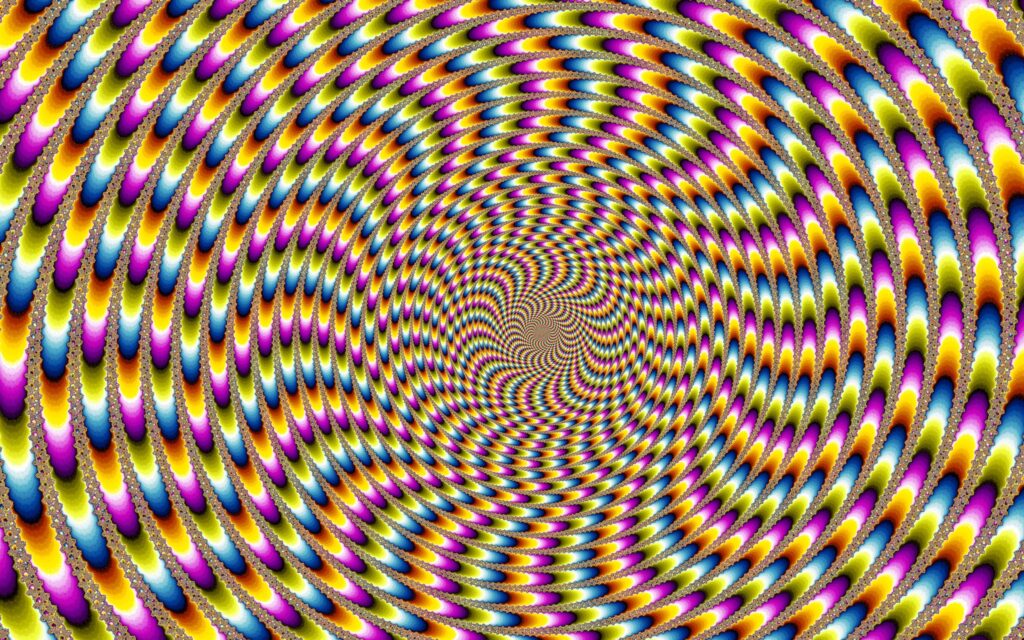
Champions of Illusion is a new book published in the United States last year. In it, authors Susana Martinez-Conde and Stephen Macknik present a series of intriguing visual illusions and explain the psychological and neuroscientific principles behind them.
Here are three examples from the book. First, look at the viewing instructions below and the images attached at the end of the article, and then read the explanations.
****
Viewing instructions:
Image 1: Birds in a Cage

First, stare at the green bird on the left for 30 seconds, then immediately look at the cage. You’ll see a red bird appear inside it. If you stare at the red bird on the right for 30 seconds and then look at the cage, you’ll see a green bird.
Image 2: Sunrise
First, hold your phone a little farther away, then move it toward yourself. Does the image seem to get brighter? It looks as if the image’s brightness changes as you move it back and forth.

Image 3: The Coffer Illusion
Stare at the image for a few seconds. Do you notice anything unusual? (This illusion is fairly well hidden; I’ll reveal what’s wrong with it below.)

****
Explaining the Three Illusions—
Birds in a Cage:
This illusion is based on a visual afterimage. After we stare at red for a while, the cells in the retina that respond to red light reduce their activity to save energy and prepare to detect future changes against a red background. When you then look at a white background, the retina remains adapted to the red environment for a moment. Subtract red from white, and you see red’s complementary color: green.
Sunrise:
The neural mechanism behind this illusion is still not entirely clear. One possible explanation is that when a visual object appears (expands) or recedes (contracts), some motion-sensitive neurons in the visual pathways are selectively activated. Perhaps the faint, cloud-like image radiating from the center is less conspicuous to these neurons than the red-and-blue background. So when the clouds and the background expand or contract together, these neurons perceive different degrees of expansion or contraction in the two, creating the illusion that the clouds are moving faster than the red-and-blue background.
The Coffer Illusion:
Did you see the 16 circles in the third image just now? If not, take another careful look. Our visual system doesn’t make a complete copy of the objective world. In fact, our brains prioritize extracting, emphasizing, and processing the features most important for recognizing an object. Sharp protrusions or indentations in an object’s outline (in other words, corners) matter more to vision because they contain more key information about the outline than straight edges or gentle curves do. So in our subjective visual perception, sharp corners stand out more than curves. The reason you couldn’t see the 16 circles is that they were all hidden inside sharp corners.
References:
Scientific American: Mind, January 2019. The New Champions of Illusion: An excerpt from a new book on visual illusions.
Note
- This article in the “New Psychology Insights” series was a short popular-science essay / informal piece written at the time to accompany related content from the Zhichao Wei: New Psychology Insights Course. It was published on the now-closed platform “Fantuan,” and the original link no longer exists.
Leave a Reply