Today’s article is a little harder than usual, but I simply couldn’t resist writing it and introducing it to you.
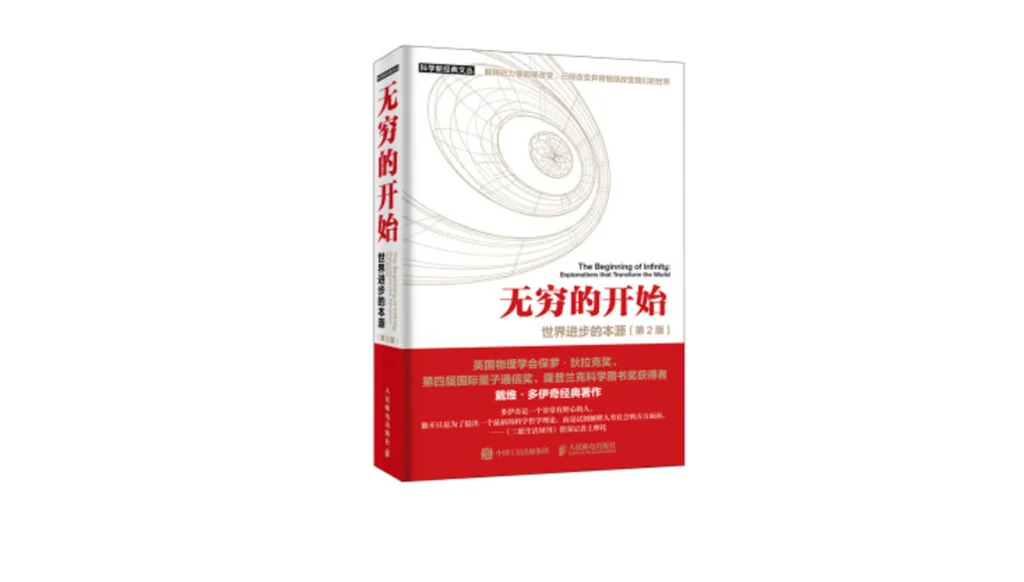
Starting with today’s article, I’ll be introducing some ideas from The Beginning of Infinity: Explanations That Transform the World.
It was the most profound and beautiful work of nonfiction I read last year.
Introducing this book in a few short essays is extremely difficult, because its information density is simply enormous: every sentence is packed with jewels, and almost nothing can be cut (unlike some padded-out books, from which there are barely a few words of useful substance to extract). The only way to fully understand the book’s essence is to read it from cover to cover (though some parts are genuinely difficult and take a bit of chewing).
So my way of introducing this book is not to cover everything, but to pick out a few small passages and interpret them. I’m just dangling some bait and hoping you’ll bite ^_^
The author of The Beginning of Infinity is David Deutsch, a god-level physicist and one of the theoretical founders of today’s hottest frontier technology, quantum computing.
That said, The Beginning of Infinity is not a popular science book about physics.
This book has an extraordinarily broad vision. It tries to reveal the true source of the unprecedented progress human beings have made over the past several centuries, since the Enlightenment and the Scientific Revolution. To investigate the answer, Deutsch traverses almost every basic field of science and philosophy in the book.
If we sum up the answer the book gives in one blunt word, it is—“good explanations.” That is also the book’s central keyword.
Deutsch writes: “In this book I shall argue that all progress, whether theoretical or practical, comes from a human activity: seeking what I call good explanations.”
Put simply, a good explanation explains something and is “hard to vary.”
It is precisely the pursuit of good explanations that has driven humanity’s unprecedented progress over the past several centuries.
And “good explanations” are also the true foundation of the Scientific Revolution.
It is generally believed that the most fundamental difference between science and the traditional ways humans acquired knowledge in the past is that scientific theories must be “testable.”
“A theory must make predictions, and if it is false, its predictions will conflict with some possible observations. Thus, although scientific theories are not derived from experience, they can be tested by experience—through observation or experiment.”
But Deutsch points out: “Testability cannot be the decisive factor in the Scientific Revolution.” After all, “testable predictions have always been ubiquitous. Every rule of thumb for making a flint blade or lighting a campfire is testable.”
“For example, consider how ancient Greek mythology explained the arrival of winter each year. Long ago, the god of the underworld, Hades, kidnapped and raped Persephone, goddess of spring. Later, Persephone’s mother, Demeter, goddess of the earth and agriculture, negotiated a contract with him for her daughter’s release. It stipulated that Persephone would marry Hades and eat a magical seed, forcing her to visit him once a year. Whenever Persephone left her mother to fulfill this obligation, Demeter became deeply sad and commanded the world to turn cold and barren, so that nothing could grow.”
“Although this is only a myth, and entirely fictional, it does contain a certain explanation of the changing seasons: it is a claim describing what causes the reality of winter that we experience. It is also perfectly testable: if winter is caused by Demeter’s periodic sorrow, then every place on Earth must experience winter at the same time. Therefore, if the ancient Greeks knew that Australia was going through a warm growing season when they believed Demeter was at her saddest, they should have been able to infer that their explanation of the seasons was wrong.”
You see, even a mythological theory that we modern people know is completely made up can still be testable.
So what is the key ingredient that science has but pre-scientific knowledge did not?
Deutsch continues: “But why these gods rather than others? In Norse mythology, the changing seasons are caused by the fickle fortunes of Freyr, god of spring, in his eternal war against the forces of cold and darkness. When Freyr wins, the earth is warm; when he loses, the earth becomes cold. … As to what actually happens to cause the seasons to change, the myths of Persephone and Freyr assert completely incompatible things.”
“All the details can be replaced, with equal effect, by infinitely many other details.” So the fundamental flaw in these mythological explanations of the changing seasons is that they can be “varied arbitrarily and substantially.”
When a theory is very easy to vary, experimental testing is almost useless for correcting errors. Deutsch calls such theories bad explanations.
Even when bad explanations are repeatedly confirmed by experiments, they contribute almost nothing to progress.
Good explanations are completely different.
A good explanation of the changing seasons is that the sphere’s axis of rotation is tilted relative to the plane of its orbit around the Sun. For half of each year, the Northern Hemisphere tilts toward the Sun while the Southern Hemisphere tilts away; for the other half, the situation is reversed. Whenever sunlight strikes one hemisphere vertically (providing more heat to each unit of surface area), it strikes the other at an angle (providing less heat).
This is a good explanation—hard to vary, because every detail plays a real role.
(If you find the following passage difficult, feel free to skip it.)
“For example, we know—and can test this by methods unrelated to the experience of the seasons—that a surface tilted away from radiant heat warms less than one tilted toward it; a sphere rotating in space always points in a constant direction. We can also explain why this is so using theories of geometry, heat, and mechanics. The same tilt is involved when explaining how high above the horizon the Sun appears at different times of the year. By contrast, in the myth of Persephone, the coldness of the world is caused by Demeter’s sadness—but people’s sadness does not usually make their surroundings colder, and apart from winter itself, there is no way for us to know whether Demeter is sad or whether she can really make the world cold. In the explanation based on the tilt of Earth’s axis, we cannot replace the Sun with the Moon, because the Moon’s position in the sky does not repeat once every year, and sunlight, which warms the Earth, is indispensable to the explanation. Nor can we casually insert a story about how the sun god feels about it, because if the correct explanation of winter lies in the geometry of the Earth–Sun motion, who feels what about it is entirely irrelevant; if the explanation has some flaw, no story about anyone’s feelings will make it correct.”
Only when a theory is a good explanation—hard to vary—does its testability have any significance.
So what is the key ingredient science has but pre-scientific knowledge did not? The answer is “good explanations.” Since the Scientific Revolution, human beings have begun pursuing good explanations. Good explanations are not only a basic principle of science; they are also a basic principle of the entire Enlightenment.
As for how good explanations come into being, we’ll have plenty of chances to talk about that slowly later on.
Note
- This series of “New Psychological Insights” articles consisted of short popular-science essays and informal pieces written at the time to accompany the related content of Zhichao Wei: New Psychological Insights. They were published on the now-closed platform Fantuan, and the original link no longer exists.
Leave a Reply