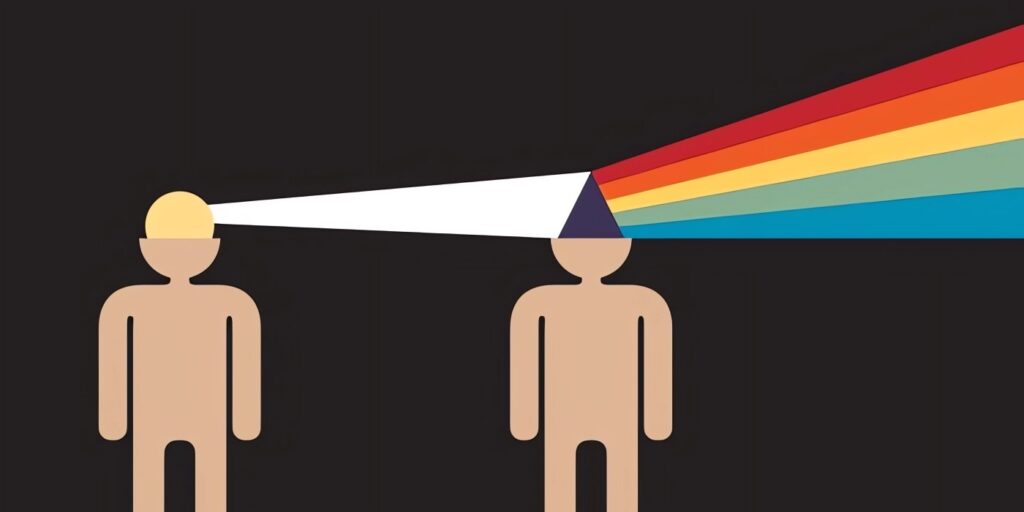
How do people usually react when they encounter a new idea?
On this question, in my reading over a period of time, I came across two seemingly contradictory views.
View A comes from Annie Duke’s Thinking in Bets (the book behind Thinking Like a Poker Pro, the title used for our New Knowledge Course). The idea is that people are quick to believe ideas they have merely heard through the grapevine: they take a new idea into their minds without thinking, and only later, through some chance combination of circumstances, seriously examine whether it is right or wrong.
View B comes from The Enigma of Reason (a Chinese edition has recently come out too). The idea is that when people hear all kinds of reasons, defenses, and opinions from others, they activate their “contrarian” mechanism and try to argue with the other person. In other words, people not only don’t readily believe what others say; they become especially vigilant about picking holes in it.
You could say these two views are diametrically opposed. So are people easily persuaded by a new idea, or are they quick to pick holes in one?
The actual situation may be that both things happen. The key is to look at the form in which the new idea appears before you.
Here’s how I understand it:
If, when a new idea is presented, you vaguely sense some kind of “agenda” behind it that might work against your interests, you activate the contrarian mechanism and remain wary of the idea. This is the situation described in The Enigma of Reason. The examples in that book all concern how people react when they have some potential “interaction” with one another. If someone might work with you, travel alongside you, do business with you, or provide services for you in the future, then any idea they present to you comes with a kind of “original sin”—because you are highly sensitive to losing out, and you always have to watch out for whether they are trying to take advantage of you.
So, once you sense that the other person may have an “agenda” when presenting a new idea, persuading you becomes rather difficult.
Conversely, if a new idea is presented in an especially “pure” form, and you cannot detect any ill intent behind it, then you can easily undergo “subtle influence”—being affected by it and persuaded by it without much resistance.
So how can a new idea be presented in a “pure” form?
The first way is for the presenter to appear sincere—the person presenting the idea either genuinely has no ill intent, or is such a good actor that you cannot see it at all.
Why is it always Luo Pang who gets scolded whenever people talk about “knowledge sharing” online, while Gao Xiaosong rarely gets much abuse (even though what Gao Xiaosong says is full of holes)?
One possible reason is that Gao Xiaosong gives people the impression that he simply really wants to chat with you, nothing more. You feel that he genuinely loves talking; if you don’t give Gao Xiaosong a chance to chat on television, he would probably talk to his friends the same way at a dinner gathering—you never feel that he is trying to get something out of you, so a lot of the time you can comfortably accept his ideas. Luo Pang, for some reason, always seems to give people the feeling that he has an agenda—even if that may not be what he intends.
The second way is to hide the “agenda” completely.
The social psychologist Serge Moscovici once conducted an experiment. He showed two groups of participants a set of blue cards with varying degrees of purity and asked them to say what color the cards were. The key design was this: in the experimental group, several participants were actually confederates, who deliberately called some cards that were closer to green “green,” and the genuine participants could see them making that judgment.
So were the genuine participants’ later judgments influenced? On the surface, no. When they later judged the cards, they still stuck to their “blue” judgment.
But the participants immediately took part in a second, apparently independent experiment. In this experiment, they had to sort a series of cards into “green” or “blue” (the colors on the cards were actually all somewhere between blue and green).
The result was that the participants who had seen the confederates call some blue cards “green” in the earlier experiment sorted more cards into “green” in the later one. In other words, the participants’ judgments of color had in fact been influenced by the confederates’ view.
We could say that in this study, the psychologist’s “agenda” was “malicious”: they wanted to manipulate the participants. But the participants did not notice this agenda at all. They simply saw an unrelated passerby with no stake in the matter—a confederate—presenting an opinion. When ill intent is completely hidden in this way, people are very easily influenced by a new idea. This is the situation described in Thinking in Bets.
So, if you want to achieve “subtle influence” and make other people more likely to accept an idea you put forward, you have to make the idea pure—either you genuinely have no ill intent, or your acting is explosive enough and you hide it deeply enough.
After turning it over and over in my mind, I feel that instead of honing my acting skills and hiding my motives, I might as well be straightforward—I also make money from knowledge products; I genuinely want to make money through this, and at the same time I genuinely enjoy introducing you to all the new knowledge I come across. I also genuinely enjoy the thrill of talking until my saliva flies everywhere. Wanting to make a living and support my family by doing something I love—that is my agenda.
Note
- This series of articles, “New Psychological Knowledge Mini-Course,” consisted of short popular-psychology essays and casual pieces written at the time to accompany Zhichao Wei: New Psychological Knowledge Course. They were published on the now-closed platform Fantuan, and the original link no longer exists.
Leave a Reply