 ▶
▶
The full talk is in the Feifan series on Fanshu, a Chinese audiobook app; this page is only a summary.
What this episode is about
So, does the me in a crowd use a completely different brain from the me who is alone?
When I’m alone, I’m wise, independent, and quick-witted; but in a crowd I become slow, conformist, prone to reading too much into things, and somehow unable to stop trying to please everyone?
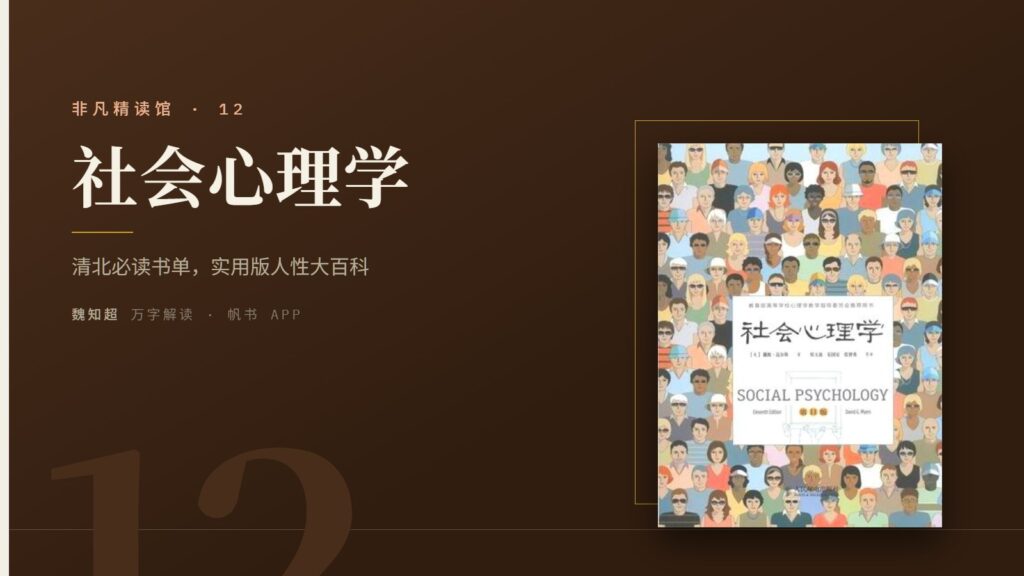
This monumental classic of social psychology helps you see the underlying logic of group thinking and understand how interpersonal interaction affects the individual. It lets socializing nourish you instead of hurting you.
You’ll hear
- Understand the group thinking we inevitably fall into when we enter a group
- See the biggest driving force and the strongest repelling force in interpersonal relationships
- Find your comfort zone in a crowd with ease, and access a sense of relaxation anytime
Quote of the episode
Genes and the environment interact. For example, under the stimulation of testosterone, men generally develop more muscle and grow taller, so society and culture come to expect more of what is supposedly “masculine” from boys. In this way, culture amplifies genetic differences.
People have a very obvious bias: by default, we assume the group we belong to is superior to other groups. Even when the grouping is completely random, we naturally see members of our own group as friendlier, more honest, and more trustworthy than members of other groups.
Many people instinctively feel that flying is more dangerous than driving, and that’s the influence of the “cognitive miser”: we get this impression because the horrific images of plane crashes are reported so often, making it far easier to recall cases of plane crashes than car accidents.
About the author
David G. Myers Professor of psychology at Hope College, he devoted his life to bringing psychology to ordinary people. His books Psychology and Social Psychology are among the most popular introductory psychology textbooks today.
Leave a Reply