 ▶
▶
The full talk is in the Feifan series on Fanshu, a Chinese audiobook app; this page is only a summary.
What This Episode Covers
So, does the me in a crowd actually use a completely different brain from the me when I’m alone?
When I’m alone, I’m wise, independent, and quick-minded; but in a crowd, I become slow, conformist, prone to reading too much into things, and somehow unable to stop people-pleasing?
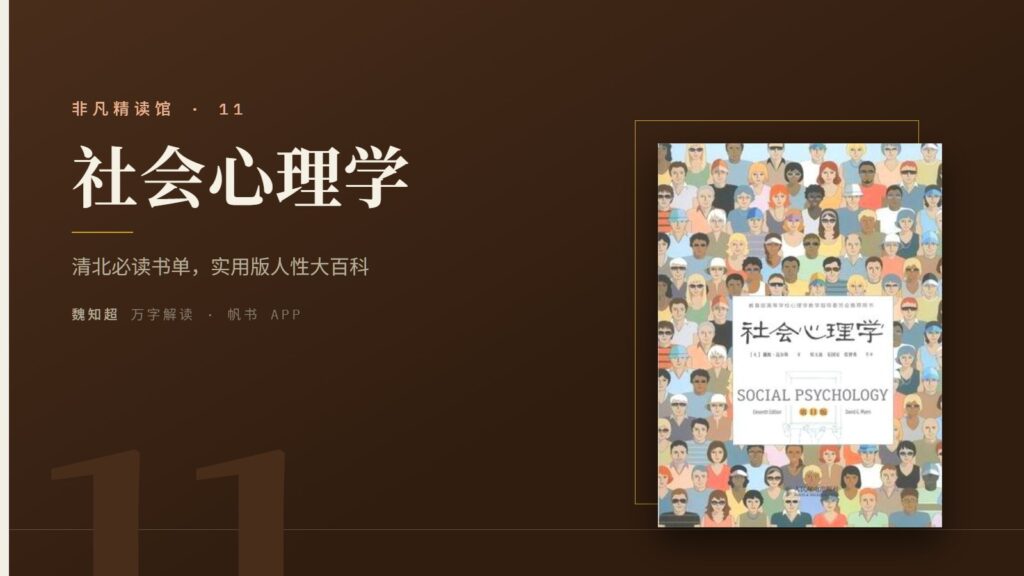
This landmark classic of social psychology helps you see the underlying logic of group thinking and understand how interpersonal interaction affects the individual. It turns socializing into nourishment instead of harm.
You’ll Hear About
- Why stepping into a group inevitably pulls us into group thinking
- The biggest driving force and the strongest repelling force in human interaction
- How to find your comfort zone in a crowd and access a sense of ease whenever you need it
Key Takeaways
Quite often, our “social anxiety” is completely unnecessary. Whenever you worry about looking bad in front of other people, or get stuck in endless self-consumption because of some embarrassing moment, remind yourself: I’m just desperate to belong. That’s the spotlight effect at work.
If we agree to a small request first, we send the other person a friendly signal. Then, when they make a more excessive request, we try to keep our behavior consistent, and unconsciously persuade ourselves to accept that request too.
Our longing to belong in a group can produce all kinds of “dark sides.” For example, because we’re so eager to prove that we’re reliable, we can be used for brainwashing; because we want to fit in with the group, our views can become seriously distorted and our individual sense of responsibility can disappear.
About the Author
David G. Myers Professor of psychology at Hope College, he devoted his life to bringing psychology to ordinary people. His Psychology and Social Psychology are among the most popular introductory psychology textbooks today.
Leave a Reply