 ▶
▶
The full talk is in the Feifan series on Fanshu, a Chinese audiobook app; this page is only a summary.
What This Episode Is About
Why does the middle of the night always make us unable to stop emo-ing? Why do songs that get us hyped keep hijacking our brains when we’re trying to do something serious? Why is it that the harder we try to stay calm, the more anxious we become?
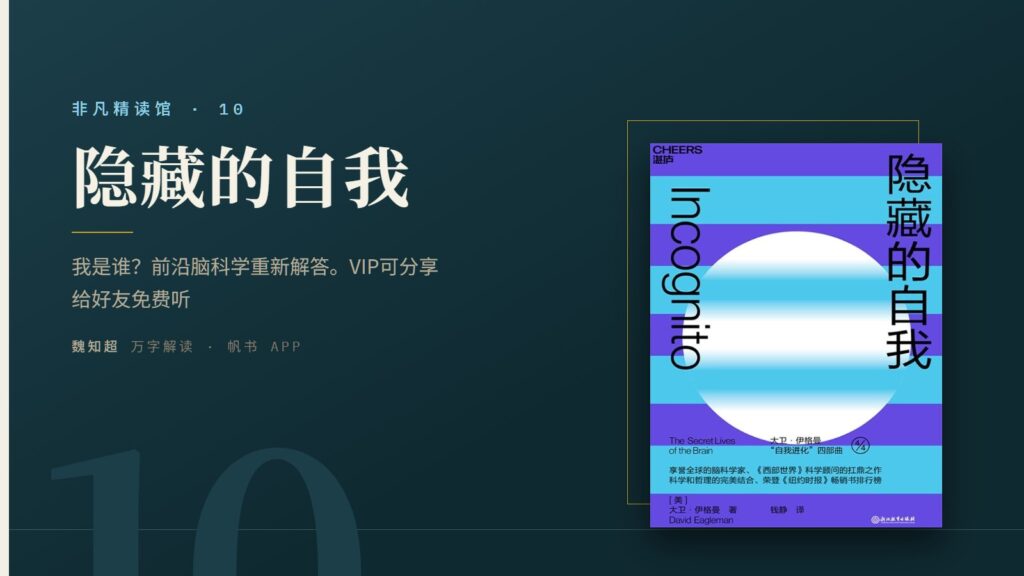
Sometimes it feels as if another person has taken control of our bodies, and all we can do is silently endure the consequences of losing control. As Carl Jung put it: “In every person’s inner world there is another person they do not know.” This book uses the brain’s “unconscious” as its key, taking you beneath the surface of consciousness to unlock another hidden self—and revisit the question that has troubled psychologists for a century: Who, exactly, am I?
You’ll Hear
- The cutting-edge theories and findings of cognitive science and neuroscience
- The underlying logic of the brain’s decisions—and its fatal blind spots
- A new way to understand “Who am I?” from the perspective of the unconscious
Quote of the Episode
The relationship between consciousness and the unconscious is a bit like the relationship between the CEO of a large company and the tens of thousands of employees working under them. The unconscious handles all kinds of concrete tasks, while consciousness is responsible for coordinating, allocating resources, and dealing with conflicts among the unconscious processes.
Over the past few hundred years, the progress of science could also be described as the process of humanity being steadily exiled from the center of the universe.
In this vast universe, this tiny existence of ours somehow has the ability to look back at itself and explore the essence of the self. Isn’t that the most astonishing miracle in the universe?
About the Author
[U.S.] David Eagleman A world-renowned neuroscientist and professor at Stanford University, he has published more than 100 academic papers in journals including Nature and Science. He is the recipient of the American Neuroscience Society’s Science Educator Award.
Leave a Reply