I came across a mind-reading trick in William Poundstone’s Rock Breaks Scissors. It’s very easy, and after reading this article and learning it, you might even be able to use it to bluff people at a drinking party ^_^
The trick usually goes like this:
The magician invites a spectator onto the stage and asks them to stand beside a table. On the table is a row of five upside-down teacups, numbered 1 through 5 (see the image below).
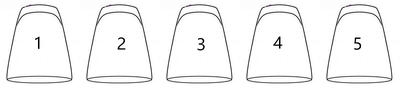
The magician first asks the spectator to take out a personal item, such as a watch.
Then the magician says, “In a moment I’ll turn around with my back to the table. Please hide the watch under any cup on the table.”
As he explains, the magician also gives a demonstration: he picks up Cup 1, puts the watch inside, covers it with the cup, and then takes it back out and returns it to the spectator.
Next, the magician turns around. To prove that he isn’t peeking, he may even blindfold himself.
The spectator then picks a cup—for example, Cup 4—and hides the watch underneath it.
After the watch has been hidden, the magician turns back around and says to them, “Now concentrate completely on where the watch is. I’ll read the watch’s location from your mind.” He puts on an impressive-looking stare and studies the spectator for a while. Then, sure enough, he lifts Cup 4 and pulls out the watch hidden underneath. Trick accomplished.
Apparently, as long as the whole process is carried out correctly, the magician’s accuracy can reach around 90%—because the vast majority of spectators will, through some mysterious force, put the watch under Cup 4.
Why does this happen? Let’s look at it step by step.
First, Cups 1 and 5 can be ruled out. Imagine that we have five objects lined up in front of us and someone asks us to pick one at random. Don’t we generally avoid choosing the first or last one? We feel that the objects at the ends are too conspicuous, too prominent, and therefore not random enough. Putting the watch there seems almost too easy to guess.
By avoiding the ends, we’ve already eliminated two positions.
Next, people generally won’t choose Cup 3 either. It’s right in the middle, so it’s conspicuous too; putting the watch there would feel especially deliberate. That leaves only Cups 2 and 4.
But would anyone choose Cup 2? The odds are also quite low. Remember, during the demonstration, the magician put the watch under Cup 1. This is actually a very powerful piece of psychological manipulation: once a position has been touched by the magician, once it seems to have become the focus of the magician’s attention, spectators will unconsciously choose a position as far away from it as possible. So Cup 2, being next to Cup 1, is also unlikely to be chosen.
And so, most spectators obediently put the watch under Cup 4.
The pattern exploited by this trick is fascinating: the more people want to make their choices inconspicuous, the more they fall into a pattern that can be seen through. To borrow a line from Edgar Allan Poe, the father of detective fiction:
“When people try hard not to be predictable, they are always predictable.”
p.s.:
There are a few more things worth saying about this mind-reading trick. What if the magician has bad luck and happens to pick a spectator with bizarre bones and an abnormal mental circuit—someone who simply refuses to choose Cup 4? What then? There are actually plenty of techniques for rescuing the situation. For example, the magician can use the move Stephen Chow used in The Tricky Master:
“This one—not,
this one—neither.”
Note
- This article in the “New Findings in Psychology” series was a short popular-science essay/ramble written at the time to accompany content related to Zhichao Wei: New Findings in Psychology. It was published on the now-closed platform F团, and the original link no longer exists.
Leave a Reply