![The Final Judgment | A Review and Preview of LOST Season 5, Part 2 [The Apostles]](https://weizhichao.info/wp-content/uploads/2023/06/eQv1Of-1024x640.jpg)
This is a review and bit of speculation about the story after the end of LOST Season 5. Major spoilers ahead, so if you haven't finished the first five seasons, proceed with caution!
Jacob’s True Identity
Last time I suggested that Jacob might not be God, but rather a “half-immortal” trying to stop God from carrying out the Final Judgment. If this guess is correct, then who is Jacob really? Could he be someone who actually existed in mythology, religious texts, or even history? That’s entirely possible. The success of The Da Vinci Code shows that things which are half true and half invented are far more compelling than complete fiction. I suspect the LOST writers may have been thinking along the same lines.
Most people’s first reaction would be that Jacob was probably some ancient Egyptian figure, since the island’s civilization clearly looks like part of ancient Egyptian civilization. But I think the island’s civilization is one thing, while Jacob and the Man in Black may not be as old as the island itself. For example, Greek writing also appears on Jacob’s tapestry, and ancient Greek civilization emerged somewhat later. That suggests Jacob’s background may not be entirely rooted in ancient Egyptian legend. According to my Atlantis hypothesis from earlier, the island was originally somewhere near the Mediterranean, with connections to both ancient Egypt and ancient Greece. So even speculating that Jacob was a Greek god isn’t especially far-fetched.
Besides, the LOST writers love blending elements from different religions. So far the show has included at least Christianity, Egyptian religion, Buddhism, and Taoism. Jacob may seem to live in a place resembling ancient Egypt, but his identity could have nothing to do with ancient Egypt.
The most famous Jacob in history is of course the ancestor of the Israelites in the Old Testament who wrestled with an angel. The awkward relationship between him and his brother Esau also looks a lot like the relationship between LOST’s Jacob and the Man in Black. And, unless I misremember, that Jacob eventually died in Egypt. Other than that, though, we don’t seem to find many links between him and LOST’s Jacob. Besides, Jacob’s identity is one of LOST’s biggest mysteries, so the writers should be throwing more fog around it. If the name alone gave everything away, that would be far too obvious. So I’m not very willing to believe that LOST’s Jacob is the Old Testament figure.
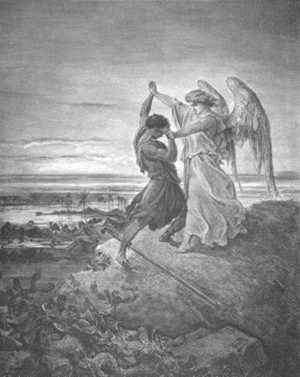
Jacob in the Old Testament
So who exactly is Jacob? My theory comes from the following pieces of evidence.
First, the others had to learn Latin. During the time jumps, Juliet, Sawyer, and Locke traveled back to 1954 and encountered a young Widmore and his companions. Widmore quietly spoke with them in Latin, but Juliet caught him in the act. It turned out Juliet had studied Latin too, and she said it was a required course for the others. From her conversation with Widmore’s companions, we also learn that the “Ricardus” later mentioned by Ilana is Richard’s Latin name. In the season-five finale, Ilana asks Richard, “what lies in the shadow of the statue?” Richard answers, “Ille qui nos omnes servabit,” also in Latin. Translated into English, it means “he who will protect us all.”
So Latin seems extremely important to this group of Jacob’s followers, the others. We know Jacob appears to speak every language, using whichever one he needs. So why is Latin so special? My guess is that Latin may well be Jacob’s native language!
Lots of people throughout history knew Latin, and for a very long time it existed as a sacred language. But who used it as a mother tongue? The Roman Empire—the place where Latin was born and originated! If Latin really is Jacob’s native language, then Jacob may originally have been someone who lived during the Roman Empire (27 BCE–476 CE).
Second, “God loves you as he loved Jacob.” The line “God loves Jacob” suggests that Jacob was once a person who stood extremely close to God. According to my speculation about the Final Judgment in the previous article, Jacob was once so close to God that he had considerable influence over Him. So he may well have been someone who stood beside God and was trusted by Him.
Putting those two points together, Jacob’s most likely identity turns out to be one of the apostles who stood beside Jesus! The twelve apostles lived during the Roman Empire (after Jesus’s birth, naturally around the first century CE), and they were the people closest to God. Whatever historians think of Jesus’s identity, in religion he is the Son of God, essentially one with God.
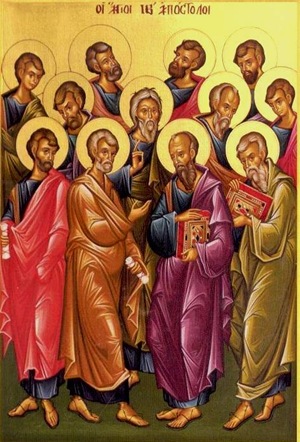
But was there a man named Jacob among the twelve apostles?
As it turns out, yes!
Here is the list of Jesus’s twelve apostles:
Peter: Renamed by Jesus, his original name was Simon (Mark 3:16); was a fisherman from the Bethsaida “of Galilee” (John 1:44, cf. John 12:21). Also known as Simon bar Jonah, Simon bar Jochanan (Aram.), Cephas (Aram.), and Simon Peter.
Andrew: The brother of Simon/Peter, a Bethsaida fisherman, and a former disciple of John the Baptist.
James, son of Zebedee: The brother of John.
John: The brother of James. Jesus named both of them Bo-aner’ges, which means “sons of thunder”.(Mark 3:17)
Philip: From the Bethsaida of Galilee (John 1:44, John 12:21)
Bartholomew, son of Talemai: It has been suggested that he is the same person as Nathanael, who is mentioned in John 1:45-51.
Matthew: The tax collector. The similarity between Matthew 9:9-10, Mark 2:14-15 and Luke 5:27-29 may indicate that Matthew was also known as Levi.
Thomas: Also known as Judas Thomas Didymus – Aramaic T’oma’ = twin, and Greek Didymous = twin.
James, son of Alphaeus: Generally identified with “James the Less”, and also identified by Roman Catholics with “James the Just”.[19]
Thaddeus: In some manuscripts of Matthew, the name “Lebbaeus” occurs in this place. Thaddeus is traditionally identified with Jude; see below.
Simon the Zealot: Some have identified him with Simeon of Jerusalem.[20]
Judas Iscariot: The disciple who later betrayed Jesus. (Mark 3:19) The name Iscariot may refer to the Judaean towns of Kerioth or to the sicarii (Jewish nationalist insurrectionists), or to Issachar. Also referred to as “Judas, the son of Simon” (John 6:71 and John 13:26). He was replaced by Matthias as an apostle shortly after Jesus’ resurrection.
What do you think? Can’t see Jacob? Exactly. This may be a little trick the LOST writers played to conceal Jacob’s true identity. In English, there really isn’t anyone among the twelve apostles called Jacob, so viewers raised in an English-speaking environment would notice nothing strange. They would never think to connect him with the twelve apostles.
Actually, there are two Jacobs among the twelve apostles: James, son of Zebedee and James, son of Alphaeus.
“Saint James”? No! In the Chinese Bible, they are called “the elder” James and “the younger” James.
That’s because the name James in the English Bible was translated from the Italian “Giacomo.” Giacomo is a variant of Giacobo, and Giacobo comes from the Latin Iacobus—which is Jacob!
James is actually Jacob.
Most English-speaking viewers know that there is a Jacob in the Old Testament, but they have no idea that the great saint they know as St. James was also called Jacob.
I don’t know much about the translation process behind the Chinese Bible, but it very likely referred to the Latin Bible. That is why the names of these two apostles were translated as “Yagebo,” accidentally bringing them closer than English does to their original names.
As for the “younger” James, son of Alphaeus, the Bible says only that he was one of the twelve apostles and records no other deeds. We know very little about his life.
The “elder” James, son of Zebedee, on the other hand, was one of Jesus’s important disciples (the following quotation is taken from Wikipedia).
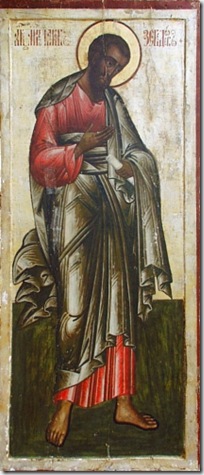
How the elder James was called:
"When Peter lent his boat to Jesus and obeyed the Lord's instructions to cast the nets, enclosing a great many fish, James was called to help. They filled two boats with fish, and in his astonishment he heard the Lord promise, ‘You will catch people as you catch fish.’ He and Peter then left everything and followed the Lord Jesus, becoming fishers of people (Luke 5:4–11)."
In the Bible, James’s family were fishermen. LOST’s Jacob also seems to fish and live on fish. Could this be a sign that he hasn’t forgotten his roots?

James was the first of the twelve apostles to be martyred. “After the Holy Spirit descended at Pentecost, the apostles bravely testified for Jesus. Miracles became evident, believers loved one another, and many people converted to Jesus—but this also provoked resentment and persecution. At that time King Herod Agrippa I (who reigned from 41 to 44 CE) began persecuting the church and killed James with a sword (Acts 12:1–2). James became the first martyred apostle.”
Although the Bible clearly records James’s death, what ancient figure in the classics hasn’t already died? That doesn’t seem to stop the LOST writers from portraying him as a demigod who lived into modern times.
“James’s original personality was quite fierce and hot-tempered. Once, when the people of a Samaritan village refused to receive Jesus, he suggested to the Lord that He call down fire from heaven and burn up those who insulted God’s Son, just as Elijah once asked God to burn those who mocked the prophet (Luke 9:51–54). So Jesus gave him the nickname Boanerges, meaning ‘Sons of Thunder’ (Mark 3:17).”
“But later, through Jesus’s teaching and the indwelling of the Holy Spirit, he changed into an apostle who could accept and tolerate others.”
James underwent a major transformation of character, changing from a violent, hot-tempered man into a compassionate one. This idea has led some friends to suggest that the Man in Black and Jacob are really two sides of the same person—the Man in Black being another personality of Jacob. Honestly, that theory has some logic to it. Could the Man in Black be the embodiment of the punitive, violent personality James once had?
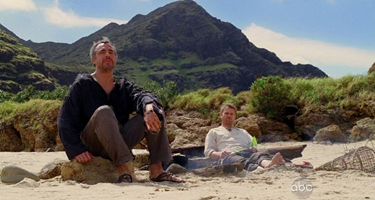
Of course, there is no direct evidence that Jacob is St. James, but I don’t think the idea is any less plausible than the theory that Jacob is the Old Testament figure.
The Origins of the Dharma Initiative
Returning to the question left over from last time: besides the idea that Jacob’s wager was intended to save humanity from the Final Judgment, there is another piece of circumstantial evidence—the origins and purpose of the Dharma Initiative.
The man behind the Dharma Initiative, Alar Hanso, was the great-grandson of Magnus Hanso, captain of the Black Rock. Magnus Hanso and the Black Rock’s crew were the subjects of Jacob’s previous experiment. As things stand, that experiment appears to have failed. The people aboard the Black Rock may have done exactly what the Man in Black said: fight, destroy, and finally corrupt. Otherwise Jacob would not have needed to conduct another experiment with the 815 survivors. But that doesn’t mean everyone connected with the Black Rock died.
Whether Magnus Hanso eventually turned the wheel and returned to the real world like Ben and Locke did later, the point is that his descendants eventually operated in the real world. The fact that those descendants later established the Dharma Initiative and directly confronted Jacob and his followers suggests that Magnus Hanso held a grudge against Jacob. Perhaps he blamed Jacob for dragging him and his crew into a conflict that had nothing to do with them, one that may ultimately have cost most of his crew their lives. In any case, Magnus Hanso may have hated Jacob. His descendants may have spent years searching for a way back to the island and seeking revenge on Jacob, but given the conditions of the time, he had little chance of succeeding.
A turning point finally appeared in the 1950s. This was the era when the US military was conducting large-scale hydrogen-bomb tests on uninhabited islands in the Pacific after World War II. One American unit accidentally stumbled onto Jacob’s island while searching for a testing site. At first, they may have mistaken it for an ordinary uninhabited island and stationed themselves there as a test site for the next hydrogen-bomb explosion. Later they may have begun noticing some of the island’s strange properties, such as its magnetic field and its invisibility on maps.

That is what was happening when Sawyer and the others traveled to 1954. Richard and the other followers of Jacob (including the young Widmore) had already clashed with the US military. When Richard captured Dan and the others, he told Dan that they had discovered some soldiers stationed there a few months earlier and killed them. This is also probably why the others of that era wore military uniforms: they had likely seized the Americans’ equipment. But the hydrogen bomb the military left behind had not been dealt with. In the end, at Dan’s suggestion, the others sealed it away.
To prevent more American troops from arriving, the island may have been forced to undergo another relocation, making it impossible for the military to find its position again. The military was naturally extremely tense about losing a hydrogen bomb. The higher-ups were presumably furious at the absurd explanation that an island had simply vanished, and many people involved in the test program were punished. But there must have been a group of American researchers who had been in close contact with the island and could not let it go. They believed the island really had disappeared. From then on, those people devoted themselves to finding its location again. Of course, as a supernatural event, the whole matter was eventually swept under the rug within the US military.
But this incident was soon noticed by Alar Hanso, who had inherited Magnus Hanso’s legacy. Alar Hanso was a major arms dealer, so having ties to the U.S. military was only natural—and it gave him opportunities to learn about classified events. On instinct, Alar Hanso quickly concluded that this mysterious island encountered by the U.S. military was the same island where his great-grandfather had once lived. And so the Dharma Initiative officially got underway. Alar Hanso may even have personally recruited its first group of members, likely U.S. researchers devoted to finding the island’s location again. Their research base was beneath a church in Los Angeles, over a magnetic field similar to the one on the island. This was the Dharma Initiative’s first station, the Lamp Post—and the very place Ms. Hawking later told Jack and the others how to return to the island.

According to Ms. Hawking, a genius later appeared at the Lamp Post station and built a pendulum, along with an equation for predicting the island’s location. That’s how the Dharma Initiative found the island.
When Jack entered the Lamp Post station, he noticed a photo of the island pinned to the blackboard. Under the photo, it said, ‘us army 9/23/54 top secret‘. That means the Lamp Post’s research materials came from the classified files of the U.S. military team that landed on the island in 54.

I need to take a step back here. Magnus Hanso, captain of the Black Rock, didn’t simply hate Jacob. Otherwise, why would his descendants establish the Dharma Initiative? If revenge was all they wanted, they could have found the island, brought armed personnel, and slaughtered Jacob and his followers. But the Hanso family clearly used science to study the island. My guess is that Magnus Hanso was once very close to Jacob. He knew about Jacob’s plan to save humanity from the Final Judgment, and believed it really was about to arrive. So his descendants opposed Jacob while building the Dharma Initiative to study the island’s properties. They hated Jacob and didn’t believe his methods could save humanity, but they did believe the end of the world was coming. The Hanso family’s goal was to pursue salvation through humanity’s own methods. That was the purpose of the Dharma Initiative: to use science to uncover the island’s secrets and save humanity by methods different from Jacob’s—or, put another way, to use humanity’s own power to resist fate.
So Alvar Hanso didn’t simply hire mercenaries to storm back onto the island and avenge their ancestor. Instead, he developed the Dharma Initiative into a comprehensive research project, recruiting scientists to conduct research on the island. In the interactive game LOST experience, released after Season 2, a video of Alvar Hanso surfaced. In it, he claimed that the Dharma Initiative’s purpose was to delay humanity’s end times, and that the famous numbers were parameters in an equation concerning the timing of humanity’s apocalypse.
Of course, we don’t have to take the game LOST experience as gospel. LOST’s executive producer also said that the game’s content was independent of the main series. Still, it offers a glimpse of what the writers may have had in mind.
Besides, after the others purged the Dharma Initiative, Kelvin in the Swan hatch became the last living member of the Dharma project. He later told Desmond that pressing the button every 108 minutes was meant to ‘save the world.’ Apparently, the people in key positions in the Dharma project knew the real purpose behind this entire plan.
I suspect the Hanso family knew not only Jacob’s purpose, but also a great deal about Jacob himself—even his weakness (volcanic ash?). For whatever reason, they didn’t want to kill Jacob; they wanted to imprison him. Since they knew his weakness, they could do it. So Horace, the Dharma Initiative’s man in charge on the island, built a small wooden cabin to keep Jacob confined.

We don’t know exactly how they lured Jacob into captivity. But they seem to have successfully trapped him with volcanic ash. We also don’t know when this happened. It was quite possibly not long before the others purged the Dharma Initiative, since the others and the Dharma Initiative had originally agreed to a truce. They may have decided to wipe out the Dharma Initiative only after Richard discovered that Jacob had disappeared.
After the Dharma Initiative was purged, Richard opened a gap in the volcanic-ash barrier, allowing Jacob to escape. The gap in the ash that Ilana discovered in the Season 5 finale may have been left behind when Jacob was freed from the cabin. From that point on, the cabin was effectively abandoned.

Later, Locke asked Ben to take him to see Jacob. Ben had never actually met Jacob, but his pride got in the way and he refused to admit it. So he thought of the cabin where Jacob had once been imprisoned. Ben knew Jacob was no longer there; he had only intended to put on a little show for Locke. He never expected someone to genuinely be inside. The person who told Locke ‘help me’ now seems very likely to have been Christian, not Jacob.

All this time, who exactly has been using the cabin?
Before the Season 5 finale, viewers had a persistent blind spot: we assumed that the island, the Smoke, Christian, and Jacob all represented the same will. Only after the finale did we discover that even at the level of gods, the island was home to several opposing forces. So whose will, exactly, does Christian represent? What is his relationship with the Smoke, the Man in Black, and Jacob? I’ll continue the analysis in Part 3.
Leave a Reply