
[This article reviews and analyzes the story after the end of LOST Season 5, with massive spoilers. If you haven't finished the first five seasons, enter at your own risk!]
As I mentioned last time, before the Man in Black appeared in the Season 5 finale, the writers of LOST had set a blind spot for the audience: they led us to assume that representatives of the island’s supernatural forces, such as the Smoke Monster, Jacob, and Christian, all embodied the same will. So before then, we never realized that their actions might contradict or diverge from one another; instead, we tried to explain everything consistently with a single logic. Now we’ve discovered that this whole line of reasoning was completely off. It turns out that even on the level of these supernatural forces, things aren’t monolithic. So far, at least Jacob and the Man in Black are two factions openly at each other’s throats. As the story develops, more forces may emerge. At this point, the relationships among Jacob, the Man in Black, the Smoke Monster, the resurrected Christian, the resurrected Locke, and “the Island itself” are genuinely bewildering and hard to pin down. And looking back now, the tangled relationships in LOST go far beyond these. Let’s start with Widmore.
Widmore and the Dharma Initiative
After the Dharma Initiative on the island was wiped out, where did the off-island Dharma Initiative go? In principle, it should still have possessed considerable power off the island, but many signs suggest that it too was destroyed. LOST Experience mentioned quite a bit about the current state of the Hanso Foundation, one of Dharma’s backers, but the LOST writers also said we shouldn’t take the interactive game’s content as canon. So in the actual LOST series, the fate of the off-island Dharma Initiative remains a mystery even now.
If the off-island Dharma Initiative was wiped out by the Others, then its institutions off the island should have been taken over by the Others, just like the submarine and the Dharma facilities on the island. In reality, the off-island lighthouse station was occupied by Ms. Hawking. Although Ms. Hawking has a conflict with Widmore, she also appears to be someone the Others abandoned (it doesn’t look as though the elderly Hawking still has any connection with Richard and the others). Having an abandoned disciple occupying a place that can locate the island is certainly no good for the Others. They should either have kept it themselves or destroyed it. So could the Others not be the ones who destroyed the off-island Dharma Initiative after all?
On the other hand, Charles Widmore and the Dharma Initiative seem to have a relationship that is hard to explain. In LOST Experience, Widmore’s company was connected to the Hanso Foundation. Even if we don’t count that, there are other links between Charles Widmore and Dharma. For instance, the painting in Widmore’s office, with a polar bear and the word “NAMASTE,” is packed with Dharma elements. Could Widmore’s company have been rebuilt on the foundation of the Hanso empire after he destroyed Hanso and Dharma (with the painting taken as a trophy)? If the Others destroyed Dharma, these things shouldn’t have become Widmore’s property. Also, judging from Widmore’s bidding for the Black Rock’s first mate’s journal and the paintings of the Black Rock, he seems to have quite a lot of information about the Hanso family.


So does that mean the off-island Dharma Initiative was destroyed by Widmore after he was driven off the island?
Widmore and Hawking
After Ben drove Widmore off the island, Widmore tried everything to get back, and supposedly spent decades failing. But here’s the strange part: Hawking, who knew how to find the route back to the island, was Widmore’s old flame! Did Widmore know where Hawking lived (Widmore gave Desmond Hawking’s address), yet not know that there was a lighthouse station beneath her church that could help him find the island? Or did he know perfectly well but feel too embarrassed to force Hawking to help him? Either way, these two old-timers fell out with astonishing thoroughness. One clearly possessed the means to return to the island, while the other spent decades searching blindly.


Even stranger, later Ben extracted Hawking’s whereabouts from Locke and went to see her, and Hawking actually helped Ben. Did Hawking not know that Ben was her old flame’s sworn enemy? Or did she know exactly who Ben was and simply not care? The latter still seems more likely.
What terrible, universally detested sin did Widmore commit to offend Hawking so deeply? After turning it over in my mind, I think the likeliest explanation is actually very simple: Widmore cheated, kept a mistress, and shattered Hawking’s vase of jealousy!
Don’t forget: Widmore was originally expelled from the island because he often secretly left it to visit his illegitimate daughter, Penelope. Hawking seems to have already left the Others when Widmore was expelled (apparently to leave the island and look after young Dan), so Widmore’s “secret” may well have been exposed by Hawking in a jealous fit of wounded pride.
The illegitimate daughter is accounted for, but the identity of the “mistress” has never been explained. Going by the LOST writers’ style, Widmore’s mistress certainly wouldn’t be some random extra; she would be a character who has already appeared. So among the middle-aged and elderly women we’ve met, who is the most likely candidate?
I think the most likely one is Jack’s mother, Margo Shephard!

Of course, this is pure gossip, but it isn’t entirely baseless. Maybe old Christian became depressed, demoralized, and addicted to alcohol after discovering that he had been cuckolded. Faced with a vicious thug like Widmore, who was even nastier than a Mafia boss, direct revenge obviously had no chance. So he had to take the indirect route. You cheat on me, I’ll cheat on you: Christian went to Australia to keep his own mistress, and that’s how Claire came to be. Suddenly, all the elders’ spectacular affairs make sense. This is nothing less than a domino effect.

So it’s entirely possible that Penelope is Jack’s half-sister through their mother (or perhaps his half-sister older than him)! Jack is practically America’s Duan Yu, haha.
Widmore and the Man in Black
In the war between Jacob and the Man in Black, which side is Widmore really on?
What we can say with some confidence is that Ilana is Jacob’s trusted follower. If we can establish that Ilana is on Jacob’s side, then Widmore may well have defected to the Man in Black. In the episode that revealed Miles’s background, Ilana’s subordinate Bram tied Miles to a car. Bram told Miles not to work for Widmore and not to choose the wrong “team”; he said he himself was on the “team” that would win. Ilana and Bram seem to have known, broadly speaking, that a powerful hostile force existed and intended to go to war with Jacob. So the team Bram mentioned must mean Jacob’s side and the Man in Black’s side. Judging from Bram’s kidnapping of Miles, Ilana’s group had once done everything it could to stop Widmore from coming to the island. Does that mean Widmore was working for the Man in Black?
Could Widmore’s rise off the island after his expulsion actually have been because he joined the Man in Black’s side?! Although Widmore’s actions after leaving the island appear on the surface to be driven by “self-interest” (revenge against Ben, regaining control of the island, staging a fake Flight 815 to prevent others from interfering with his search for the island, and so on), might there be a deeper motive underneath?
In the loophole the Man in Black found, Locke was a crucial link. That makes Widmore’s kindness to Locke after Locke left the island look highly suspicious. When Widmore asked Locke why he had chosen to leave the island, Locke mumbled and refused to answer, but Widmore quickly guessed: “You’re here to take those people who left the island back.” After Locke denied it, Widmore said, “I can tell you’re lying.”
How did Widmore know that Locke’s mission was to bring Oceanic 6 back to the island?! In fact, it was the future “fake Locke” who had Richard tell Locke about this mission. By the usual interpretation, “fake Locke” was the Man in Black, so this mission was plainly an edict from the Man in Black. How did Widmore know what that edict said?
One explanation is that Widmore was the Man in Black’s trusted follower, so he knew part of the Man in Black’s plan. Naturally, he would then help Locke return to the island.
Another explanation is that Widmore and Hawking saw Jack, Kate, Sayid, and the others when they burst into their camp in the 1970s. After Oceanic 6 left the island, Widmore recognized that some of them were the intruders from the future whom he had met when he was young. After Locke also left the island, Widmore followed these clues and inferred that the people from the 1970s had later been brought back to the island, and that Locke must be the one bringing them home. Although Widmore didn’t understand Locke’s purpose, he may, like Hawking, have been someone who believed in a predestined fate that could not be changed (for example, he knew that his son Dan would die if he returned to the island, yet sent him anyway). So he helped Locke mobilize Oceanic 6 out of that faith; what he feared was that if Locke failed, fate would be altered. If this explanation is correct, Widmore did not have to be on the Man in Black’s side at all.
Actually, the more important part of the Man in Black’s edict was telling Locke that he had to sacrifice himself. And on that point, Widmore apparently knew nothing. Later, when Locke told Widmore that Richard had said he would die, Widmore looked genuinely surprised. He said, “I don’t know why he said that, but I’m not going to stand by and do nothing.” It doesn’t sound as though he was lying.
When Locke asked Widmore why he was helping him like this, Widmore said, “Because there will be a war very soon, and if you aren’t on the island when it happens, the side of evil will win.” This line can likewise be explained from two opposite angles. Either Widmore was the Man in Black’s accomplice, helping Locke return so the Man in Black could carry out his plan; or he was still on Jacob’s side, and his earlier actions against the island were driven by self-interest plus an attempt to “purge the court of bad advisers,” while he sincerely believed Locke was Jacob’s capable ally and that the island and Jacob would be safe with him there.
Faced with this somewhat contradictory evidence and these competing theories, I actually lean toward the second explanation: Widmore is a spoiled heir from Jacob’s side, with plenty of ambition, who has done quite a few things bad for Jacob and the island, but may not be on the Man in Black’s side after all.
Christian and Jacob
Besides Ben and his followers, and Ilana and hers, there is another person who has a bone to pick with Widmore: the resurrected Christian. After Locke entered the cabin for the second time, he saw Christian and Claire inside and asked Christian who he was and why Claire was there. Christian told Locke that the people on the ship (the mercenaries) were already on their way, and once they arrived, these questions would be meaningless; Locke should ask the questions that mattered most. And so Locke received instructions for moving the island.
So whose interests was Christian representing? Christian himself said that he could speak for Jacob, but was that really true?
Not necessarily.
The evidence linking Christian to Jacob is Christian’s two appearances in the cabin. But who had actually been using the cabin all along was a huge mystery. Jacob had definitely stayed there for a while (for instance, Ilana’s first assumption after arriving on the island was that Jacob was still living in the cabin). But when did he abandon it and move back to his old home beneath the statue? Based on my theory in the previous part, if Ben dared to take Locke to the cabin the first time and perform his little conversation with an empty chair, Ben must have known that Jacob had already abandoned it. In other words, by the time Ben was in power, Jacob was no longer using the cabin. The people who appeared there afterward may therefore not have belonged to Jacob’s faction at all. Ben took Locke to that empty cabin intending to put on a show for him. He never expected the cabin to actually shake the earth and scare the life out of Ben himself. So who was the mysterious figure in the cabin, capable of making it tremble like that? Judging from his hairstyle and face shape, he was neither Jacob nor the Man in Black; judging from his clothes, he was not Christian, who later sat in the chair either!

Even stranger, we may have forgotten that besides this mysterious figure, there was always another person in the cabin!
This person appeared twice. The first time was when Ben brought Locke into the cabin. As the cabin shook violently, one shot swept past a terrified eye. That eye belonged to neither Ben nor Locke.

The second time was when Hurley got separated from the main group and found the cabin. He saw Christian sitting in a rocking chair through the window, and then someone suddenly leaned up against the windowpane and stared back at Hurley. Again, only one eye was visible.

Although the colors of the two eyeballs look a little different, the first one could be explained as having a more dilated pupil. The Man in Black and Jacob are both perfectly calm, while this mysterious eye is always acting startled and jumpy, so it probably isn’t the Man in Black or Jacob (that wide-eyed look does bear a striking resemblance to Desmond). Who is he, exactly? What is the relationship between the will represented by this mysterious eyeball and the Man in Black and Jacob?
Judging from Christian’s behavior, he was very likely working with the Man in Black. Richard’s side was kept completely in the dark throughout the whole business of moving the island and sending Locke off it. Christian was the one luring the entire process along. If moving the island and sending Locke away had been Jacob’s idea, Richard shouldn’t have been totally clueless. Christian first asked Locke to save the island by moving it, but his real goal seems to have been getting Locke off the island. When Locke, who had fallen down the well and broken his leg, later met Christian again, Christian was clearly displeased that Locke had let Ben complete the island-moving mission. He said: I asked “you” to move the island. Since when did Ben get to call the shots? If Christian’s only goal was to save the island, why insist that Locke do it personally?

What’s more, he told Locke that after leaving the island, Locke should go find Hawking to help him return, and should bring everyone who had left the island along with him. That is precisely the fake Locke’s marching order.
When Locke said Richard had told him he would die, Christian gave a very mysterious smile. He wasn’t surprised or sympathetic; instead, he smiled and said, “I suppose this is what they call sacrifice.” Earlier, in the cabin, Christian had agreed that Locke was the chosen one, but now he seemed completely unconcerned about whether Locke lived or died. Isn’t that strange? Could all of this have been one move in the Man in Black’s game?
On the other hand, just before the people who had left the island were preparing to board Flight 316 back to the island, Jacob appeared to Hurley and urged him to get on the plane. Was this Jacob’s damage-control measure after discovering the Man in Black’s interference, or was the whole business of Locke leaving the island and bringing everyone back actually part of Jacob’s plan? If the latter is true, then Christian’s actions can also be explained as him helping Jacob.
Since we currently know so little about Jacob’s and the Man in Black’s respective plans, Christian’s relationship with them is extremely difficult to judge. Once again, just as with Widmore, both the pro and con interpretations work. This time, though, I lean toward Christian being on the Man in Black’s side. I hope the writers remember to explain exactly what Christian was about in Season 6, and who that eye that appeared in the cabin actually belonged to.
The relationship between Locke and the “fake Locke”
If you ask me, the most suspicious relationship so far is the one between Locke and the “fake Locke.” By now, pretty much everyone assumes that the Locke who “came back to life” on the island isn’t real—that the Man in Black has taken Locke’s form. The most direct evidence is what happened when the “fake Locke” met Jacob. Jacob said, “Looks like you found your loophole.” The fake Locke replied, “I sure did.” Clearly, Jacob was treating the Locke in front of him as the Man in Black, and the “fake Locke” admitted it. It couldn’t be more obvious.
But I think there are plenty of problems with simply explaining the “fake Locke” as the Man in Black.
First of all, Locke acted “perfectly normal” right after coming back to life. He genuinely seemed not to know how he had arrived on the island; the last thing he remembered was being killed by Ben. When he faced Ben, he even had that smug, “I’ll show you—I came back to life” attitude. After learning that Hurley and the others were on the plane too, he said he had a pretty good idea how he had returned to the island. To me, all of these reactions were completely “normal,” exactly what you’d expect from a resurrected Locke—not the expressions, mannerisms, and behavior of a substitute. Unless the Man in Black had read all of Locke’s memories and was putting on an act for everyone else. But some of it really didn’t look like acting at all: it was natural and perfectly logical, and some of it didn’t need to be acted out in the first place (for example, when he was dealing with irrelevant people like Caesar). If the LOST writers later reveal that they wrote all this that way just to mislead the audience, I will personally fly to America and kick them to death. So if you’re telling me Locke was already fake at this point, I don’t buy it.


Later, when Locke heard Ben say that he had returned to face the “monster’s” judgment, he looked a little surprised, and his expression didn’t seem fake either. If he was the Man in Black, he presumably shouldn’t have been surprised by any of this.
Let’s pause here for a moment to look at the most badass scene after Locke’s resurrection—although it has nothing to do with the fake Locke’s true identity.
The morning after Locke and Ben first crossed paths (at the beginning of EP12), Ben walked onto the beach and saw Ilana, Bram, and the others attaching bamboo poles to a large box. Ben asked Ilana what was inside. Ilana said it was just some things they needed to move, with an ambiguous look on her face. Ben then asked Bram whether he wanted help. Bram said no too, with a smile that looked less than natural. Obviously, the box contained Locke’s corpse. Not long afterward, Ilana and the others hijacked Frank, carried the box, and went off to find Jacob.

The bizarre thing is that the “fake Locke” was on that same beach, not far away, looking out at the sea! In other words, Ilana and the others were watching the “fake Locke” right in front of them while “packing up” the real Locke’s corpse. What an unbelievably eerie picture!

Judging from Ilana and the others’ later behavior, they knew that some powerful figure was trying to harm Jacob. So as soon as they found Locke’s corpse, they immediately realized that the Locke in front of them was connected to that powerful figure. They prepared the corpse for transport so they could warn Jacob, while somehow keeping completely poker-faced in front of the “fake Locke” (probably because they didn’t want to tip their hand, or because they knew they weren’t a match for him)! Ilana is one seriously tough customer.
Back to the point. Ben and Locke later returned to the main island and ran into Sun at Ben’s house. Up to this point, Locke’s behavior was perfectly normal. Ben then went into the secret room to summon the black smoke. After that, Locke disappeared! Ben waited in the hallway for the black smoke, but the person who appeared was Locke!
In fact, Locke only became “different” after reappearing. Before that, everything about him was normal! Something crucial must have happened during the period when Locke disappeared. I imagine Season 6 will fill in this part of the story. If Locke changed from real to fake, it didn’t happen after his resurrection; it happened after this disappearance. Ever since Locke reappeared, he seemed to know everything. He suddenly knew how to find the black smoke, and even made a point of emphasizing to Sun, “I know how bizarre this is too, but I promise you I’m still the same old me.” Locke only became “fake” after this period of disappearance.
Locke then took Ben to the Temple. Strangely, Locke seemed to “know” that the black smoke was in the underground level of the Temple. He deliberately reminded Ben to enter from underneath the Temple. This seems to suggest that the Temple’s different levels serve different functions. When Ben was a child, Richard took him in through the upper level and brought him back to life; this time, they went through the underground level to “sever the boundary between life and death.” In the lower level, we saw a mural of the Egyptian god Anubis summoning the black smoke, but that doesn’t necessarily mean the entire Temple is an Anubis temple. It looks possible that the upper level governs “life” and the lower level governs “death,” with each part of the Temple doing its own job. Maybe this Temple is a “palace of the gods.” That’s why Locke insisted on entering through the lower level. I expect the Temple’s true nature will also be revealed next season.

A brief digression here: what is the relationship between the black smoke, Jacob, and the Man in Black?
Anubis, who is closely associated with the black smoke, is one of the gods of death in Egyptian mythology. It’s easy to connect Anubis with the Man in Black, so it is natural to speculate that the black smoke belongs to the Man in Black’s side. After Ben was judged, the Alex manifestation of the black smoke warned Ben that he had to obey Locke unquestioningly. That certainly looked like it was serving the Man in Black. But, as with Widmore and Christian, the problem is that we don’t know exactly what Jacob’s plan includes, nor do we know whether the black smoke realized that the Locke in front of it was an impostor. So we still can’t determine whose side the black smoke is on. Later, when Ben mentioned that his dead daughter had ordered him to obey Locke, Locke looked a little surprised (and didn’t seem to be pretending). He had no idea what had happened beneath the Temple, which shows that at the very least, the black smoke and the fake Locke are not sharing a single mind.
Back to the point: Locke later found Richard and insisted on seeing Jacob. When they reached the foot of the statue, Locke said, “Nice foot, but what does it have to do with Jacob?” Richard said it was Jacob’s home. Only then did Locke stare solemnly at the statue for a long time. Neither the exchange nor Locke’s expressions looked like an act. If the fake Locke was the Man in Black, he would have known where Jacob lived all along. Even if having Richard lead the way was part of the performance, there was no need to keep performing those few expressions after seeing the statue. Nobody was watching him at that point.

After meeting Jacob, the fake Locke said something very strange: “You have no idea what I’ve gone through to get here.” If the Man in Black only “possessed” Locke after Locke’s corpse returned to the island, or after Locke disappeared, then there is no way he had gone through that much hardship. By saying this, the fake Locke must have been indicating that he had endured a great many truly horrible and difficult things before then! It was definitely not as simple as merely “possessing” Locke.
Looking back over all the characters in LOST, who has spent an entire lifetime “going through hardship”? Every character in LOST seems to have had some bad luck, but if we’re talking about a life made up of one tragedy after another, a life so miserable you’d want to write the character for “tragic” on someone else’s leg, there’s only one person: Locke himself!
Could it be that the Man in Black has been accompanying Locke throughout his entire life?! Could the hardships the “fake Locke” was talking about actually be the hardships the real Locke went through?
I was reminded of Season 4, when Richard visited Locke as a child, pretending to be a special-education representative. This was, of course, because the time-traveling Locke had found him in 1954 and vanished right in front of him, so Richard had been keeping an eye on him ever since Locke was born. And this time, Richard saw a crude drawing on the wall of a person being attacked by the black smoke.
He asked whether Locke had drawn it, and Locke nodded! How are we supposed to explain this bizarre scene? Why did Locke have memories of the black smoke when he was a child?

Later, Richard brought out a pile of objects for Locke to identify. He told Locke to pick out the thing that “already belonged to you.” Of course, we now know that Richard wanted Locke to choose the compass, because in 1954 Locke himself had handed it to Richard. Unfortunately, Locke picked the wrong thing.
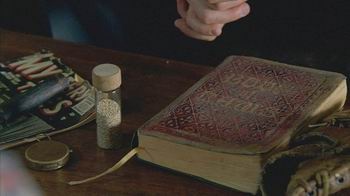
Richard’s test of Locke was copied wholesale from the Tibetan Buddhist method of testing for a reincarnated lama. In Tibetan Buddhism, a living Buddha will generally leave clues about the location of his next incarnation before his death. His disciples then use those clues to search for the reincarnated child. Once they have narrowed it down to a few candidates, they mix some of the lama’s possessions from his previous life in with unrelated objects and ask the children to identify them. Only if the child chooses correctly can the reincarnation be confirmed.
Back then, Locke predicted in front of Richard that he would be born three years later, then vanished in front of him like a god. Clearly, these “miracles” didn’t make Richard think about time travel; instead, they successfully fooled him into believing that Locke was a supernatural person capable of predicting his own “reincarnation.” He thought Locke saying he would be born three years later meant he would reincarnate three years later! So he believed that little Locke, this “reincarnated child,” ought to be able to pick out something he had possessed in his “previous life.” Unfortunately, the test failed. Richard immediately lost heart and decided this child wasn’t very magical after all—perhaps the reincarnation had gone wrong and the original divine spark had been lost in transit.
We now know that little Locke was not the reincarnation of the Locke from 1954, so if he had managed to pick out that compass, it really would have been a supernatural miracle.
But could Richard’s misunderstanding have accidentally hit the mark?!
How could little Locke, who had never even been to the island, have drawn the black smoke? What on earth is going on? Could Locke really be the reincarnation of someone who once lived on the island, retaining just a tiny bit of his past-life memory as a child (most reports about past lives say that children can remember them, but forget as they grow up)?
All right, the answer is practically shouting at us. My theory is this: there is no such thing as a real Locke and a fake Locke. There has only ever been one Locke, and Locke is actually the reincarnation of the Man in Black.
If my guess is right, then after all LOST’s mythology and religious references, it has finally made intimate contact with Tibetan Buddhism. This was almost certainly one of the LOST writers’ sources of inspiration, and that source was hiding in plain sight in the characters’ names.
I once wrote in The Upanishads: The Supreme Treasure at the Summit of the World that Richard Alpert was a real historical figure who, as far as it seemed, was still alive.

When he was young, he taught at Harvard and hung around with Leary, the famous inventor of the psychedelic drug LSD, during the hippie movement (Leary later became one of the movement’s spiritual leaders, because the feeling of being very high after taking LSD was considered an experience of intimate contact with God). He did a great deal of LSD research, but was later fired by Harvard after being accused of distributing a psychedelic drug to students. He then embarked on a journey to the East, mainly India, seeking out Indian gurus and learning some Hindu philosophy and spiritual practices. He is said to have even visited Tibet. Once, he met a living Buddha. We know that living Buddhas, thanks to meditation, can maintain a happy state of mind in everyday life. Richard Alpert presumably wanted to study why a living Buddha was so happy, so he secretly slipped a little LSD into his drink. LSD is a powerful hallucinogen; even a tiny dose usually produces intense hallucinations and briefly sends ordinary people into a schizophrenic state. But after taking LSD, that living Buddha showed no reaction at all! Along with his astonishment, Richard Alpert reached a conclusion: apparently, living Buddhas are already in a drugged state even when they are not taking drugs! (For anyone interested in the story of Richard Alpert and LSD, check out the brief history of LSD in Reader 702.) After completing his studies, Richard Alpert returned to the United States and transformed into the great teacher Ram Dass, founding many spiritual-practice workshops involving meditation, Zen practice, and yoga. In short, he was spreading the Hindu and Buddhist ideas he had learned in the East.
Without a doubt, the legendary real-life Richard Alpert was the inspiration for the character Richard in LOST. It seems that LOST’s Richard using Tibetan Buddhism’s method of finding a reincarnated child to test Locke was no coincidence at all.
If Locke really is the Man in Black reincarnated, then the line “You have no idea what I’ve been through to get here” suddenly makes perfect sense.
To achieve his goal of destroying Jacob, the Man in Black reincarnated himself as a total loser (who was also Jacob’s test subject), spent a lifetime suffering (his legs alone were broken n times—just thinking about it hurts), and endured every imaginable hardship to return here. And apparently, it was his own death that created the condition for destroying Jacob—in other words, a loophole! After all that suffering, how could it not count as a lot?
This also explains why little Locke could draw the black smoke. At the time, he still retained a tiny fragment of vague memory from his past life. His previous incarnation was a demigod living on the island—perhaps even the master of the black smoke—so of course he had memories of it.
Once he grew up, his past-life memories disappeared, and everyone knows what happened next.
After Locke died, he was “resurrected” on the island. Actually, I believe that, just as Ben said, “Dead is dead”: the dead cannot come back to life, and this Locke on the island may not even be a living thing. The true identity of this “resurrected” Locke may once again have been inspired by Tibetan Buddhism!
My guess is that this “resurrected” Locke is actually a “bardo body” from Tibetan Buddhism! Tibetan Buddhism has a very distinctive theory that after death, people enter a state called the “bardo”—the state of consciousness occupied by the dead between death and the instant before their next rebirth. The famous The Tibetan Book of the Dead describes this theory of the bardo, and The Tibetan Book of Living and Dying, written by Sogyal Rinpoche on that basis, had an enormous influence in the West.
I think the “resurrected” Locke on the island is actually Locke’s bardo body. The island seems to have always possessed the ability to make the dead visible and give them physical form. Locke’s bardo body seems to have been made physical too. What Ilana and the others found was only Locke’s already-dead flesh; a bardo body has nothing to do with the physical body in the first place.
Locke had only just awakened again in his bardo-body state, and at first he did not know what had happened to him. He simply continued in the mental state he had occupied before death. In other words, he was confused while alive and remained a confused ghost after death. Many literary and screen works describe this state: dead people do not know that they are dead. So at first, Locke’s behavior seemed completely “normal”—until he disappeared.
I believe that during the period when Locke disappeared, he very likely went to the cabin to find Christian. He wanted new instructions. But Christian (or some other force) guided Locke into a new stage of the bardo state (it may even have been the black smoke, originally flying in to judge Ben, that encountered Locke on the way and woke him up; this could also explain why Ben failed to summon the black smoke). In Tibetan Buddhist bardo theory, a bardo body can cultivate the first five of Buddhism’s six supernatural powers (the sixth can be cultivated only by a Buddha), including the “power of knowing past lives”! Once Locke’s bardo body cultivated that power, he could recover the Man in Black’s memories from his previous life. Of course, this recollection may have been like an incredibly realistic dream, with many details still unclear (for example, he might not remember Jacob’s residence). But however you look at it, Locke’s consciousness and the Man in Black’s consciousness had, in a sense, become one again.
This was Locke’s state after disappearing and reappearing: he suddenly “knew everything.” In reality, he had remembered a great deal from his previous life.
This also explains Locke’s strange answer when Ben asked Jacob and Locke under the statue, “Have you two met before?” Locke replied, “In a manner of speaking” (meaning that, in a certain sense, you could say they had met). Either they had met or they had not—what does it mean to have met in a certain sense? If Locke really was the Man in Black reincarnated, the line is easy to understand: he remembered meeting Jacob in his previous life, so in a certain sense, it was fair to say they had met.
LOST’s writers often play little tricks to reveal their ideas. For example, in the third-season finale, the funeral home where Locke’s body lay was called “Hoffs/Drawlar”; rearrange the letters and you get “flash forward,” exactly the device the writers began using there. Likewise, in season five, the truck Ben drove off the island had a company name written on it: “Canton-Rainier.” Rearrange that and you get “reincarnation”!

A lot of the information from season five was not revealed until the season finale. We currently know too little, so everything above is only speculation. Even if I guessed correctly, many key links would still be lost in a fog. For example, even if I am right about the reincarnation part, I still have no idea why the Man in Black had to be reincarnated specifically in Locke’s mother’s womb. I hear the LOST writers have hinted that the beginning of season six will be wildly unexpected, so it is safe to assume that this time, my theory is probably wrong from start to finish.
I offer this article as an act of self-torture.
(The end.)
Leave a Reply