 ▶
▶
The full talk is in the Feifan series on Fanshu, a Chinese audiobook app; this page is only a summary.
What this episode is about
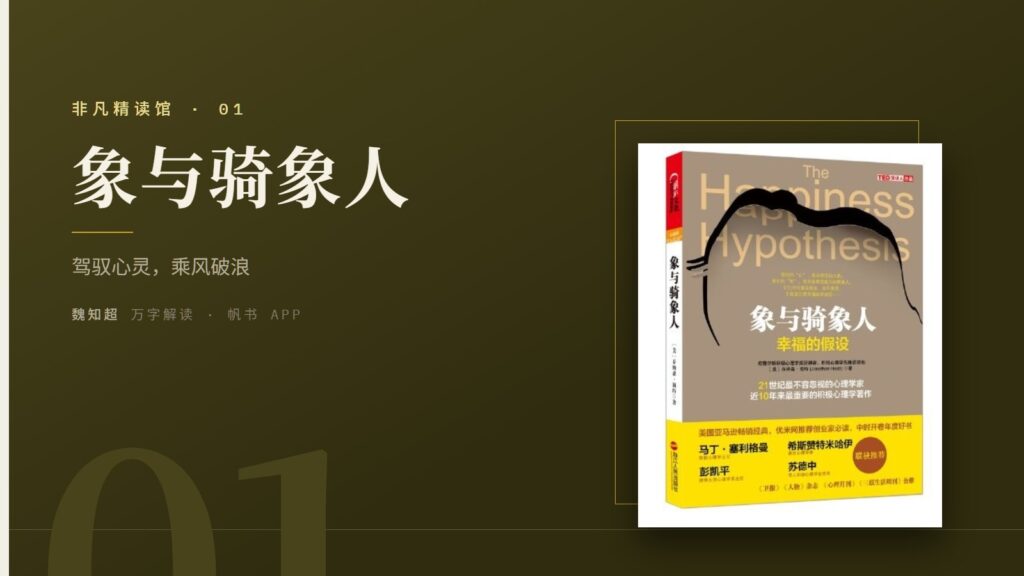
This book leads us to recognize a basic reality: getting happiness isn’t that easy. “How do we achieve happiness?” is a complicated question involving many factors. The author first helps us break through the nine major obstacles to happiness one by one; on that foundation, he then offers a series of practical recommendations for increasing our sense of happiness. The “elephant” and the “rider” represent the unconscious and conscious psychological processes in our minds. Their constant tug-of-war and cooperation not only create many of the obstacles to our happiness, but also provide the key to breaking through them. Understanding this can help us steer our inner world better. The Happiness Hypothesis is a book of profound insight, but also an unusually candid book about happiness. It doesn’t casually assure us that getting happiness is easy; instead, it tells us how to “know the difficulty and keep moving forward.”
You will hear
- Understanding the 9 obstacles to happiness
- Practical recommendations for increasing your sense of happiness
- How conscious and unconscious processes work
- Understanding the core ideas of cognitive psychology
Key quote from this episode
A healthy sense of self is the foundation that allows us to stand securely in society, and it is very hard to shake. So what we need to do is not give up our self-esteem, but understand that self-reflection itself does not actually harm our self-esteem.
Love, throwing yourself wholeheartedly into your work, and merging with the greater self are powerful weapons against the emptiness of life.
Happiness depends not only on how we feel inside, but also on many objective external conditions. What we can do, in fact, is do our best with what is in our control, adjust our mindset, and accept what fate brings. Do our best: improve the external conditions. Adjust our mindset: improve the internal factors. Accept what fate brings: when something truly cannot be changed, don’t spend too much of your mental energy on it.
About the author
[US] Jonathan Haidt, a renowned social psychologist, was selected by Prospect magazine in 2013 as one of the “world’s top thinkers.” He is the author of The Righteous Mind, The Happiness Hypothesis, and other books.
Leave a Reply