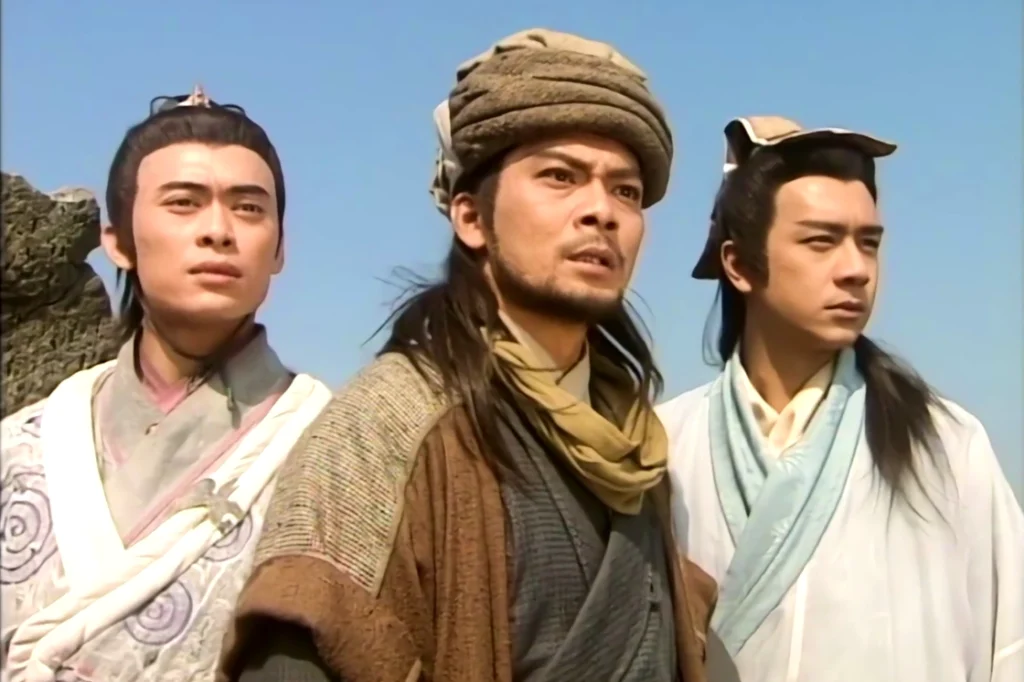
A few days ago, my wife and I rewatched half of the 1997 edition of the Demi-Gods and Semi-Devils (did the soundtrack in my head start looping Xiao Feng’s BGM?), and after a while we got talking about a question: Why does the TVB version of Jin Yong’s story look better no matter how you compare it with the later mainland version? Even the mainland adaptation’s peak—Zhang Jizhong’s the Demi-Gods and Semi-Devils—looks much less colorful next to the 1997 version.
The editing may be a big part of the problem. The rhythm of the 1997 the Demi-Gods and Semi-Devils (and a whole pile of TVB martial-arts dramas) can grind the later mainland versions into the dirt: imagine the Xiao Feng BGM from the 1997 the Demi-Gods, then imagine Li Yapeng’s slow-motion shot in Zhang Jizhong’s Laughing in the Wind—“break—sword—pose—.”
But that still doesn’t seem to be the main reason. More importantly, mainland Jin Yong adaptations are always missing a little of that “martial-arts flavor.” No matter how good Hu Jun’s Xiao Feng is, I still feel he’s a Liangshan hero; only the one played by Huang Rihua feels like the real Xiao Feng. (When Hu Jun fights Duan Yanqing’s Eighteen Dragon-Subduing Palms, a BGM like “The Great River Flows East” might actually fit quite well.)
So where, exactly, does that “martial-arts flavor” in TVB’s Jin Yong dramas come from?
There must be all sorts of ways to read it.
My interpretation is this: in TVB’s Jin Yong dramas, everything—from the dialogue and the way people deliver their lines, to the costumes and sets, to the actors’ bearing and their fighting styles—is connected to the real world of ancient China “in every way, yet unlike it in every way.” And that is precisely what matches the audience’s expectations of the martial-arts world.
The French philosopher Michel Foucault once proposed a very interesting concept: “heterotopia.” I think we can borrow it to sum up the point above: in the audience’s mind, the martial-arts world should be a heterotopia, and TVB’s Jin Yong dramas happen to construct one.
Most people are familiar with “utopia.” There is actually a related word, “dystopia.” The American scholar Walter Russell Mead once put the meaning and difference among these three kinds of “-topia” very simply:
“ Utopia is a place where everything is good; dystopia is a place where everything is bad; heterotopia is where things are different.”
“In utopia, everything is beautiful; in dystopia, everything is terrible; and in heterotopia, everything is unlike anything you know.”
Heterotopia is originally a concept of space. And the most classic heterotopia in real life happens to be Hong Kong. When Westerners arrive in Hong Kong, everything can feel strangely familiar, as if they have seen it before, while everything is also utterly unfamiliar; when mainland Chinese arrive in Hong Kong, everything can feel familiar too, yet everything is still unfamiliar.
The martial-arts world should likewise be a heterotopia that feels both familiar and strange.
Martial arts has long been regarded as a kind of children’s story for adults. Romantic imagination is one of its most important dimensions, but martial-arts fiction is also rooted in history, and in that dimension it has an exceptionally realistic foundation. The martial-arts world must therefore reconcile the essential contradiction between romance and realism within a single worldview.
So only when “everything seems familiar, yet everywhere differs from reality” can it display, in just the right way, that subtle balance between romance and realism. Too much reality becomes a soap opera (the mainland Jin Yong dramas); too little reality becomes fantasy. Only the point in between is martial arts.
Everything in martial arts should give you this feeling: at a glance, or the moment you hear it, you sense a connection to ancient Chinese history, but at the same time it must keep a little distance from the real historical world. Everything seems familiar, yet everything is strange—that is exactly the feeling heterotopia gives us.
And TVB’s Jin Yong dramas happen to give us this feeling. Take the way the lines are delivered: in TVB’s Jin Yong dramas, nearly every actor’s delivery has a touch of theatrical affectation. Put that flavor in a modern drama, and it might become TVB-style melodramatic diction (the kind of “having money really does let you do whatever you want”); put it in a proper historical drama, and it would also feel unnatural. But in a Jin Yong drama, it is just right—it is one step removed from reality, familiar yet strange. It lets the audience believe, on one hand, that these are ancient Chinese people speaking, while also believing that the world they inhabit is not real. Romance and realism are reconciled.
The so-called martial-arts flavor is nothing more than this familiar strangeness.
Note
- This article in the “Psychology New Knowledge Mini-Lessons” series was written that year to accompany the related content of Zhichao Wei: Psychology New Knowledge. It was a short popular-science essay published on the now-closed platform “Fandou.” The original link no longer exists.
Leave a Reply