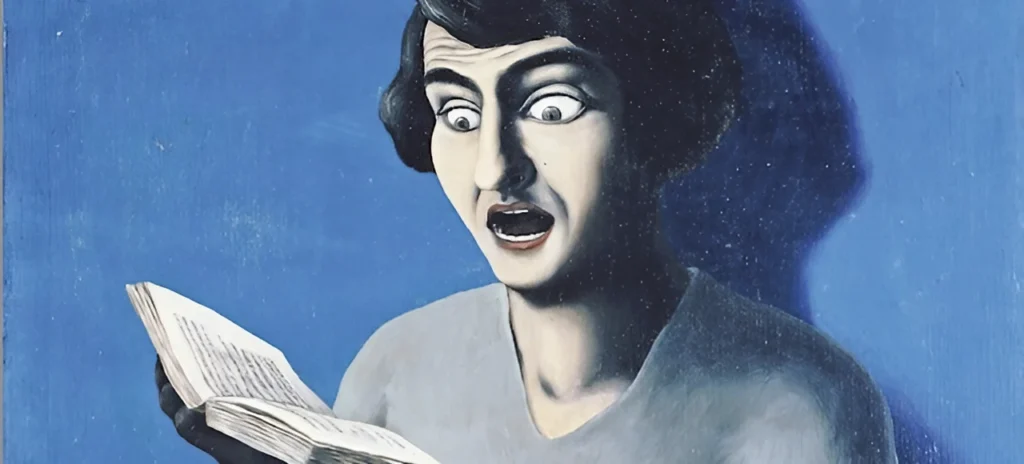
I often see people ask: What’s the point of reading fiction? You can’t pick up hard knowledge from a novel, nor learn any real skills. Apart from improving your literary cultivation—which is presumably reason enough—isn’t it otherwise just a waste of time?
I’ve also seen plenty of defenses of fiction, but most of them are rather airy-fairy, along the lines of “cultivating the soul” or “gazing up at the stars.”
Recently, in Steven Pinker’s The Better Angels of Our Nature, I came across a particularly mind-opening defense: the popularity of fiction in the 17th and 18th centuries greatly expanded humanity’s capacity for empathy, causing people’s tolerance for “cruelty” to plummet. This set the stage for the humanitarian revolution of the 18th century. Today, human society broadly rejects the violence of cruelty; the cultural and moral climate that made this possible was, in fact, partly thanks to people in the past reading fiction.
Of course, this is only a hypothesis put forward by Pinker, and there isn’t much direct evidence for it. Still, I find it quite convincing. Pinker’s argument goes roughly like this:
Before the 17th century, human societies could be described as awash in violence. From ancient Rome to the Middle Ages, from the West to the East, torture was everywhere, without exception. So did ordinary people back then reject violence? Not necessarily. People were generally “bloodthirsty.” In medieval Europe, for instance, public executions by torture in the town square would draw crowds of cheering citizens.
“Torture was not confined to dark dungeons; it was also mass entertainment. Public executions attracted crowds who watched the victims struggle and wail amid cheers and excitement. Limbs torn apart under the breaking wheel, bodies dangling from the gallows, criminals in iron cages suffering through wind, sun, hunger, and thirst, then dying bit by bit and watching their bodies rot bit by bit—these were familiar everyday sights, part of the scenery of the medieval world.”
To modern people like us, scenes like that are practically unimaginable.
So what exactly brought humanity from the “bloodthirsty” Middle Ages to the “humane” modern world?
Scholars have proposed all sorts of theories. Maybe the development of commerce led to more cooperation, so people began to care about what others felt. Maybe economic prosperity made people value life more. But these explanations actually came after the decline in torture had already begun.
So Pinker proposed a strong competing explanation: the popularity of fiction.
The maturation of high-efficiency printing technology triggered an explosion in the book-publishing industry. The number of books published each year grew rapidly in the 17th century, then shot up in a straight line toward the end of the 18th century.
Books came in more and more varieties and became cheaper and cheaper, so people’s desire to read grew stronger and stronger—including a huge number of novels. “Unlike works published in the early period, the new novels were no longer fixated on recounting the achievements of heroes, nobles, and saints. Instead, they depicted ordinary people’s joys and sorrows, partings and reunions, struggles and disappointments.”
“Reading is a technique for switching perspectives. When another person’s thoughts enter your head, you are observing the world from that person’s standpoint. You don’t just see and hear scenes you have never personally experienced; you also step into that person’s inner life and, for a moment, share their attitude toward and reactions to the world.”
“Once you take another person’s standpoint, you realize that this person is a first-person ‘I,’ living in the present tense, with the same kind of conscious mental activity you have—only with thoughts that differ from yours. The habit of reading other people’s words can train someone to inhabit other people’s viewpoints, and thus to feel their pleasures and pains…”
“…satirical fiction brings people into imaginary worlds where they see their own foolishness and ridiculousness. Without any need for lengthy preaching, people’s emotions can change. Realist fiction leads readers, step by step, into the life of someone completely different from themselves—to think what that person thinks and feel what that person feels. In this way, the reader’s circle of empathy expands.”
“Fiction…gets people accustomed to stepping out of narrow, selfish corners. That alone may mean that the explosive growth of reading had already contributed to the humanitarian revolution.”
In a word, it was through reading fiction that people began to feel that other people were “people” just like themselves. The cruelty we cannot bear ourselves should not be inflicted on others either.
The heart of compassion: everyone owes it to fiction.
Thanks to Pinker, my guilt about sneaking off to read fiction has hit a new historical low. ^-^
That’s all.
Note
- This article in the “New Psychology Knowledge Mini-Lessons” series was a short popular-psychology essay written at the time to accompany content related to Zhichao Wei: New Psychology Knowledge Course, and published on the now-closed platform “Fantuan”. The original link no longer exists.
Leave a Reply