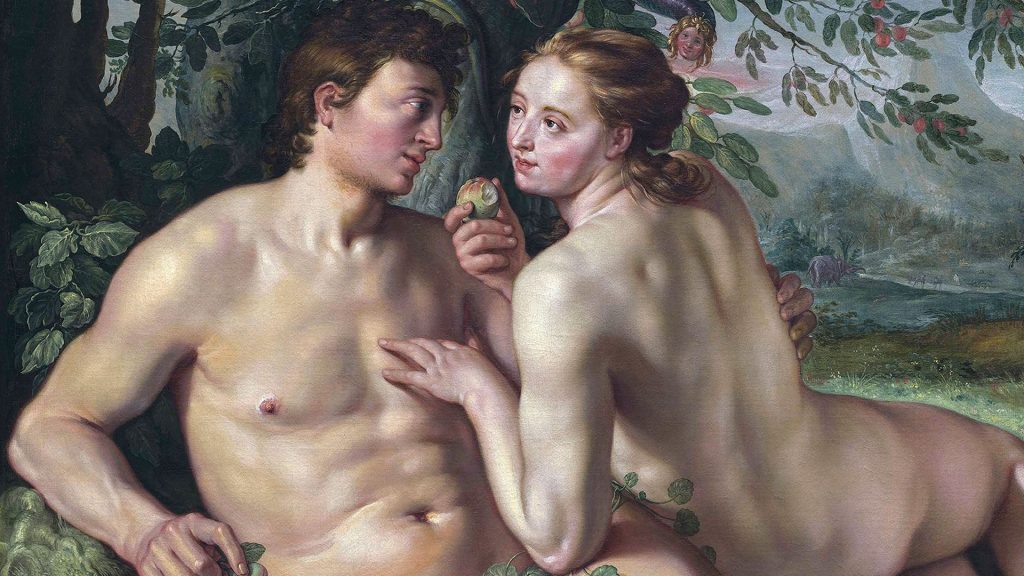
A single key to unlock all the secrets of Eden.
Today I’m going to play detective for once. I plan to crack one of the great unsolved mysteries in human religious history: the logical paradox in Genesis of the Bible:
If God is supposed to be all-knowing and all-powerful, why couldn’t he stop Adam and Eve from sneaking a bite of the forbidden fruit?
I’m holding Professor Feng Xiang’s annotated translation of the Pentateuch. This version is somewhat controversial in academic circles, but in terms of wording, it should be the most precise Chinese edition available so far.

I’ll use it to help us revisit the story in Genesis of the Bible, where Adam and Eve are expelled from Eden, examine its many suspicious details, and finally offer my own answer.
The Four Mysteries of Eden
The story of Eden begins like this:
God created Adam and put him in the Garden of Eden to play around.
The garden was full of all kinds of ‘beautiful trees’ with ‘branches laden with delicious fruit.’ In the middle stood a Tree of Life and a Tree of Knowledge of Good and Evil.
These two trees matter.
In the entire Bible, God’s first words to humanity were a warning about the Tree of Knowledge of Good and Evil. God said to Adam:
You may freely eat the fruit of every tree in the garden. Only the fruit of the Tree of Knowledge of Good and Evil you must not eat. The day you eat it, you will surely die!

Mystery 1: God Is Being a Bit of a Jerk
Here’s the first mystery:
If Adam was absolutely forbidden to eat from the Tree of Knowledge, why put it in the most conspicuous spot in Eden and leave it completely unguarded?
If God knew everything and foresaw Adam and Eve eating the fruit, why plant the tree there at all?
Even if there was some reason it had to stand in the exact center of the garden, wasn’t God all-powerful? Couldn’t he have put up a force field around it, like those wizards in Harry Potter? Then Adam would have been automatically bounced away the moment he got close.

So this is especially contradictory. On the one hand, God plants a tree there to tempt you and leaves it totally unprotected; on the other, he warns you never to eat from it.
Isn’t that a little jerkish of you, God?
The story continues:
After warning Adam, God worried that he might be lonely, so he made Eve from one of his ribs. Adam was overjoyed and delivered that classic line:
At last! Bone of my bones, flesh of my flesh!
The Bible goes out of its way to point out that at this point Adam and Eve were naked, but felt no shame.

Next, the Bible’s first villain—the serpent—makes its entrance.
The serpent asked Eve:
Did God really say that you must not eat from any tree in the garden?
Eve replied:
We may eat the fruit of any tree in the garden. Only the fruit of the tree in the middle: God said we must not eat it or even touch it, or we will surely die.
The serpent said:
No way—you won’t die! God knows perfectly well that once you eat it, your eyes will be opened and you will be like the gods, knowing good and evil.
Here the serpent spells out what the Tree of Knowledge is for: distinguishing good from evil.

Eve gazed at the fruit on that tree. It looked so delicious and appealing—and it could grant wisdom too!
She couldn’t take it anymore!
So she picked one and ate it, then gave one to Adam. Adam ate it too. The moment they swallowed the fruit, their eyes were opened. They suddenly realized they were naked, and hurriedly wove fig leaves into a loincloth to cover their shame.
Mystery 2: What Kind of Good and Evil?
All right, here’s the second mystery.
Wasn’t the Tree of Knowledge supposed to help them distinguish good from evil? That should mean that immediately after eating the fruit, they understood:
Oh, you’re a living Lei Feng—I should take you as my role model;
Oh, you’re the Demon King—I don’t want to play with you.
Shouldn’t it have worked something like that?
But Adam and Eve reacted like this:
Oh no, how embarrassing! Quick, find some leaves to cover ourselves.
What does that have to do with anything? What the hell does this have to do with distinguishing good from evil? If you insist that knowing men and women should keep their distance counts as a form of moral discernment, you could just about make the story add up—but isn’t that quite a leap?

Back to the story:
After a while, God came back. Adam and Eve hid in the bushes.
God asked:
Adam, where are you?
Adam answered:
I heard you walking in the garden. I was naked and afraid, so I hid.
God asked:
Naked? Who told you that? Have you eaten the fruit I commanded you not to eat?
Adam and Eve had no choice but to confess the whole story of how the serpent lured them into eating the fruit, hoping honesty would earn them leniency.
God was furious and pronounced a whole pile of curses. First he cursed the serpent, taking away its legs and making it crawl on its belly for the rest of its life; then he cursed Eve with the pain of pregnancy and childbirth; finally he cursed Adam, making him toil all his life just to scrape together enough food.

After cursing them, God stitched two leather garments for Adam and Eve and put them on them. Then he declared loudly:
Behold, the human has become almost like one of us, knowing good and evil. If he now reaches out his hand and eats from the Tree of Life, he will live forever!
Then he drove Adam and Eve out of Eden and sealed off the road to the Tree of Life.
That is how the story of Eden ends.
Mystery 3: The Mysterious Audience
Here’s the third mystery:
God uses the word ‘us’: ‘The human has become almost like us.’
Huh? Wasn’t God a one-man operation? Where did this ‘us’ come from? And whom was God talking to? The tone of this speech doesn’t sound at all as if it were addressed to Adam and Eve. So who were those mysterious listeners?

Mystery 4: The Tree of Life Appears Out of Nowhere
And here’s the fourth mystery:
The previously ignored Tree of Life suddenly appears. The reason God expelled Adam and Eve was that he was most worried they might later sneak a bite of its fruit and become immortal. Because of that, after driving them out, God even deliberately destroyed the road leading to the Tree of Life.
But if the fruit of the Tree of Life was also forbidden, why did God warn them only about the Tree of Knowledge at the beginning and never mention the Tree of Life at all?

All right, detective me is on the case.
The Key to Solving the Mystery
To solve these four mysteries, we need to find one crucial key.
That key is hidden in an unremarkable little chapel in France.
In the small town of Mérigny, in France’s Indre department, stands a dilapidated chapel called Plaincourault Chapel.

The chapel was built in the thirteenth century by the Knights Hospitaller, one of Europe’s three great military orders.
The key to the mystery of Eden is a mural on the chapel wall:

It depicts Adam and Eve being tempted by the serpent and sneaking a bite of the Tree of Knowledge in Eden. Adam is on the left, Eve on the right, and the serpent coils around the Tree of Knowledge in the middle.
But the strangest thing is the so-called tree in the center.
That’s no tree! It’s plainly a giant mushroom!
After studying the mural, British archaeologist John Allegro said that judging by its shape, the Tree of Knowledge depicted here was actually a fly agaric—a famous poisonous mushroom.

Fly agaric is also called Amanita muscaria. It grows in almost every part of the world.
People discovered long ago that fly agaric has hallucinogenic effects.
Ancient Greek texts record that before religious ceremonies, priestesses would first eat this mushroom. Afterwards they entered a state of ecstatic trance in which they could supposedly converse with spirits and gods. Of course, that was simply the effect of a poisonous mushroom.
Fly agaric has a second effect too: it can act as an aphrodisiac.
The priestesses didn’t eat fly agaric only to converse with the gods. In the ancient world, rituals were sacred religious ceremonies on the one hand, and often something resembling sex parties on the other.

So after eating an aphrodisiac mushroom in a setting like that, it isn’t hard to imagine what happened next. I’ll leave out the next five hundred words.
In other words, whoever painted this mural believed that what Adam and Eve ate was not fruit from a tree at all, but a ‘poisonous mushroom’!
Reconstructing the Truth of Eden
At this point, we can reconstruct one possible truth about Eden—
In the distant past, somewhere in what is now the Middle East—the very region where the biblical story originated—there was a primitive tribe. The territory ruled by that tribe was Eden.

The tribe had an old patriarch who had the final say on everything. Naturally, this was God himself.
There was also a young boy and girl in the tribe named Adam and Eve. They were young, innocent, and still clueless about romance. They often played together naked as jaybirds.
The old patriarch was worried about one thing: poisonous mushrooms often grew in the grass around the tribe. So he warned the two little kids, Adam and Eve:
You can play around the tribe, but if you see mushrooms in the grass, do not eat them under any circumstances. Eat one and you’ll die.

God wasn’t lying. At a certain dose, fly agaric can cause hallucinations and arousal, but an overdose—or a bad reaction—can absolutely be fatal.
Solving Mystery 1: It Wasn’t Jerkishness—It Was Impossible
That explains the first mystery: why was God being such a ‘jerk,’ leaving the forbidden fruit in Eden even though he knew it was dangerous?
The reason is that this so-called Tree of Knowledge wasn’t planted there at all. It was a wild mushroom that could sprout just about anywhere outdoors.
Because God had no way to control where they grew, all he could do was warn Adam and Eve not to eat them if they came across any. He couldn’t remove them in advance.
It wasn’t jerkishness. He genuinely couldn’t do it.

But kids are kids, and when do children ever take an adult’s warnings seriously? One day, while Adam and Eve were playing together, they suddenly saw a snake dart through the grass. And in the patch of grass the snake had pushed aside, a few fly agarics happened to be showing.
Curious, the two little kids completely forgot the patriarch’s warning, picked the mushrooms, and ate them. The result was an instant surge of desire: dry tinder meeting open flame, followed by some things that cannot be described here.
Adam and Eve were probably at that just-barely-starting-to-understand stage when it came to sex, and that mouthful of poisonous mushroom gave them the final push.
Solving Mystery 2: It Wasn’t Moral Discernment—It Was Desire
That explains the second mystery. If one effect of fly agaric is aphrodisiac, then naturally the reaction after eating it would have everything to do with sex and nothing to do with distinguishing good from evil.
After eating the forbidden fruit, what awakened was not wisdom but sexual desire. The phrase ‘Tree of Knowledge of Good and Evil’ was either a later embellishment forced onto the story, or a euphemistic rewrite.

The patriarch soon discovered what Adam and Eve had done. He took one look and said, ‘Right, let’s call a tribal meeting.’
The patriarch summoned every adult in the tribe and announced in public:
The poisonous mushroom didn’t kill the two of you, so count yourselves lucky. But you two did that sort of thing, broke our tribe’s rules, and you can’t stay here anymore. Get lost.
So they drove Adam and Eve out.
Cracking the Mystery No. 3: The Audience Was the Tribe
That explains the third mystery. When the tribal chief announced that Adam and Eve were being expelled from Eden, he was speaking so the other adults in the tribe could hear.
‘Humans have now become little different from us’ means that Adam and Eve had reached sexual maturity and joined the ranks of us adults.
So what tribal rule had Adam and Eve broken that was serious enough to get them thrown out?
Simple—
Men and women within the tribe may neither marry nor reproduce with close relatives.
Humans came up with all kinds of social systems to prevent close relatives from reproducing. Requiring marriage between people of different surnames or different tribes is one of the most common.
Cracking the Mystery No. 4: Bloodline
That cracks the fourth mystery: what exactly was the Tree of Life?
Obviously, we don’t believe there was a tree in the world that could make people live forever. ‘Immortality’ is clearly a metaphor too.
Its metaphorical meaning is the unbroken continuity of the tribe’s bloodline.
That’s why Adam and Eve had to be driven out of Eden and kept forever apart from the Tree of Life.

Not letting Adam and Eve get their hands on the Tree of Life meant making sure the tribe’s bloodline could never be tainted by a pair of incestuous siblings. Adam and Eve’s blood could never, in the future, merge with the blood of their own tribe again.
And this problem didn’t exist before Adam and Eve reached sexual maturity, which is why it never appeared in God’s earlier warning.
The Poisonous Mushroom’s Fault
This is the Eden story we’ve reasoned out—the ‘poisonous mushroom’ version—
In a prehistoric tribe, a teenage boy and girl accidentally got together, broke the tribal rules, and were driven out.
And what people call ‘humanity’s original sin from eating the forbidden fruit’ was really nothing more than the work of one poisonous mushroom.
Isn’t this a lot more plausible than the original Eden story?
People, books, and assorted gossip mentioned in the article:
1. Feng Xiang, Genesis: Legends and Annotations

For reasons everyone knows, Feng Xiang’s Pentateuch was never published in mainland China. The translation discussed in this article, however, is included in the Sanlian Bookstore edition of Genesis: Legends and Annotations.
2. Plaincourault Chapel
The Chinese name was taken from the book below. It doesn’t feel quite right, but I can’t pronounce the French word Plaincourault, so let’s go with it for now.
3. A History of Aphrodisiacs (Cuìqíng yàowù de lìshǐ)

The fly agaric’s dark history draws on Isolde’s Potion: A Cultural History of Aphrodisiacs (Sanlian Bookstore).
The translation is so awful it made me cry.
4. Allegro

John Marco Allegro (1923–1988) was a British archaeologist and an expert on the Dead Sea Scrolls.
He became a pariah in academia for advancing the bizarre theory that early Christianity was actually a form of shamanism, with hallucinogenic mushrooms used extensively in its rituals.
And yet, I really do love a wonderfully far-out thinker like this!
5. Intertribal Marriage
The origins of intertribal marriage are a complex question in evolutionary biology and anthropology. I’ll go into it in more detail if the right opportunity comes along.
Leave a Reply