
[Zhihu question] Why Do Professional Writers So Frequently Repeat Themselves?
I’ll answer “whether” first, and then “why.”
1. Do writers frequently repeat themselves?
Yes—and it’s actually pretty common. It’s not just mediocre little writers with limited creative ability who repeat themselves; highly successful, celebrated writers love repeating themselves too.
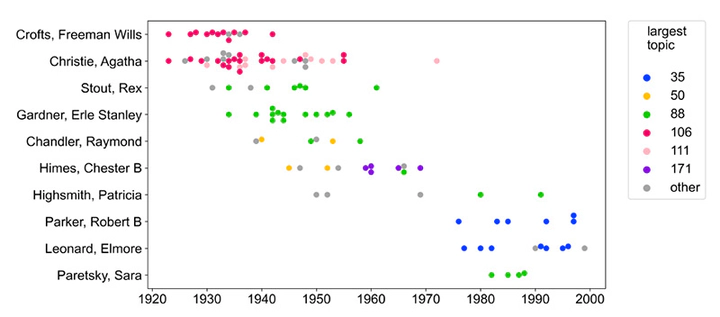
The chart above comes from an interesting study published in 2022[i]. The researchers developed an algorithm based on computational text analysis, used it to extract themes from nearly 11,000 novels published between 1880 and 1999, and then calculated the similarity of themes across each novelist’s works. They found that most writers’ works kept returning to the same theme.
The chart above lists the thematic similarity of works by several well-known mystery novelists. Each dot represents one work. The colored dots represent the theme that writer returned to most often; the x-axis shows the decade in which the work was published, and the y-axis shows different writers.
For example, let’s look at the second row, Agatha Christie, the “Queen of Mystery.” Agatha established several different paradigms for detective fiction, with creativity that was frankly off the charts. Yet her section of the chart is a sea of magenta: most of her works were actually repeating herself.
In fact, mystery fans are hardly unfamiliar with this kind of self-repetition. The overwhelming majority of mystery novelists spend their whole lives writing stories about the same detective character—and even the various details in each novel get repeated. In Agatha Christie’s novels, for instance, there are country houses, gentlemen and ladies, and so on.
Detective fiction may be an extreme example, but the study above found that this pattern exists across genres. Take Jules Verne, the founding father of science fiction: nearly every novel he wrote was about a “voyage extraordinaire” (extraordinary journey). Some journeys took place under the sea, as in Twenty Thousand Leagues Under the Sea, while others took place in the sky, as in Around the World in Eighty Days. He kept repeating himself for a full 40 years.
In this paper, the researchers only needed a sample of a few books by one author to predict the themes of that author’s other novels with fairly high accuracy.
2. Why do writers frequently repeat themselves?
Why do writers repeat themselves?
Oleg Sobchuk of the Max Planck Institute for the Science of Human History recently pointed out in an article[ii]:
The most important reason probably isn’t creative exhaustion at all, but something more practical—the success of their work.
A study by Dashun Wang’s team at Northwestern University[iii] analyzed the careers of more than 4,000 film directors, more than 20,000 scientists, and more than 2,000 artists, examining how their styles and themes changed as their careers progressed.
The pattern they found was this: before these artists achieved commercial success or these scientists produced recognized scientific achievements, their styles and research themes were not fixed. Early in their careers, they explored in every direction; their styles changed constantly and their research interests were broad. Then, once certain works or a few papers became successful, their “exploration phase” came to an abrupt end, and the process of self-repetition began.
In his article, Sobchuk used the abstract painter Jackson Pollock as an example. Pollock became world-famous for abstract paintings like the one below, in which paint was dripped and splattered onto a large canvas:
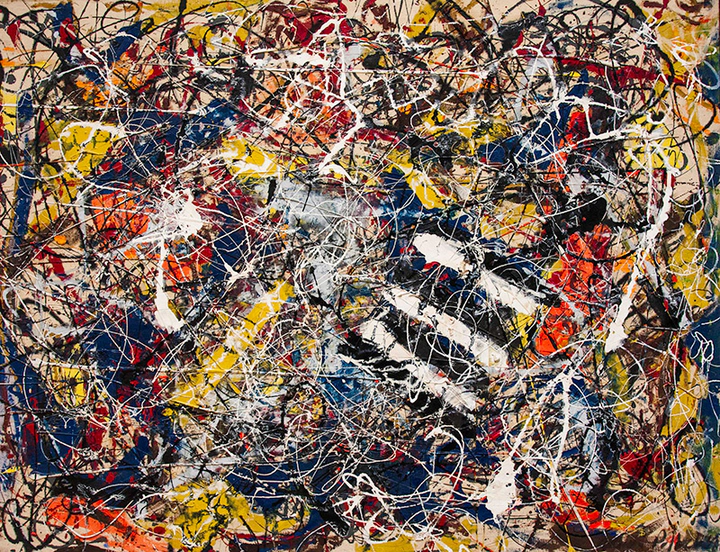
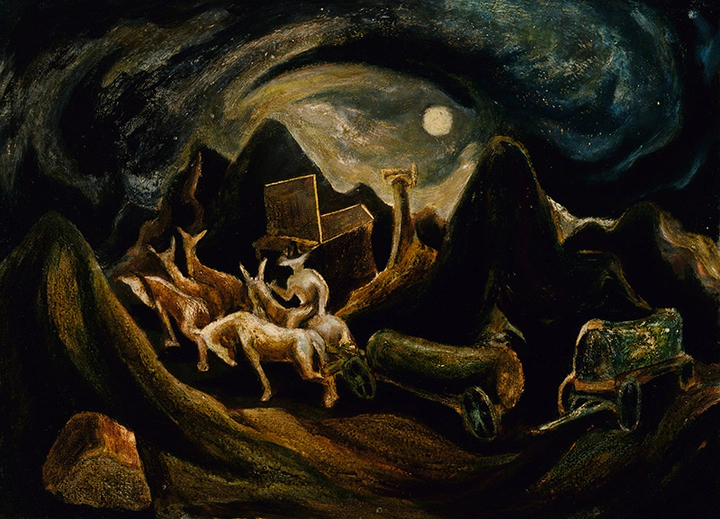
After becoming famous, Pollock never changed his style again. Before he became famous, however, he had explored all kinds of artistic styles, including something like this:
So, in a sense, “repeating yourself” is actually a kind of “privilege”—the privilege of creators who have already proven their success (though of course it’s also a form of laziness). If you’ve never created a successful work, you simply have no idea what to repeat.
Of course, although this is a common pattern, it doesn’t mean every writer follows it. Some writers, even after achieving fame and success, still long to abandon their former selves and explore new possibilities—for example, J. K. Rowling published a new novel anonymously after finishing Harry Potter. Other writers, despite never achieving worldly success, hold fast to their style and ultimately become major literary figures—for example, Wang Xiaobo, who was not recognized during his lifetime.
That’s all.
Written by: Zhichao Wei
[i] Underwood, T., Kiley, K., Shang, W., & Vaisey, S. (2022). Cohort Succession Explains Most Change in Literary Culture. Sociological Science, 9, 184-205.
[ii] Oleg Sobchuk. Are successful authors creative geniuses or literary labourers? https://psyche.co/ideas/are-successful-authors-creative-geniuses-or-literary-labourers
[iii] Liu, L., Dehmamy, N., Chown, J., Giles, C. L., & Wang, D. (2021). Understanding the onset of hot streaks across artistic, cultural, and scientific careers. Nature communications, 12(1), 1-10.
Leave a Reply