
This episode is also on Bilibili too.
[Zhihu question] Why does tying a band around a woman's thigh look so sexy? What psychological principle is at work here?
Let this psychology veteran try to reason it out.
Here’s the conclusion first: the reason a band around the thigh is sexy is that it strongly suggests the woman can give birth to smarter babies!
This seemingly ridiculous conclusion is derived as follows—
First, I found that for a band around the thigh (a leg band) to look sexy, it roughly needs to meet these four conditions.
Condition 1: It has to be a woman’s thigh
A band only looks sexy when it’s tied around certain women’s thighs. Tie it around my leg and you’ll only think it’s a form of psychological pollution (obviously).
This means that the psychology behind finding thigh bands sexy is very likely related to the mechanism of sexual selection in mate choice. It involves men and women falling for each other, and even more fundamentally, the question of reproduction.
Condition 2: It has to be a woman’s thigh of “moderate thickness”
A band tied around skinny, chopstick-like legs doesn’t seem particularly sexy; tied around relatively thick legs, its sexiness is limited too (by comparison, it seems especially unsexy on thin legs).

This means that the sexiness of a band is related to an appropriate amount of fat in a woman’s thighs.
Condition 3: The thinner the band, the sexier it is
A thin band is far sexier than a thick one. The sexiness of a band seems to follow the principle that simplicity is best: the sexiest band is just a narrow strip.

Why is a thin one sexier than a thick one? The answer may still be fat.
In an answer by @蓝铅笔 to this question, the author mentions how drawing the effect of thigh-high stockings “squeezing” the thigh makes it look “fleshy,” which makes the legs in cartoons especially sexy. Combining that with @蓝铅笔‘s point, it becomes obvious: a thin band is sexier than a thick one because it’s more likely to create that “squeezed” look, making the fat on the leg stand out more.
So condition 3 further suggests that the sexiness of a band is related to an appropriate amount of fat in a woman’s thighs.
Condition 4: A band tied around the upper half of the thigh is sexier than one tied around the lower half
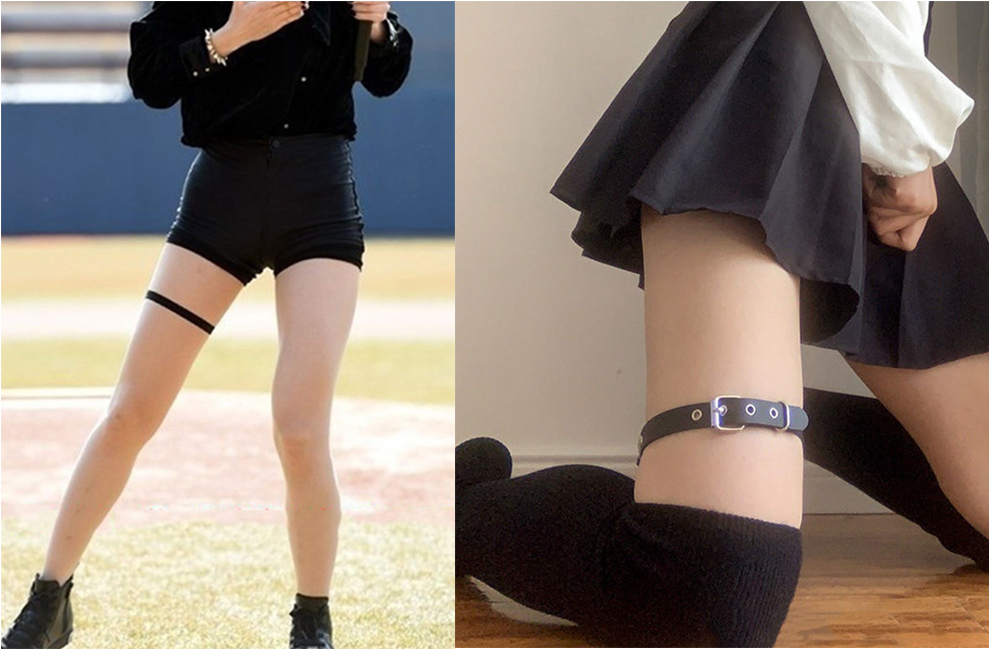
A band seems to look especially sexy only when tied around the upper half of the thigh. The closer it gets to the knee, the less sexy it becomes—even counterproductive.
So our deduction goes one step further: a band seems especially sexy only when it highlights that the upper half of a woman’s thigh contains an appropriate amount of fat.
In other words, what is actually sexy isn’t the band itself, but the upper half of a woman’s thigh with an appropriate amount of fat.
So here’s the question: why are men so concerned about, and so sensitive to, the amount of fat in a woman’s thigh—especially the upper half?
Why is the upper half of a woman’s thigh sexy?
Most likely because an appropriate amount of thigh fat helps ensure that a woman will give birth to smarter babies.
The developing nervous systems of fetuses and infants need to obtain large amounts of long-chain unsaturated fatty acids (LCPUFAs) from the mother (through the placenta) and breast milk, especially omega-3 docosahexaenoic acid (the famous DHA). A deficiency in long-chain unsaturated fatty acids can impair children’s nervous-system development and cause cognitive deficits[1]. Only children who receive enough long-chain unsaturated fatty acids are more likely to grow into smart babies with good brains.
Although a mother can replenish her body’s long-chain unsaturated fatty acids through food, research has found that 60-80% of the long-chain unsaturated fatty acids in breast milk come from fat stores in the mother’s body, rather than from her current dietary intake[2]. This is likely because an infant’s brain develops so quickly that the long-chain unsaturated fatty acids obtained from food simply aren’t enough. So during pregnancy and breastfeeding, the mother’s body draws heavily on unsaturated fatty acids stored in advance to supply the fetus and infant.
In other words, how abundant the mother’s “stored provisions” are directly determines the level of the infant’s brain development.
So where exactly in the mother’s body are these crucial long-chain unsaturated fatty acids stored?
They are mainly stored in the mother’s gluteofemoral fat[3]—in plain English, the fat in the buttocks and thighs.
The two images below show the distribution of women’s gluteofemoral fat (the yellow-green areas):
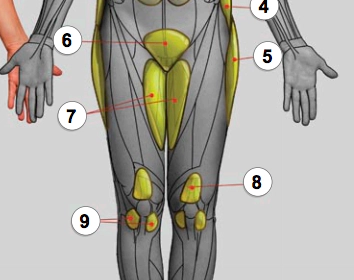
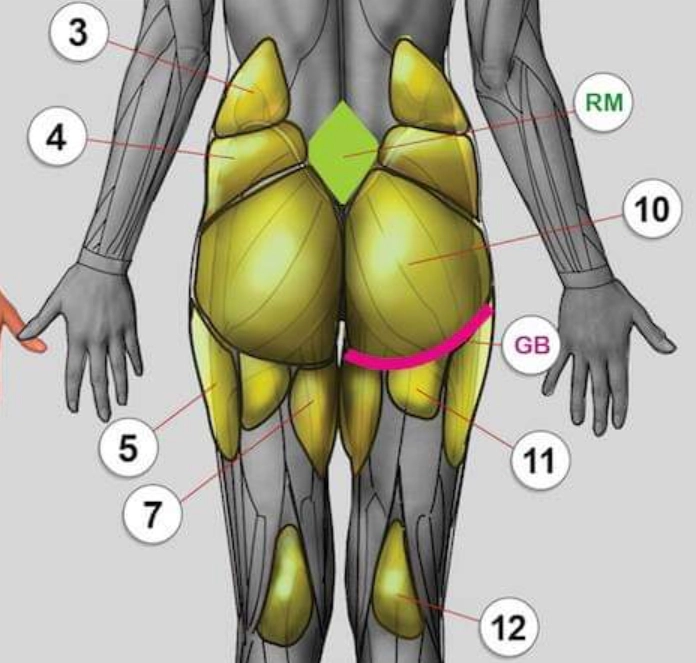
Buttock fat isn’t especially relevant to this answer, so let’s look only at the distribution of thigh fat—the leg fat rich in long-chain unsaturated fatty acids doesn’t cover the entire thigh; it is concentrated mainly in the upper half.
Yep, that’s right—the exact spot that looks sexiest after a band is cinched around it.
Why Bands Are Sexy
By now, the whole story has emerged as a complete chain of logic. The full story of “why a band around a woman’s thigh is sexy” goes like this:
Because the long-chain unsaturated fatty acids stored in the fat of a mother’s upper thighs are crucial to early brain development in children, over the course of human evolution, men developed a strong preference for women’s thighs containing a certain amount of fat (especially the upper thighs)—because in men’s eyes, this is actually a salient signal that the woman can give birth to and nurse smart babies.
Now, if a woman uses a narrow band to squeeze the upper half of her thigh, making the signal that it is “a little fleshy” stand out more strongly, that makes a part already incredibly sexy in men’s eyes twice as sexy. So yes, the psychology behind finding thigh bands sexy really does involve reproduction.
This theory also explains why a band tied around the upper half of the thigh is sexier than one tied around the lower half, and why a band tied around a thin leg with little fat doesn’t look sexy enough: overly thin thighs signal insufficient stores of long-chain unsaturated fatty acids in a woman’s body, which is unfavorable for nursing smart babies. So overly thin thighs are a “sexy penalty”; adding a flourish to a penalty doesn’t help.
One thing that needs explaining is why a band tied around overly thick legs with too much fat also doesn’t look sexy enough. That’s because more fat in a woman’s body isn’t always better. Overly thick thighs signal excessive fat throughout the body. The health damage caused by too much fat needs no elaboration; even specifically in terms of “effects on a baby’s cognitive abilities,” excess fat has negative effects. For example, research[4] found that abdominal fat reduces the amount of Δ-5 desaturase (Δ-5 desaturase) in the body, lowering the body’s efficiency at synthesizing long-chain unsaturated fatty acids from precursor compounds in food. Thus, thick legs that imply excess body fat are also a “sexy penalty”; embellishing a penalty is just as ineffective.
In sum, why are bands so sexy? Because under the right conditions, they send men a strong signal—this is a woman who can give birth to and raise smarter babies.
That’s it.
Written by: Zhichao Wei
P.S.:
The scholars William D. Lassek, a medical researcher at the University of Pittsburgh, and Steven J.C. Gaulin, an evolutionary anthropologist at the University of California, Santa Barbara, conducted research, reviews, and outreach concerning the idea that “an appropriate amount of buttock and thigh fat helps ensure that a woman will give birth to smarter babies.” Their work can be found in:
Lassek, W. D., & Gaulin, S. J. (2008). Waist-hip ratio and cognitive ability: is gluteofemoral fat a privileged store of neurodevelopmental resources?.Evolution and Human Behavior,29(1), 26-34.
Lassek, W. D., & Gaulin, S. (2011).Why Women Need Fat: How“ healthy” Food Makes Us Gain Excess Weight and the Surprising Solution to Losing it Forever. Penguin.
References
- ^Qawasmi, A., Landeros-Weisenberger, A., Leckman, J. F., & Bloch, M. H. (2012). Meta-analysis of long-chain polyunsaturated fatty acid supplementation of formula and infant cognition. Pediatrics, 129(6), 1141-1149.
- ^Del Prado, M., Villalpando, S., Elizondo, A., Rodríguez, M., Demmelmair, H., & Koletzko, B. (2001). Contribution of dietary and newly formed arachidonic acid to human milk lipids in women eating a low-fat diet. The American journal of clinical nutrition, 74(2), 242-247.
- ^Demmelmair, H., Baumheuer, M., Koletzko, B., Dokoupil, K., & Kratl, G. (1998). Metabolism of U13C-labeled linoleic acid in lactating women. Journal of Lipid Research, 39(7), 1389-1396.
- ^Fuhrman, B. J., Barba, M., Krogh, V., Micheli, A., Pala, V., Lauria, R., … & Muti, P. (2006). Erythrocyte membrane phospholipid composition as a biomarker of dietary fat. Annals of nutrition and metabolism, 50(2), 95-102.
Leave a Reply