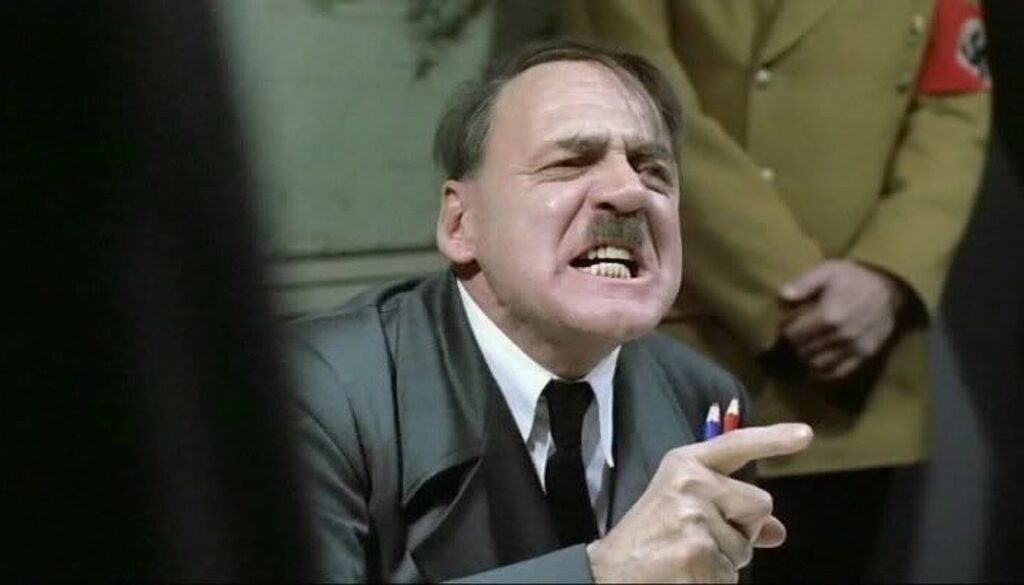
Our previous article ended with “the Führer’s fury,” so let’s just carry on with that.
The meme of “the Führer’s fury” comes from the scene in the German film Downfall where Hitler angrily berates his subordinate generals (of course, it was later thoroughly wrecked by all sorts of remix videos).
Our question is: Why does the Führer’s fury happen?
In theory, this scene should never have happened in history. Anyone who still had a shred of rationality could see that, at the moment of the Führer’s fury, the Allies were already attacking Berlin and the German army had no chance of winning. In fact, long before that moment, almost every signal had clearly pointed to Germany’s inevitable defeat. If Hitler had even a sliver of rationality left in his head, he should have surrendered (or killed himself) long before the Führer’s fury. But Hitler chose to fight on desperately until the very last moment.
Although the scene of Hitler berating his generals may have been an artistic invention, in real history Hitler did indeed hold out until the very last moment. Crazy as Hitler was, he was also extraordinarily intelligent. Could he really not see that his defeat had been certain for a long time?
Many later works of art and literature made something of this point. They assumed, one after another, that Hitler held out to the bitter end because he still had a devastating trump card hidden away; it simply never got used because of a series of unfortunate coincidences, leading to defeat (for example, Iron Sky).
But in the actual history of war, it is perfectly routine for the weaker side to fight on to the bitter end. Hitler’s behavior was not unusual at all. Take World War II: Japan, like Germany, fought on for a long time despite knowing that defeat was inevitable.
What was the point of all this?
If we treat victory in war as an object being auctioned, then an auction called “war” is quite different from an ordinary auction. In an ordinary auction, only the highest bidder has to pay the price in real money; the second-highest bidder pays nothing at all. So rational bidders set a maximum price in their minds—the highest price they are willing to bear—and stop competing once the price goes beyond it. And when they withdraw, they pay no actual cost.
War, however, is a war of attrition: the moment you enter the bidding, you pay a price whether you ultimately win or lose.
The first consequence is that, even as the “bid” quickly exceeds the returns victory could bring, bidders still grit their teeth and keep raising it as the war deepens. Each side hopes the other will collapse first, so that victory can make up at least a little of its losses. That is why almost every large-scale war eventually turns into a Pyrrhic victory—whether you win or lose, the cost paid is far greater than the return.
The second consequence is that, to make the other side back down first, you often have to wage psychological warfare. One of the tactics most likely to work is to adopt a hard-line posture and communicate: “Our army will hold its ground and fight to the death.” The opponent may then retreat somewhat, intimidated by your resolve.
But anyone can bluff. Simply stating your resolve out loud has no effect. The only effective signal is a costly signal. When two thugs are fighting, if you immediately slash your own arm a few times with a knife, the other guy may finally believe that you really do not care whether you live or die. The same logic applies on the battlefield. Saying you will fight to the end is not enough to scare the other side; you have to actually send your people to the front, and only then might the opponent believe you are truly all in.
I think this is why, even late in a war, the weaker side does not abandon the posture and actions of “going down with you.” By then, the defeat may be impossible to reverse, but the weaker side might still secure somewhat better terms for ending the war if the stronger side worries that continuing will cost too much. But it is still a gamble, because the other side’s decision is based on more than the cost of continuing to fight. In the Pacific theater, after weighing the cost of continued combat, the U.S. military simply ended the war with two atomic bombs; in the European theater, the Allies were determined on moral grounds to eliminate Hitler, whatever the cost.
So Hitler’s fury ultimately could not prevent the most costly of defeats.
References:
Steven Pinker. (2015). The Better Angels of Our Nature. CITIC Press.
Note
- This series of articles, “New Knowledge in Psychology,” consisted of short popular-science essays and casual reflections written at the time to accompany the related content in Zhichao Wei: New Knowledge in Psychology. They were published on the now-closed platform Fantuan; the original link no longer exists.
Leave a Reply