
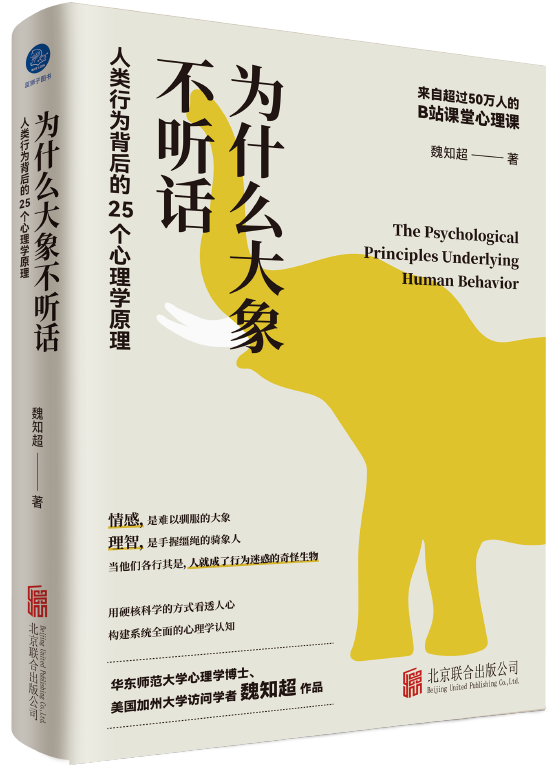
Why Elephants Don’t Listen
Subtitle: 25 Psychological Principles Behind Human Behavior
Author: Zhichao Wei
Publisher: Beijing United Publishing Co., Ltd.
Produced by: Blue Lion
Publication date: 2022-11
Pages: 290
List price: 56.00 yuan
Binding: Paperback
ISBN: 9787559664655
Overview
【来自超过50万人的B站官方心理课】
Emotion is the elephant that’s hard to tame;
reason is the rider holding the reins,
and when they each go their own way, we become strange creatures baffled by our own behavior.
See through the human mind with hard science,
and build a systematic, comprehensive understanding of psychology.
Even with the rider holding the reins, the elephant remains wild and difficult to tame—basically, it doesn’t listen to him at all.
Inside every one of us, there’s a quarrel resembling the one between the elephant and the rider. The elephant is like our emotional behavior itself—our habits and feelings—while the rider represents our rational thought, our willpower. Most psychological processing takes place unconsciously.
People’s seemingly complicated, bizarre, and baffling behaviors actually follow patterns. Drawing on an official Bilibili psychology course taken by more than 500,000 people, the latest findings in psychology, neuroscience, and genetics, and classic works of psychology, this book guides us through the 25 psychological principles behind human behavior. Through rigorous scientific analysis, controlled experiments, and theoretical knowledge, it helps readers build a systematic, comprehensive understanding of psychology—to learn to interpret the information hidden behind human behavior and emotions from a psychological perspective, so that we can understand ourselves better and understand others more deeply.
Contents
Chapter 1 Psychology and Physiology
Principle 1 Mind and brain are one—the mind is produced by brain activity / 003
Principle 2 The brain is a blend of old and new, divided into layers and functions—the structure and functional localization of the brain / 013
Principle 3 Hormones are adaptable—how hormones regulate behavior / 023
Chapter 2 Evolution and Genes
Principle 4 Babies are born clever—intuition and instinct written into infant genes / 037
Principle 5 Modern humans resemble their ancestors—the evolutionary journey shaped the human mind / 047
Principle 6 Sperm are numerous and cheap; eggs are few and precious—the tension in sexual relationships comes from evolution / 057
Principle 7 Genes and environment complement each other in different ways—how nature and nurture divide the work and cooperate / 067
Chapter 3 Learning, Development, and Personality
Principle 8 Prune the neurons, improve efficiency—how the brain develops in childhood / 079
Principle 9 Teach according to the learner—ideal education is personalized / 089
Principle 10 Memory is easy to revise—how “abstracting” and “remembering” reconstruct memory / 099
Principle 11 Personality has multiple layers—how physiology, society, and will shape personality / 108
Chapter 4 Perception, Thinking, and Decision-Making
Principle 12 Distort reality to ensure survival—the senses do not faithfully reflect the world / 119
Principle 13 Without metaphor, words fail—how humans use metaphor to understand the world / 129
Principle 14 Everything happens for a reason—the brain longs to find reasons / 138
Principle 15 A little knowledge is enough—the human tendency to make insufficient inferences / 149
Principle 16 Unconscious and conscious processes link up in decision-making—how the two decision-making paths work together / 158
Chapter 5 Emotion, Morality, and Willpower
Principle 17 Emotion is the commander-in-chief of action—how perception, decision-making, and memory become bound to emotion / 171
Principle 18 Use emotion for social gain—how emotion can transmit signals / 182
Principle 19 Emotions are constructed—how context, culture, and language shape emotion / 192
Principle 20 Emotion is the foundation of morality—right and wrong are judged emotionally / 203
Principle 21 Emotion is the foundation of willpower—instant gratification or long-term goals? / 213
Chapter 6 Groups and Culture
Principle 22 It’s not my fault—the powerful human motive for self-justification / 225
Principle 23 Benefit through conformity—understanding conformity through belonging and learning / 234
Principle 24 Solve the prisoner’s dilemma and build cooperation—how cooperative relationships are established / 245
Principle 25 The mind is shaped by culture—the influence of culture / 254
Chapter 7 Above the Principles: How Psychologists Think
Constraints matter—how to properly understand and use psychological knowledge / 267
Ask “whether” before asking “why”—how questions can get to the heart of a problem / 275
Comparative thinking—whether something is good or effective can only be determined through comparison / 282
Related Videos
Where to Buy


